Oil prices briefly surged toward $120 a barrel Monday, reaching their highest level since 2022 before easing slightly, as the escalating war in Iran threatened Middle East production and shipping and rattled global financial markets.
The prices were at their highest levels since at least mid-2022 as some major producers cut supplies and fears of prolonged shipping disruptions gripped the market due to the expanding regional war after the U.S.-Israeli action in Iran and its retaliation.
Energy markets are particularly nervous because the crisis is unfolding around the Strait of Hormuz, through which roughly one-fifth of the world's oil supply normally passes.
Brent crude futures were up $13.02, or 14%, at $105.71 per barrel at 09:17 a.m. GMT, while U.S. West Texas Intermediate (WTI) crude futures were up $12.16, or 13%, at $103.06.
In a whiplash session, Brent had earlier hit a high of $119.50 a barrel, indicating the biggest-ever absolute price jump in a single day, and WTI reached $119.48 a barrel. Before the surge Monday, Brent had already climbed 28% and WTI 36% over the last week.
The prices eased slightly amid reports that G-7 finance ministers, alongside the International Energy Agency (IEA), were set for a meeting which could release emergency stocks to counter pressures in the global energy markets.
The war could leave consumers and businesses worldwide facing weeks or months of higher fuel prices even if the conflict, which started on Feb. 28, ends quickly, as suppliers grapple with damaged facilities, disrupted logistics and elevated risks to shipping.
The war’s toll on civilian targets grew as Bahrain accused Iran of striking a desalination plant vital to drinking water supplies, and oil depots in Tehran smoldered following overnight Israeli strikes over the weekend.
Oil prices have surged as the war, now in its second week, ensnares countries and places that are critical to the production and movement of oil and gas from the Persian Gulf.
Roughly 15 million barrels of crude oil – about 20% of the world’s oil – are typically shipped every day through the Strait of Hormuz, according to independent research firm Rystad Energy.
The threat of Iranian missile and drone attacks, which have stepped up following U.S.-Israeli attacks, has all but stopped tankers from traveling through the strait, which is bordered in the north by Iran, carrying oil and gas from Saudi Arabia, Kuwait, Iraq, Qatar, Bahrain, the United Arab Emirates (UAE) and Iran.
Iraq, Kuwait and the UAE have all cut their oil production as storage tanks fill due to the reduced ability to export crude. Iran, Israel and the United States have also attacked oil and gas facilities since the war started, exacerbating supply concerns.
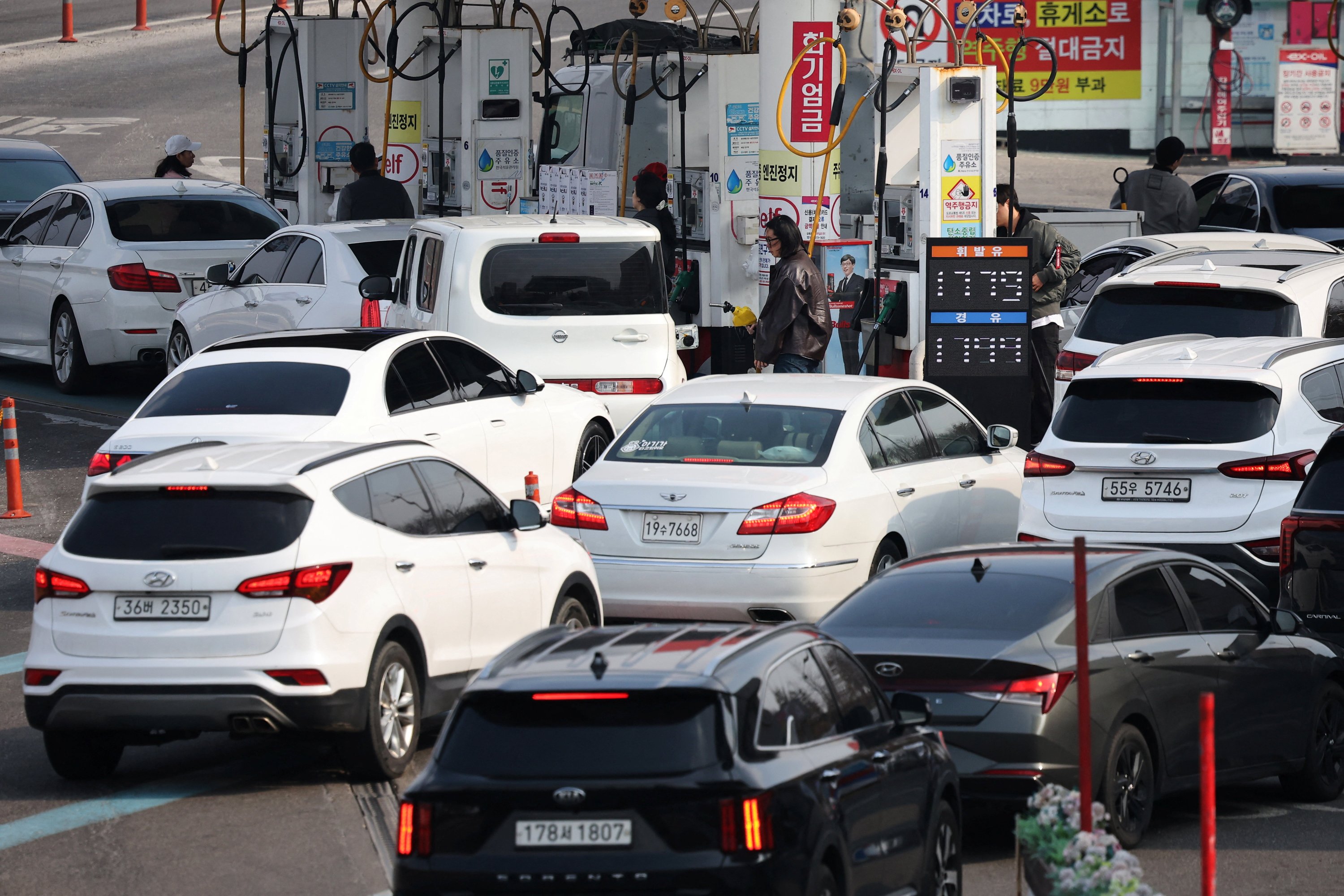
The surge in costs for oil and natural gas is pushing fuel prices higher, cascading through other industries and jolting Asian economies that are especially vulnerable due to the region's heavy reliance on imports from the Middle East.
The last time Brent and U.S. crude futures traded near the current level was in 2022, after Russia invaded Ukraine.
Higher energy costs push inflation higher, straining household budgets and denting the consumer spending that is a main driver of many big economies.
Tokyo's benchmark Nikkei 225 index plunged more than 7% early Monday, while other markets also foundered.
In the U.S., a gallon of regular gasoline rose to $3.45 Sunday, about 47 cents more than a week earlier, according to the AAA motor club. Diesel was selling for about $4.60 a gallon, a weekly increase of about 83 cents.
Still, U.S. President Donald Trump has told U.S. consumers the impact on their cost of living would be limited ahead of the mid-term elections in November.
U.S. Energy Secretary Chris Wright, speaking on CNN’s "State of the Union" said U.S. gas prices would be back under $3 a gallon "before too long."
"Look, you never know exactly the time frame of this, but, in the worst case, this is a weeks, this is not a months thing," Wright added.
If oil prices stay above $100 per barrel, some analysts and investors say it could be too much for the global economy to withstand.
Governments can release strategic petroleum reserves to counteract supply disruptions.
U.S. Senate Democratic Leader Chuck Schumer called on Trump to make such a move and a French government source said Monday that the Group of Seven nations would also discuss this.
Meanwhile, Iraq's oil production from its main southern oilfields has fallen by 70%, Reuters reported, citing sources, with crude storage having reached maximum capacity.
Kuwait Petroleum Corporation began cutting oil output Saturday and declared force majeure on shipments, though it did not say how much production it would shut.
Analysts expect the Organization of the Petroleum Exporting Countries (OPEC) heavyweights, the UAE and Saudi Arabia, to cut output soon as they run out of oil storage.
Saudi Aramco has offered more than 4 million barrels of Saudi crude in rare tenders as its export routes are throttled.
In gas markets, giant liquefied natural gas exporter Qatar had already stopped production after attacks on key infrastructure.
A fire broke out in the UAE's Fujairah oil industry zone, resulting from falling debris, with no injuries reported. Saudi Arabia's Defense Ministry said on X that it intercepted a drone heading to the Shaybah oilfield.
Refinery disruptions add to fuel supply cuts, with Bahrain's state-owned Bapco announcing a force majeure following a recent attack on its refinery complex. Saudi Arabia has already shut its biggest oil refinery.