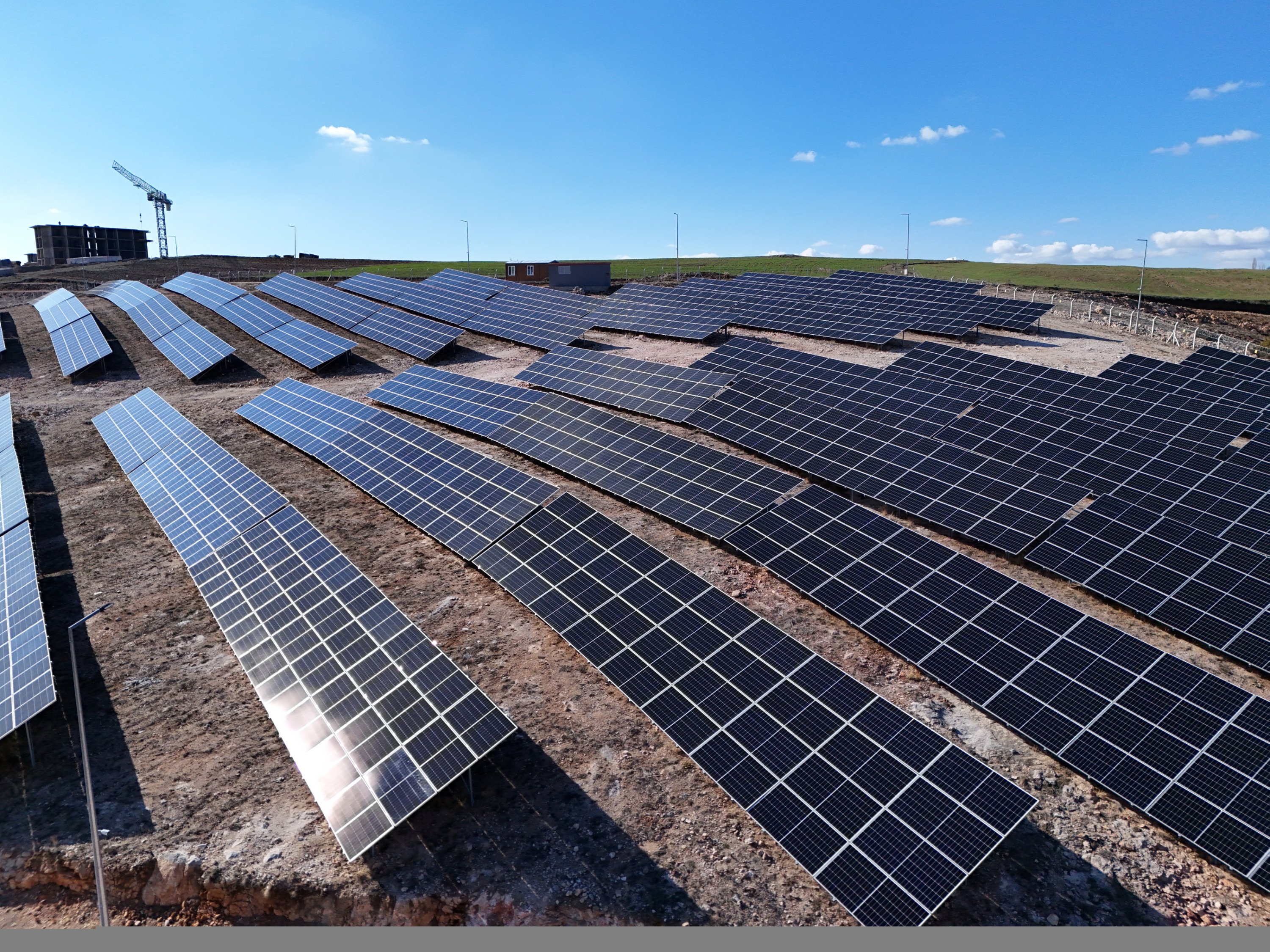
Türkiye sustained its strong renewable capacity expansion in 2025, which placed it among the countries with the biggest increases in solar power generation in the world, according to new analysis on Tuesday that also showed clean energy sources surpassed the global power demand.
Türkiye has been heavily investing and incentivizing new renewable installations as the nation that is heavily reliant on energy sources from abroad seeks to curb the external dependence and its big import bill that weighs on its current account.
Globally, clean power generation grew 887 terawatt hours last year, exceeding overall world electricity demand growth of 849 terawatt hours, a report by energy think tank Ember released on Tuesday said.
Ember analyzes electricity data from 215 countries, and studied 2025 data for 91 countries, which the firm says represents 93% of global demand.
Overall, the share of renewables – including solar, wind, hydropower and other clean energies – hit more than one-third of the world's electricity mix for the first time in modern history last year, growing 33.8% to 10,730 terawatt hours.
It's promising news for a world embattled by climate change that's driven by the burning of fossil fuels such as coal, oil and gas to meet growing needs from economic growth, rising populations and electrification.
The analysis is also especially timely amid a global energy crisis exacerbated by the U.S. war in Iran.
In another historical first, coal power saw its share fall below one-third of global generation, dropping 0.6% to 63 terawatt hours.
Solar, which grew 30% in 2025, alone met three-quarters of last year's net rise in electricity demand, lifting its share of total electricity output to 8.7%.
Combined, wind and solar generation met 99% of the increase in global electricity demand.
Türkiye stood out as one of the fastest-growing solar markets, ranking seventh globally in terms of annual increase in solar electricity generation.
The country followed China, the United States, India, Brazil, Pakistan and Germany, while Italy ranked eighth.
France and Netherlands also placed among the top 10 countries with the largest solar generation increases.
The rapid increase in Türkiye's solar capacity in recent years has significantly raised its share in electricity generation, according to the report.
Before the recent surge, solar accounted for only 4.7% in 2022. Over the past two years, its share of the country's electricity mix has doubled, reaching 10.5% in 2025.
Meanwhile, growth in wind capacity has mainly offset rising electricity demand. While wind's share remained just below 11% between 2022 and 2024, it reached 11.1% in 2025.
Combined wind and solar generation accounted for 22% of Türkiye's electricity output last year, above the global average of 17%.
For the first time, wind and solar surpassed hydropower in 2025, becoming the main drivers of growth among renewable energy sources.
New wind capacity in Türkiye rose to a record 1.9 GW in 2025, surpassing the previous peak of 1.8 GW in 2021.
As a result, in 2025 Türkiye achieved a record 6.5 GW of new wind and solar capacity combined. By the end of 2025, total installed wind and solar capacity reached approximately 40 GW.
Environment, Urbanization, and Climate Change Minister Murat Kurum said on Tuesday Türkiye has tripled its renewable electricity production in the last 10 years and invested more than $10 billion in energy efficiency.
"Since the 2022 energy crisis, we have authorized more energy storage capacity than all European Union countries combined, and we have set an ambitious goal of adding at least 8 gigawatts of renewable energy capacity every year until 2035," Kurum told the annual Petersburg Climate Dialogue (PCD) in Berlin.
Türkiye aims to reach 120 GW of total wind and solar capacity by 2035.
Despite strong growth in wind and solar, Türkiye's overall energy mix faced pressure from a sharp decline in hydropower generation.
That's mainly linked to climate conditions such as drought, as Türkiye experienced its lowest rainfall level in over 60 years in 2025.
The report showed that Türkiye recorded the second-largest drop in hydropower output globally after Brazil, with a decrease of 18 terawatt-hours (TWh).
This shortfall was largely compensated by increased generation from natural gas-fired power plants, resulting in an estimated additional $1.8 billion in annual gas import costs.
In 2025, hydropower accounted for 16% of electricity generation in Türkiye, while other renewables such as geothermal and biomass contributed to 5%.
Altogether, renewables made up about 43% of the country's total electricity generation, above the global average.
Ufuk Alparslan, regional lead for Türkiye and the Caucasus at Ember, said the country is emerging as a model for neighboring regions where renewable penetration remains relatively low.
While the share of wind and solar remains limited in Türkiye's southern and eastern neighbors, the country stands out as a "critical" role model for the Middle East, the Caucasus and Central Asia nations, Alparslan said.
The Ember report showed Türkiye standing out as a leader in wind and solar electricity generation in its neighboring regions.
Among 16 countries in the Middle East, the Caucasus, and Central Asia with electricity generation above 25 TWh, no other country exceeds a 20% share of wind and solar.
"With 22%, Türkiye is clearly ahead of its regional peers," the report said.
Alparslan said Türkiye "is in a highly advantageous position to consolidate its regional leadership in the clean energy transition by maintaining the momentum it has achieved."
If solar and wind resources can be rapidly expanded as targeted, he said they will transform into valuable complements that compensate for losses in hydroelectric power during dry periods and substitute for costly fossil fuel imports.
Türkiye will be a co-host of this year's COP31 climate summit after it reached an agreement with Australia last year.
The arrangement will see the U.N.-sponsored conference being held in the Mediterranean city of Antalya in November with Australia set to preside over the negotiations.
At the PCD conference on Tuesday, the co-hosts said a major energy shock rattling the global economy reinforced the need to invest in renewable alternatives to fossil fuels.
The two-day meeting gathered dozens of climate ministers to discuss priorities ahead of COP31.
It's taking place as nations struggle with energy shortages and soaring prices, with some governments rationing fuel and looking to coal to shore up supply.
Global energy supply chains are facing a historic upheaval as the Iran war disrupts shipments through the Strait of Hormuz, the key transit point for Gulf oil and gas exports.
Türkiye's Kurum said the crisis "has shown us, once again, that fossil fuels do not guarantee energy supply security."
"Investment in alternative energy sources, in particular to support energy diversity, means stability, resilience and clean development," he said.
"This is what we must all pursue," he added, stressing that nations would respond differently given individual economic circumstance.
Australia's Climate Minister Chris Bowen said nations could shore up energy security and "block the impacts of future fossil fuel shocks" through renewables.
"Renewable energy is a proven proposition and the cheapest form of energy ever know," said Bowen, who spoke via video link after cancelling his trip to Berlin over the fuel crisis in Australia.
"As our energy supply and economies face headwinds, now is not the time to hesitate, but the time to act with clarity and conviction to continue our transition to clean, cheap, reliable energy," he added.
Roughly twice as much investment goes into clean energy as fossil fuels, which are the primary driver of human-caused climate change.
But heat-trapping emissions from burning coal, oil and gas rose again in 2025 to a record high.
Nearly 200 countries agreed at COP28 in 2023 to transition away from fossil fuels, but efforts to turn that pledge into action have faced strong resistance since.
It remains to be seen how the issue may be addressed at COP31.