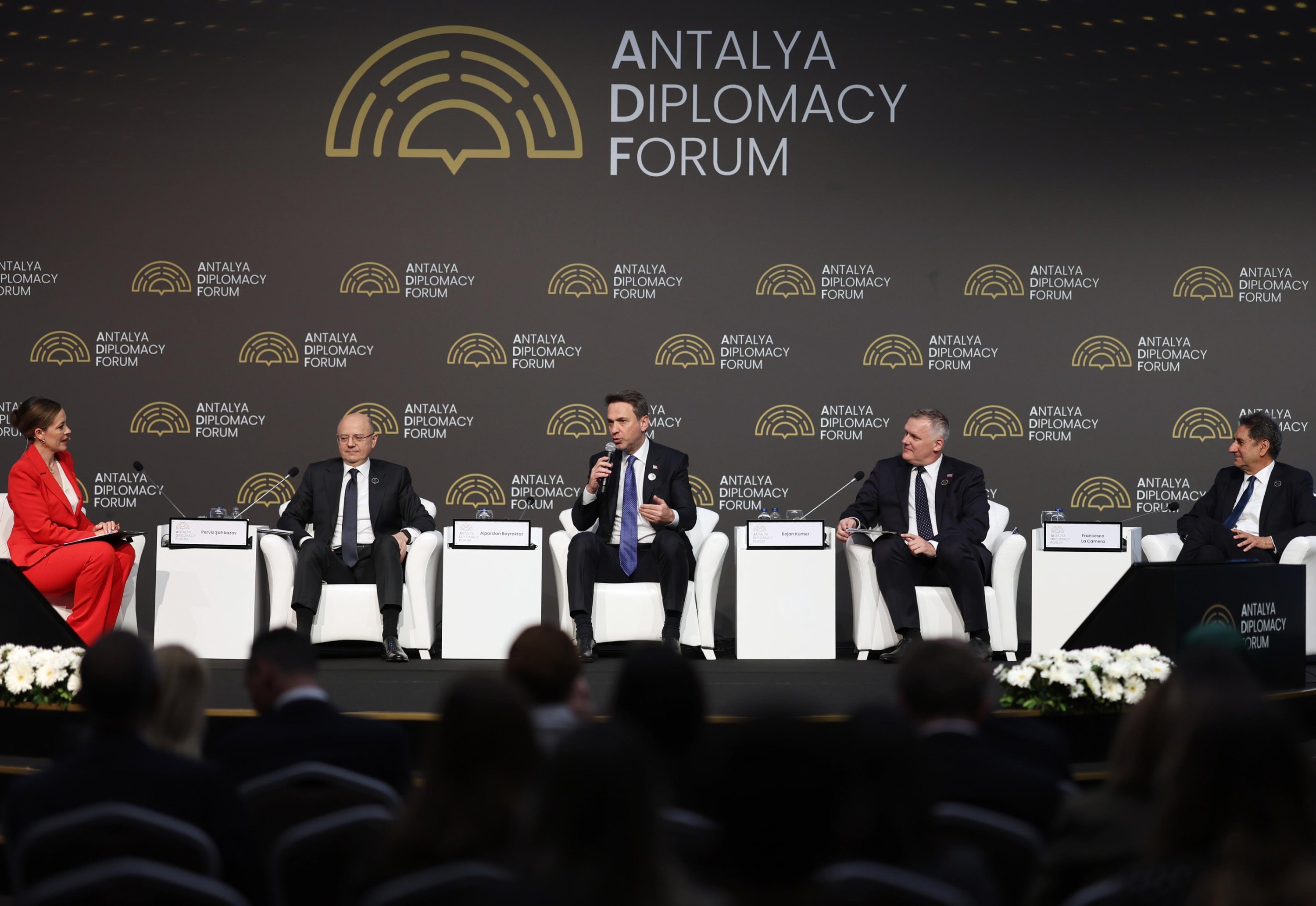
Türkiye's energy markets have demonstrated strong resilience in the face of successive global shocks, Energy and Natural Resources Minister Alparslan Bayraktar said on Friday, pointing to years of crisis-driven adaptation as a key strength.
Bayraktar was speaking at a panel on the sidelines of the Antalya Diplomacy Forum 2026, where he addressed the latest market turbulence linked to the Middle East conflict, while signaling a faster timeline for the country's transition toward a low-carbon economy.
Energy prices have spiralled since the Strait of Hormuz, a vital global oil and gas shipping route, was closed as a result of the U.S.-Israeli attacks on Iran and Tehran attacking energy infrastructure in the Middle East. On Monday, Washington imposed a blockade on ships entering or leaving Iranian ports.
The crisis came as a test for countries heavily reliant on oil and gas imports, including Türkiye.
Bayraktar said Türkiye's ability to withstand volatility stems from years of exposure to overlapping crises, including the climate crisis, the COVID-19 pandemic, supply chain disruptions and geopolitical conflicts such as the Russia-Ukraine war and tensions in the Middle East.
"This crisis has, of course, affected us deeply. However, our energy markets are quite resilient. Türkiye is resilient because we have experienced crises in the past. We are already living with the uncertainties surrounding us," said the minister.
"Over the last six to seven years, we have experienced the climate crisis, the pandemic and uncertainties in the supply chain. Following the Russia-Ukraine war, Iran and the Middle East have all made Türkiye resilient. We are used to dealing with crises."
Bayraktar emphasized that Türkiye's energy strategy has evolved over the past 25 years, with reforms opening markets to private investment, expanding regional cooperation and delivering large-scale infrastructure projects. However, he warned that rapidly rising domestic energy demand presents a growing challenge.
He emphasized that Türkiye's long-term strategy centers on boosting energy security while reducing import dependence through diversification and increased use of renewables.
"Energy demand in Türkiye is increasing very rapidly. AI-based centers and factors like electric vehicles are driving up energy needs. We have set a goal to move away from fossil fuels and utilize electricity. As an import-dependent country, we want to reduce this dependency," he noted.
“We have a carbon-neutral policy. Diversifying our energy resources is crucial for us. We want to benefit more from renewable energy sources. However, we are not turning our backs on fossil fuels either. We need to have an energy architecture."
Despite its push toward cleaner energy, Türkiye must continue to meet immediate demand from conventional sources, Bayraktar noted. He said around 40 million vehicles are on the country's roads daily, while approximately 22 million households rely on natural gas, underscoring the need to maintain stable fuel supplies.
The minister still said renewable energy would be the “keyword" for the economy going forward, with expanded capacity, storage solutions and system security critical to achieving long-term targets. Türkiye aims to become a carbon-neutral economy by 2050, though Bayraktar indicated the government is considering bringing some targets forward, including energy efficiency goals.
“We have a very strong goal to become a carbon-neutral economy by 2050. But we are considering advancing this target, potentially bringing it forward to 2035," he said, adding that plans to implement a national energy efficiency program by 2040 could also be accelerated to 2030.
Türkiye is also deepening its international energy engagement, the minister said, noting that the country has invested in multiple cross-border projects and recently launched offshore drilling operations in Somalia.
The panel brought together senior policymakers, including Azerbaijan Energy Minister Perviz Shahbazov, Slovenian Environment, Climate and Energy Minister Bojan Kumer, and Francesco La Camera, head of the International Renewable Energy Agency (IRENA), all of whom highlighted the broader global implications of ongoing energy disruptions.
Shahbazov warned that the world is facing one of its most serious energy crises, pointing to risks surrounding the Strait of Hormuz, a key artery for global oil flows.
He said disruptions affecting up to 12 million barrels of oil could have far-reaching consequences, including increased fragility in Europe's jet fuel supply.
"This is a global crisis. We all need to fight this crisis together. At this point, Azerbaijan has diversified its own supply routes. We supply 40 million barrels to 20 different countries. Recently, we have also started supplying natural gas to our European partners," he noted.
He added that producer nations are also vulnerable to price volatility despite perceptions that they benefit from crises.
“Balanced prices are important for all of us," said Shahbazov.
Kumer said Slovenia, which imports all of its oil, has been hit by rising prices and declining volumes, particularly at a time of seasonal demand increases in agriculture.
“This crisis did not find us at the right time," he said.
He stressed that the crisis underscores the need for coordinated action within the European Union.
“No country can manage such an energy crisis alone," Kumer said, adding that shifting away from fossil fuels remains essential given limited domestic resources.
“Before the Ukraine war, we were importing natural gas from Russia. Renewable energy is the future of the world. Fossil fuel is not a resource that we possess," he added.
IRENA's La Camera argued that the current turmoil reflects a structural weakness in a fossil fuel-based system rather than a conventional energy crisis.
"This is not an energy crisis. This is a crisis of the energy system being built on fossil fuels. This is a fossil fuel crisis. This will shift us more toward renewable energy," he noted.
La Camera explained that renewable energy installations added in a single year now exceed decades of nuclear capacity growth. He cited countries such as Spain, where renewables account for a significant share of energy production, and Türkiye, which has been vastly investing in renewable energy sources, as examples of the transition already underway.
He warned that regions slow to embrace renewables risk losing economic competitiveness.
“For the economy to be competitive, the energy system must be strong. Europe still underestimates renewable energy resources. That is why Asia, which invests in renewable energy, is winning while Europe is losing," La Camera said.