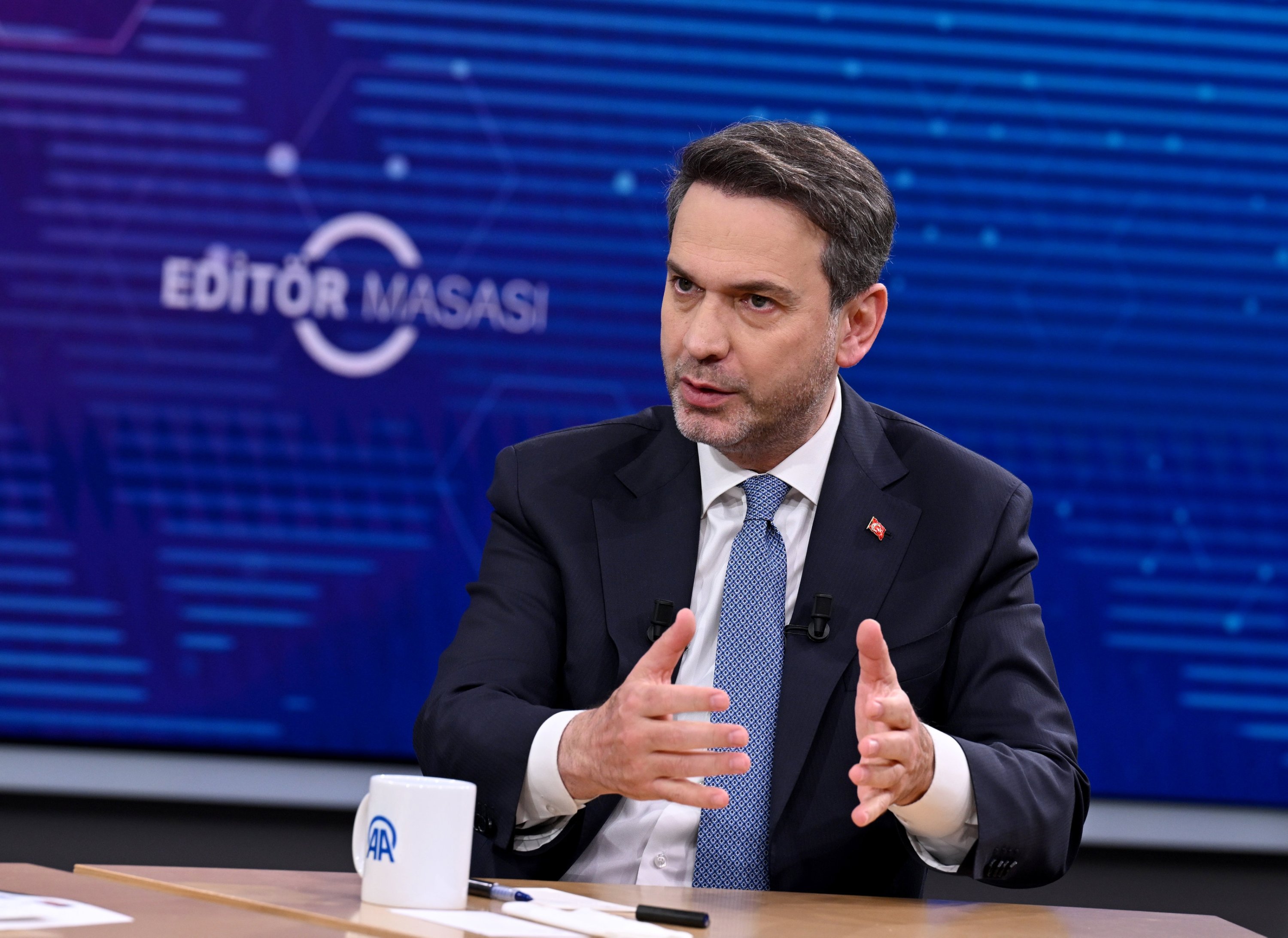
Türkiye is not experiencing any energy supply issues despite escalating tensions amid the Iran war, Energy and Natural Resources Minister Alparslan Bayraktar said on Wednesday, attributing it to the country's infrastructure and diversification policies, but also a low dependence on the Middle East oil and gas.
"Currently, there does not appear to be a problem for our country in terms of energy supply security. Our energy infrastructure and the diversification policy we have followed so far are keeping us in a 'safe harbor.' At the moment, there is no energy supply security problem for our country and our citizens," he told a live interview with Anadolu Agency (AA).
Answering the questions, Bayraktar described the crisis amid the Israel-U.S.-Iran war as "serious" and one that could have "impacts on the global economy." He also pointed out that the geopolitical tensions could potentially be more severe than recent global crises if they persist.
Bayraktar noted that the world has already endured major shocks in recent years, including the COVID-19 pandemic and the Russia-Ukraine war, both of which led to supply chain disruptions, logistical challenges, rising energy and commodity prices, and high inflation.
"However, this crisis could be even more devastating if it continues over the medium to long term," he warned, adding that a prolonged conflict could affect the entire global economy.
At the same time, he expressed hope that the conflict would be resolved soon to limit its global impact.
Moreover, highlighting the central role of energy in the crisis, the minister noted that Türkiye currently remains in a "safe position" regarding energy supply security as a result of its strong energy infrastructure and diversification policies.
Energy security encompasses supply, demand and transmission, Bayraktar explained, adding that the current situation points to a growing supply-side problem globally.
"There is no visible crisis on the demand side yet, but there is a serious supply constraint," he said, citing disruptions in key energy transit routes in the region.
He noted that around 20% of global oil and liquefied natural gas (LNG) flows normally pass through the Strait of Hormuz, adding that current disruptions are creating a significant supply challenge.
Despite this, Bayraktar said Türkiye's exposure to the region remains limited and at "manageable" levels.
"Our dependence on this region is at a low level," he underlined, noting that Saudi Arabia and Iraq account for roughly 15% of Türkiye's oil supply, with overall dependence on the region at around 10%.
He added that Türkiye does not import natural gas from the region and has diversified its LNG suppliers, including recent agreements with the U.S.
Türkiye, over the past decade, since the adoption of the National Energy and Mining Policy, has pursued a flexible approach, targeting diversification of its energy supplies, while also boosting domestic oil and natural gas production. It also includes the deployment of floating storage and regasification units (FSRUs), which have been critical in ensuring continuous winter supplies.
Similarly, Ankara has expanded its push toward renewable and nuclear energy, significantly boosting both solar and wind capacities, in addition to having a strong output in hydroelectric power.
Also asked about natural gas, Bayraktar said that there had been no supply cuts from Iran yet, but added that this was a possibility.
"There were reports that Iranian natural gas was cut a short while ago," he said. "To this point, this has not happened. But this does not mean it won't happen later, so we are carrying out significant diversification against risks that may emerge here," he noted, reiterating his remarks from a day earlier, when he denied a report that Iran cut supplies.
As part of its diversification steps, he said that Türkiye also planned to sign a cooperation deal with TotalEnergies soon, similar to those signed with other oil majors.
As part of Ankara's strategy to expand oil and gas production at home and abroad, state energy firm Turkish Petroleum (TPAO) signed preliminary deals with Exxon and Chevron earlier this year.
The company also signed a deal with Shell to explore in Bulgaria's maritime zone and buy a 33% stake in the Khan Tervel license.
Similarly, the country also had agreements with other countries for the natural gas in recent years, including with Azerbaijan and Turkmenistan.
Separately, Bayraktar said connecting the flow of oil from Syria to the Iraq-Türkiye crude oil pipeline was on the agenda, and this had been conveyed to Syrian counterparts.
Referring to the latest situation on the Iraq-Türkiye Crude Oil Pipeline extending from Kirkuk to Ceyhan, Bayraktar recalled that the capacity of this pipeline is 1.5 million barrels.
"We can transport 1.5 million barrels per day through here," he added.
Last week, the Iraqi central government and the semi-autonomous region in the country's north agreed to restart oil flows via the pipeline, albeit at a smaller capacity than its maximum volume. The move came amid attacks across the Middle East and the effective closure of the Strait of Hormuz, through which Iraq, a member of the Organization of the Petroleum Exporting Countries (OPEC), mainly shipped its oil via Basra port.
Recalling the arbitration issue with the Iraqi central government over the past 10 years, Bayraktar noted: "Regarding the allocation and use of this pipeline, we have always said, 'Two friendly brotherly countries have been living in this geography for centuries. We need to resolve problems in a friendly manner.'"
Among others, Bayraktar also said that Türkiye's efforts to produce its first electricity from the Akkuyu nuclear power plant this year are continuing without interruption.
He also suggested that Türkiye is progressing steadily toward its goal of energy independence, unveiling a new drilling operation in the Black Sea with the Abdülhamid Han vessel. "God willing, the drill will start turning in the sea at 4 a.m. tomorrow," he added.