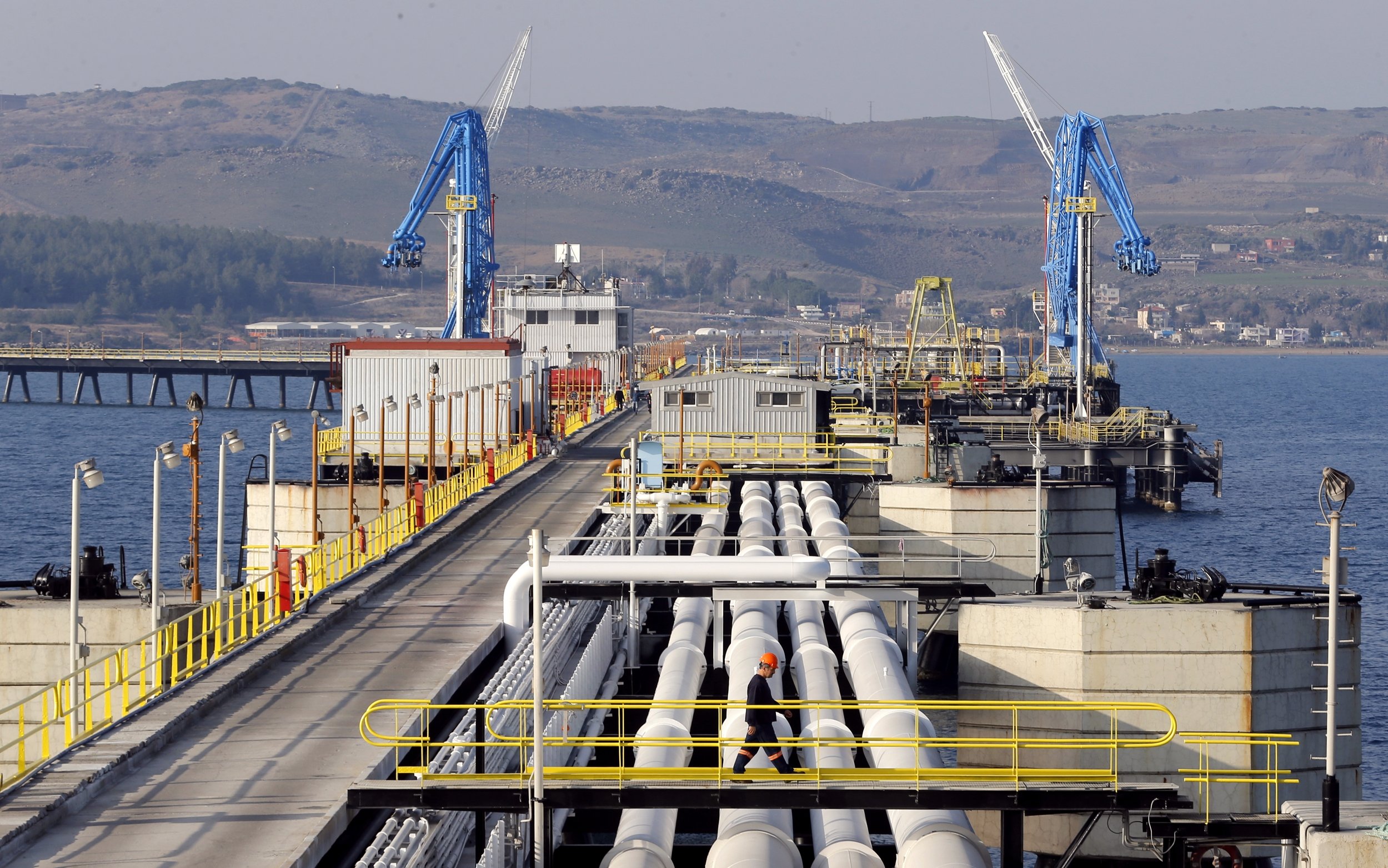
The goal of supplying up to 1 million barrels of oil per day (bpd) from Iraq to Türkiye, along with the new transportation agreement, is expected to strengthen not only the more efficient use of the Iraq-Türkiye Crude Oil Pipeline but also Ceyhan's strategic role in delivering Middle Eastern oil to world markets, experts said.
The announcement by Iraqi Prime Minister Ali al-Zaidi on July 28 that Iraq can supply up to 1 million barrels of oil per day to Türkiye highlights Iraq as one of Ankara's key partners in its strategy to become an energy hub.
A few days after this statement, a concrete step was taken to significantly increase the volume of Iraqi oil transported to Ceyhan.
Accordingly, with the one-year agreement signed between Türkiye and Iraq on Aug. 1, it is foreseen that at least 750,000 barrels of crude oil per day will be transported and loaded to Ceyhan via the pipeline.
Thus, while aiming for a more efficient use of the pipeline, which has a technical capacity of approximately 1.5 million barrels per day, and a significant increase in the volume of Iraqi oil reaching Ceyhan, there are also plans to deliver oil from Kuwait and other Gulf countries to world markets through this route in the future.
From this perspective, recent issues in oil shipments through the Strait of Hormuz have highlighted the importance of alternative export routes, which presents Ankara with the potential to reinforce its role as an energy corridor between Middle Eastern producer countries and Western markets.
Another factor that makes Türkiye-Iraq energy cooperation strategic is the expansion of the relationship from oil transportation to production.
Türkiye, through its state-run Turkish Petroleum Corporation (TPAO), is expected to lift its oil and natural gas production to about 500,000 barrels per day by 2028, and is increasing its overseas activities to raise this to 1 million barrels per day in the medium term.
In this strategy, Kirkuk comes to the fore.
On July 28, TPAO acquired a 15% stake in BP Energy Company of Kirkuk Limited (BPECKL), thus becoming a partner in the development of Kirkuk’s oil fields.
Under the agreement, TPAO, BP, and ConocoPhillips are expected to work together to increase production at the Baba and Avanah domes as well as the Bai Hassan, Jambur and Khabbaz fields.
Thus, expanding energy cooperation with Iraq from production to transportation both supports Türkiye's strategy to grow its oil and natural gas production and lays the groundwork for a broader energy corridor by which Iraqi and Gulf oil can reach world markets via Ceyhan.
Iraq’s goal of supplying up to 1 million barrels of oil per day to Türkiye increases the strategic value of the Ceyhan Terminal at a time when alternative export routes have gained importance following the risks associated with the Strait of Hormuz.
Sercan Çalışkan, a researcher at the Center for Middle Eastern Studies (ORSAM) specializing in Iraq studies, told Anadolu Agency (AA) correspondent that the Iraqi prime minister's statement about being able to supply Türkiye with up to 1 million barrels of oil per day is important as it shows the two countries' common political will to develop energy cooperation.
Çalışkan stated that it is not impossible to reach the target of 1 million barrels per day in the short term, despite seeming technically difficult.
"Although achieving an additional 1 million barrels per day in the short term seems technically difficult, what matters here is the political will of Ankara and Baghdad to expand existing capacity," he said.
"Al-Zaidi's words in Ankara about 'pumping even more oil in the energy sector' also show the Iraqi side’s political will to increase production and export capacity in cooperation with Türkiye," he argued.
"Therefore, even if it takes some time to reach this capacity, the manifestation of this political will on the ground could shorten the time required to achieve the goal."
Çalışkan also noted that for Türkiye, the process is not just about importing more oil.
"The fact that Iraqi oil can be transported to world markets through Ceyhan in higher volumes will strengthen Türkiye's aim to become an energy hub and also contribute to the development of an alternative route that can partially reduce dependency on the Strait of Hormuz for energy security," he said.
"Especially considering the risks revealed by recent regional crises, it can be said that Türkiye-Iraq energy cooperation has as much geostrategic value as economic value."
Oğuzhan Akyener, the head of the Turkish Energy Strategies and Policies Research Center (TESPAM), an Ankara-based think tank, recalled that the Iraq-Türkiye Crude Oil Pipeline has a technical capacity of about 1.5 million barrels per day, adding that it is "technically possible" for this pipeline to transport 1 million bpd in the short term.
"In times of crises, we could have the opportunity to take more oil from Ceyhan and stockpile, and we could be involved in more energy projects in Iraq," he noted.
"Delivering more crude oil to Ceyhan, with the goal of processing this oil in Türkiye and presenting it in the form of fuel and petrochemical products to international markets, means that an oil flow of 1 million barrels per day from Iraq is an important step for Türkiye's objective of becoming an energy hub."