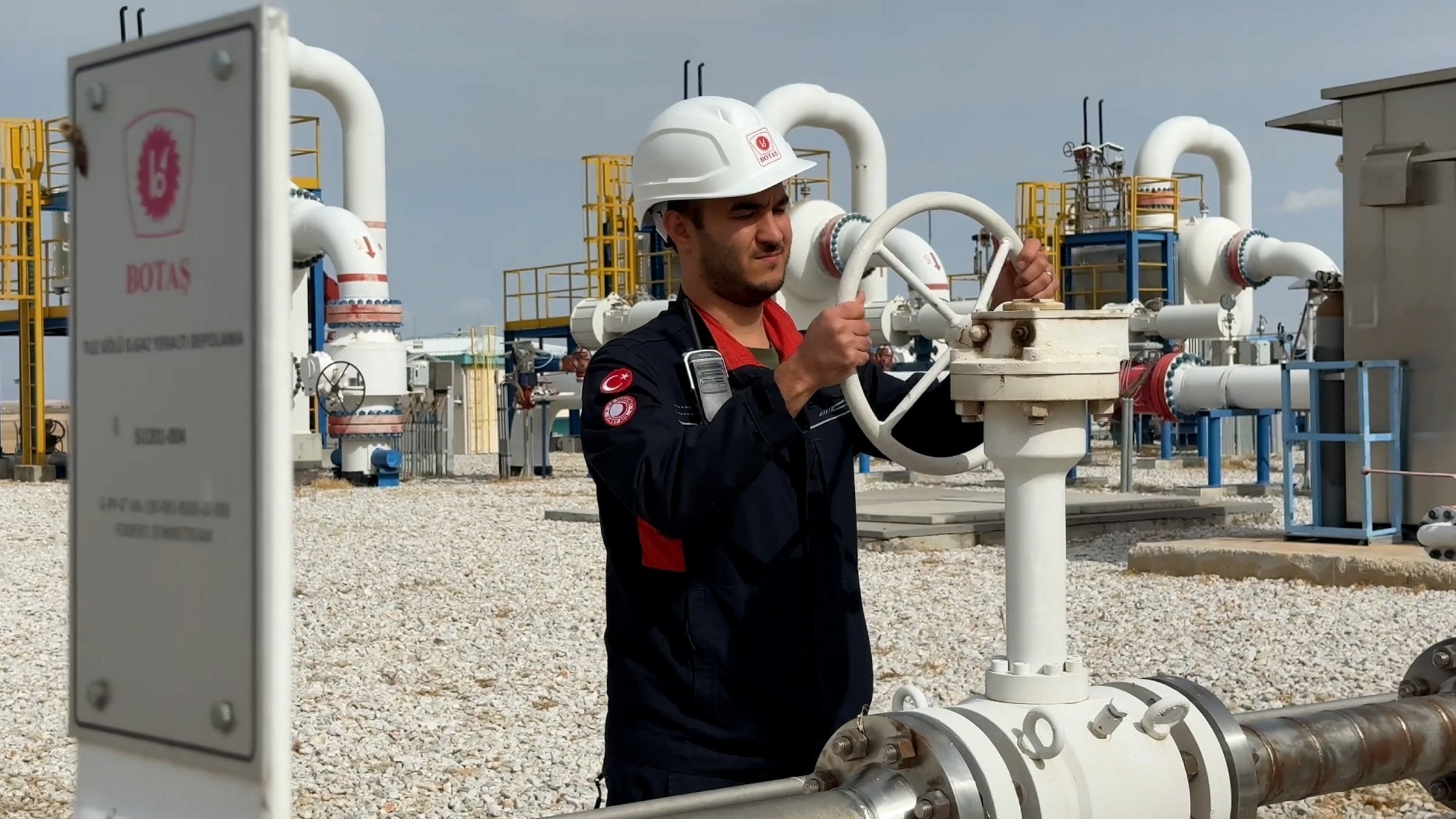
Türkiye's natural gas storage occupancy stands at 71%, according to Energy and Natural Resources Ministry on Sunday, with the ministry also highlighting ongoing efforts to refill facilities to full capacity against possible global shocks.
According to a statement from the ministry, the underground storage facilities in Lake Tuz and Silivri, which contribute to Türkiye’s energy supply security, help balance supply and demand on days when natural gas consumption increases.
Türkiye, which entered the winter with full natural gas storage, was able to get through cold winter days with minimal reliance on its reserves thanks to its developed liquified natural gas (LNG) infrastructure and diversified supply sources. Currently, storage occupancy stands at 71%.
Moreover, amid a global supply crisis and after winter months, Türkiye continues its efforts to refill its storage facilities to full capacity.
The Silivri Natural Gas Storage Facility currently has a storage capacity of 4.6 billion cubic meters (bcm). The facility, which also holds the title of “the largest storage facility in Europe in offshore waters,” is planned to increase its capacity to 6 billion cubic meters by 2028.
Meanwhile, the Lake Tuz Natural Gas Storage Facility, which currently has a capacity of 1.7 billion cubic meters, is also expected to expand to 8.5 billion cubic meters by 2032.
In the statement, Energy and Natural Resources Minister Alparslan Bayraktar noted that natural gas in storage typically decreases after the winter months and is replenished in the summer to prepare for the next winter season.
"By significantly increasing our LNG procurement capacity, we have prevented our storage facilities from remaining empty. As a result, despite exiting the winter season, our natural gas storage facilities are 71% full," he suggested.
"We are closely monitoring geopolitical tensions and supply crises around the world and taking the necessary steps. In order to minimize the impact of possible global shocks, we are working to refill our storage facilities to full capacity," he added.
Earlier this week, the minister reiterated that Türkiye currently is not facing any energy supply issues despite escalating tensions amid the Iran war, attributing it to the country's infrastructure and diversification policies, but also a low dependence on the Middle East oil and gas.
Bayraktar also emphasized ongoing efforts to expand storage capacity.
"So far, through our work, we have increased total storage capacity in Silivri and Lake Tuz to 6.3 billion cubic meters. We will continue our investments in storage. With our planned investments, by 2028 we will be able to store at least 20% of our natural gas consumption."