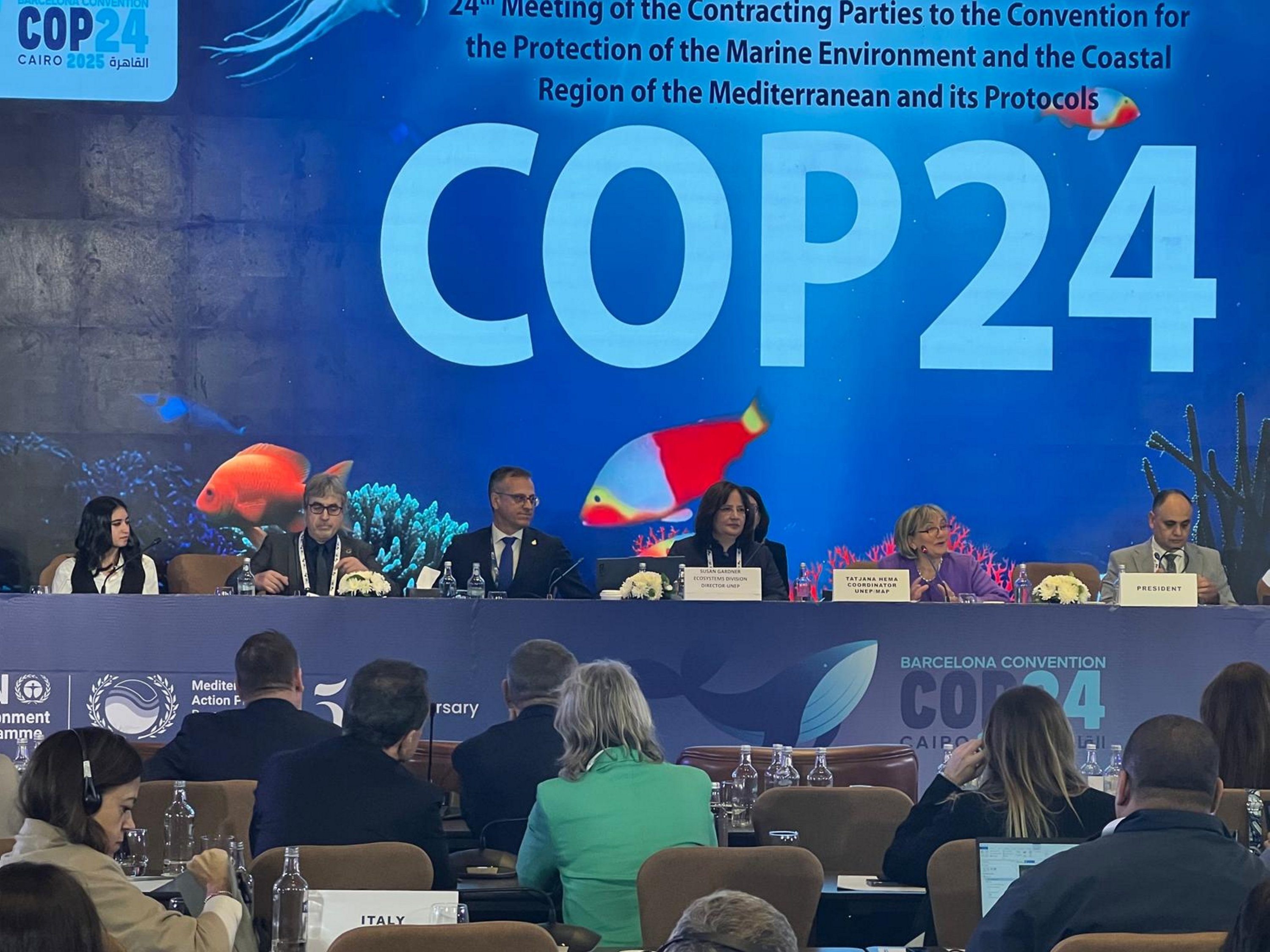
Türkiye’s new Mediterranean climate center in Istanbul is set to become operational next year after COP24 delegates approved its mandate, budget and work program in Cairo.
The 24th Conference of the Contracting Parties to the Barcelona Convention, known as COP24, met in the Egyptian capital from Dec. 2-5 to adopt new regional frameworks and funding decisions.
Delegates at the conference also adopted two key policy frameworks – the Mediterranean Strategy for Sustainable Development (MSSD) 2026-2035 and the Regional Climate Change Adaptation Framework (RCCAF) 2026-2035 – along with the Convention’s budget and work programme for 2026-2027.
Türkiye was re-elected as a full member of the Convention’s Compliance Committee, completing the final step toward establishing the center under the host-country agreement.
The new center aims to protect at least 30% of the Mediterranean Sea by 2030, coordinate regional climate-resilience efforts, and lead implementation of the Regional Climate Change Adaptation Framework across coastal states.
Deputy Minister of Environment, Urbanization and Climate Change Fatma Varank said the center will reinforce Türkiye’s leadership and support a new generation of climate-resilience projects and policy processes under a strengthened institutional framework.
"In the coming years, Türkiye will be at the center of climate action both nationally and internationally," Varank said.
Türkiye will host and chair COP31, the United Nations Climate Change Conference, in 2026, following negotiations led by Minister of Environment, Urbanization and Climate Change Murat Kurum at COP30, held in Belem, Brazil, in November.
The center will oversee the Coastal Area Management Programme (CAMP) Izmir Project, designed as a pilot initiative to develop integrated coastal and marine management models for the Mediterranean.
The project will target climate adaptation, coastal risk management, sustainable blue economy practices, integrated coastal zone management and marine spatial planning along the Izmir coastline.
Participants at the ministerial session adopted the Cairo Declaration, reaffirming commitments to protect Mediterranean biodiversity and combat marine pollution.
The declaration outlines goals to protect at least 30% of marine and coastal areas by 2030, accelerate sustainable blue-economy practices and reduce plastic pollution.