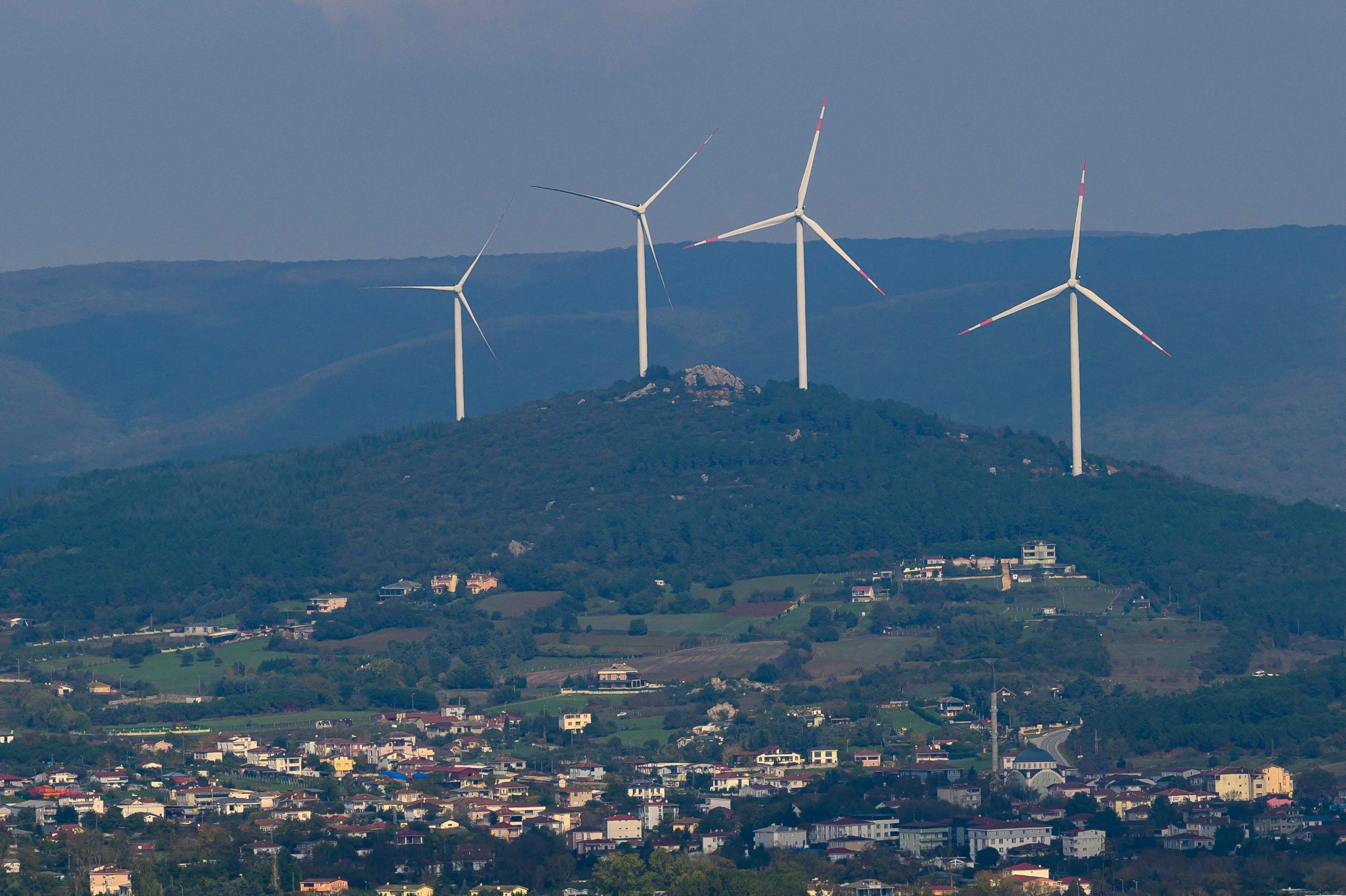
Türkiye's renewables surge has come under the spotlight ahead of next week's U.N. climate summit in Antalya, with wind farms across the country and solar plants – some of the largest in Europe – showcasing how much Ankara has accelerated the transition in recent years.
Row after row of solar panels stretches across a vast landscape in the central province of Konya, turning sunlight into electricity, help Türkiye, the host of the COP31, show to the rest of world how much it has done so far to expand renewable energy.
The town of Karapınar in Konya is home to the Kalyon Karapınar YEKA-1 Solar Power Plant, which boasts more than 3 million solar panels perched on a terrain equivalent to the size of 2,600 soccer fields.
Operational since 2023, it generates enough electricity each year to meet about 0.7% of the country’s power demand, according to plant director Burak Doğru.
"We prevent approximately 1.75 million metric tons of carbon emissions every year," Doğru told The Associated Press (AP) – evidence, he says, of how Türkiye has been directing its economy and energy sector toward cleaner energy sources.
Even though coal remains part of its energy mix, and the country uses natural gas and oil, Turkish authorities have scaled up efforts to increase the share of renewables in the energy mix. A new road map for 2040, unveiled on Thursday, aims to increase their share to 77% of total installed capacity from the current 63%.
Türkiye is also looking to nuclear power to reduce its energy dependence. The country’s first plant is under construction on the Mediterranean coast, with plans for additional reactors still under consideration.
Alongside solar and hydropower, in which Türkiye is Europe's second-largest producer, the boom in wind farms, particularly on the country's western coast and close to Istanbul, is also a testament to the renewables boom.
On a windy hillside about an hour's drive northwest of Istanbul, the Çatalca power plant was one of Türkiye's first large-scale wind farms and has been feeding electricity into the grid for 18 years.
With an installed capacity of 93 megawatts (MW), it generates 287 million kilowatt-hours (kWh) of electricity a year, enough for around 115,000 households.
"By replacing electricity that would otherwise come from fossil fuel-fired power plants, this output avoids 185,936 tons of carbon emissions each year," operator Sanko Enerji said.
Nearly two decades on, Çatalca is one of nearly 300 wind farms, its giant turbines a symbol of the rapidly expanding capacity for renewable energy in Türkiye.
Analysts, however, suggest that more investment is needed in areas such as electricity storage, grids and nuclear energy to continue with the clean energy expansion.
Environmentalists also highlight the need to further curb the use of coal.
"As Türkiye increases renewable capacity, it must ensure clean electricity replaces fossil-fuel generation rather than simply meeting additional demand," Duygu Kutluay of Beyond Fossil Fuels told Agence France-Presse (AFP).
Beyond the climate argument, geopolitical tensions have also strengthened the case for domestic renewables.
"Renewables ... are not only one of the most effective tools for tackling climate change, but also an important means of strengthening energy security and reducing dependence on foreign supplies," said Ibrahim Erden, president of the Turkish Wind Energy Association (TÜREB).
Some 265 kilometers (165 miles) away from Konya, the Nov. 9-20 summit in the Mediterranean city of Antalya will bring together tens of thousands of delegates, world leaders, business and civil society representatives for discussions on implementing climate goals.
The summit – officially, the Conference of the Parties, or COP31 – comes against a backdrop of deepening concerns over energy security and the Iran war, which has led to a rise in gas and oil prices and sent countries scrambling to meet energy needs.
Environment, Urbanization and Climate Change Minister Murat Kurum, who will preside over the summit, has said he wants COP31 to focus on turning climate commitments into action rather than new targets.
To that aim, Türkiye will push a "climate implementation bridge," an initiative to help countries turn climate pledges into action by connecting them with financing, technology and other support.
"Today, the world is not merely waiting for new decisions," Kurum said while presenting summit priorities earlier this year. "What the world wants is to see past decisions put into practice.”
COP31 will also prioritize electrification and reduction of waste and methane emissions, Kurum has said.
Like other Mediterranean nations, Türkiye faces mounting risks from heat waves, drought, water scarcity, wildfires and flooding. Last month, rains described as the heaviest in more than 80 years caused severe floods in Istanbul, Türkiye's largest city, and left eight people dead.