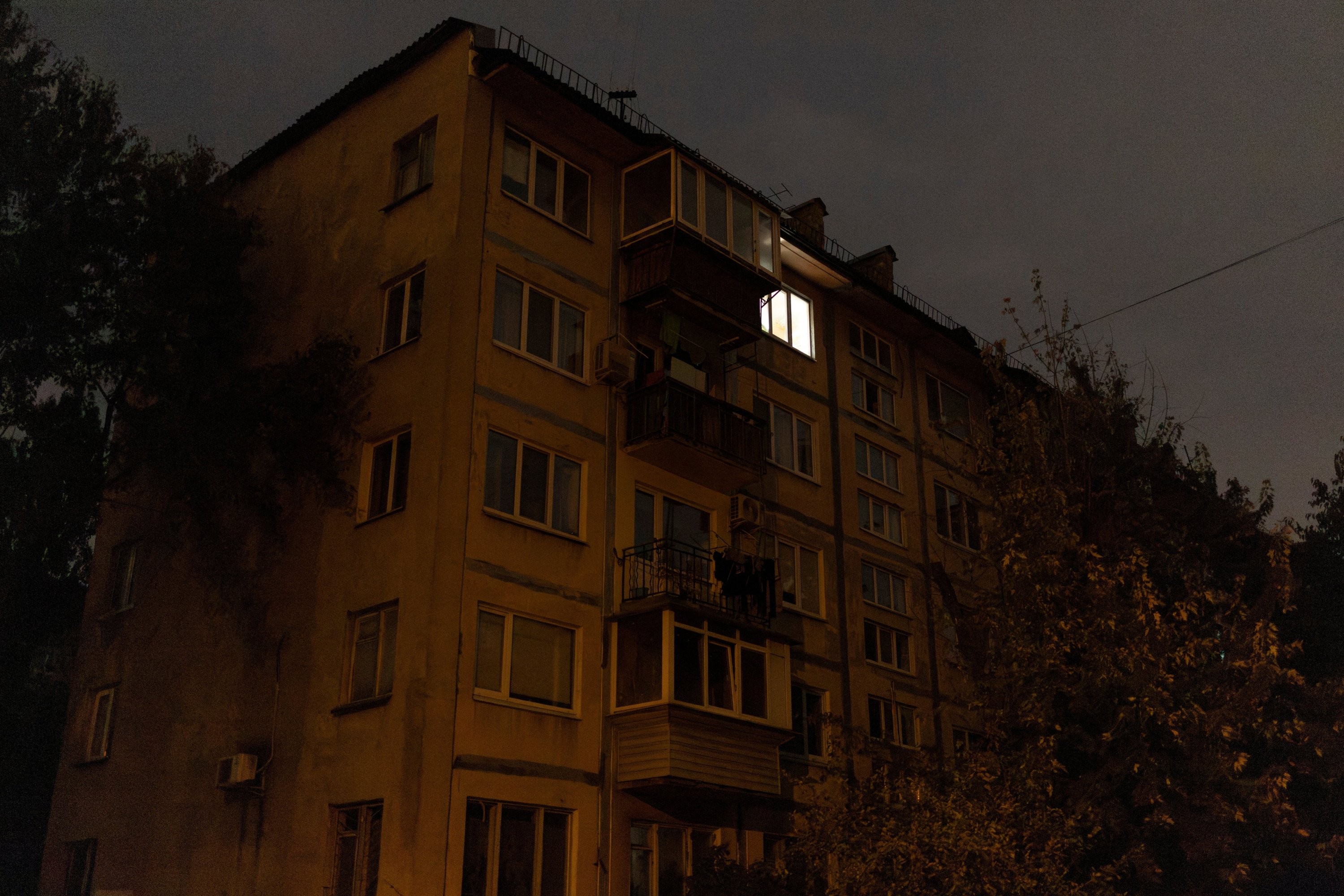
Millions of Ukrainians, including those who depend on electricity for key treatments, are preparing for another winter with power cuts.
As the lights went out in her hometown, 40-year-old Zinaida Kot could not help but think about her next dialysis treatment for kidney disease. Without electricity, the machine that keeps her alive stops working.
Kot is among millions who are bracing for another winter of power cuts and possibly blackouts as Russia renewed its campaign of attacks on the country’s energy grid. Analysts and officials say that this year, Moscow has shifted tactics, targeting specific regions and gas infrastructure.
In some regions, mostly those closer to the front line in the east, the season of buzzing generators has started, as well as long hours of darkness with no power or water. People are once again pulling out small power stations, charging numerous power banks, and storing bottles of water in their bathrooms.
The attacks have grown more effective as Russia launches hundreds of drones, some equipped with cameras that improve targeting, overwhelming air defenses, especially in regions where protection is weaker.
The consequences are already reshaping daily life – especially for those whose survival depends on electricity. For Zinaida Kot, who has been on dialysis for seven years, this is far worse than mere discomfort.
"It is bad. We really worry when there is no electricity," she said from her hospital bed, connected to a dialysis machine powered by a generator that staff call "not reliable enough."
"If there’s no treatment, I would die. I would not exist."
In early October, a Russian strike left the small northern town of Shostka – with a prewar population of nearly 72,000 – without electricity, water, or gas. The town lies just 50 kilometers (31 miles) from the front line in the northern Sumy region. Gas service was later restored, and electricity returned for only a few hours each day.
"The situation is challenging," said Mykola Noha, the mayor of Shostka. Electricity and water are now supplied on a schedule, available for a few hours each day. "And it really worries the residents as we can’t predict power cuts. We fix something and it gets destroyed again. This is our situation."
Shostka hums with the low growl of generators on rain-dark asphalt, blanketed in yellow leaves. They power cafes, shops, residential buildings, and hospitals. Across town, so-called "invincibility points" offer residents a place to charge devices, warm up, and even rest on cots provided.
The hardest days, locals say, were when there was no gas, no heat, or a way to cook, and people made meals over open fires in the streets.
At the local hospital, where all stoves are electric, staff built a simple wood-burning oven during the early days of Russia’s invasion in 2022, when the town came close to occupation. And now it helps to feed at least 180 patients, said Svitlana Zakotei, 57, a nurse who oversees the patients’ meals.
The hospital has spent three weeks running on generators, a costly lifeline that burns half a ton of fuel a day, about 250,000 hryvnias ($5,973) a week, said the hospital's chief, Oleh Shtohryn. That’s nearly as much as its usual monthly electricity bill.
Power is rationed. In the dialysis ward, lights stay dim so electricity can feed the machines that keep patients alive. One of the eight units burned out because of the blackout, a costly loss the hospital could not afford to replace soon. Still, 23 patients come daily for hours-long treatment.
The crisis in Shostka reflects Russia’s shifting strategy. In 2022-2023, Moscow launched waves of missiles and drones across the country to destabilize Ukraine’s national grid. This year, it is striking region by region.
The recent pattern shows heavier attacks on the Chernihiv, Sumy, and Poltava regions, while Kharkiv, Odesa, Mykolaiv, and Dnipro face less frequent but still regular strikes.
"They’ve had no success hitting the national infrastructure because it’s now much better protected and operators know how to respond," said Oleksandr Kharchenko, director of the Energy Research Center. "So they’ve decided to refocus and change tactics."
Front-line regions within about 120 kilometers of combat are the most vulnerable, he said. "These are attacks on civilians who have nothing to do with the war."
And for Ukrainian energy crews, that means fixing the same lines and stations again and again – from transmission towers to thermal plants – while enduring outages at home.
"But it’s our job. Who else would do it? Nobody else would," said Bohdan Bilous, an electrical technician.
"I want to be optimistic and prepared for any situation, but the reality is extremely cruel right now."
Svitlana Kalysh, spokesperson for the regional energy company in the Sumy region, said proximity to the front line makes each repair crew a target. "They’re getting better at knowing how to attack," she said of the Russians. "The real challenge is the complexity (of damage) – no source to draw (electricity) from, no way to transmit, no capacity to distribute," she said.
At a switchyard in the Chernihiv region, all seems calm – a woman tends her cabbage patch nearby – but residents are used to the explosions which intensify each year as winter nears.
The switchyard looks like a museum of nearly four years of strikes. Along the main road lined with towering pylons, a crater in the asphalt marks one of the first attacks in 2022.
The latest strike, on Oct. 4, was far more precise and devastating. In the roof of the transformer building, there’s one neat hole near the center, and another in the wall – scars left by Shahed drones.
Sandbags around the building absorbed some shock waves but couldn’t stop a direct hit. Inside, the station is cold and dark but still operating at half capacity. Thousands of homes across Chernihiv remain without steady power.
Workers are already trying to repair the damage, but even under ideal conditions – few air raids, no new strikes – it will take weeks. Each time an alert sounds, crews must leave their posts.
"If you look at this year, it’s one of the hardest," said Serhii Pereverza, deputy director of Chernihivoblenergo. "We hope for the best and think about alternative ways to supply our customers."
Kharchenko noted that last year Russia lacked the capacity to launch 500 or 600 drones at once, and the smaller attacks it could mount were largely ineffective.
But this year, even when several air-defense points and mobile units surround a facility, the Russians simply overwhelm them – sending about six drones at each defensive position and another 10 directly at the target.
"This year they’ve roughly tripled the scale," he said. "They’re breaking through individual sites by sheer volume and power."