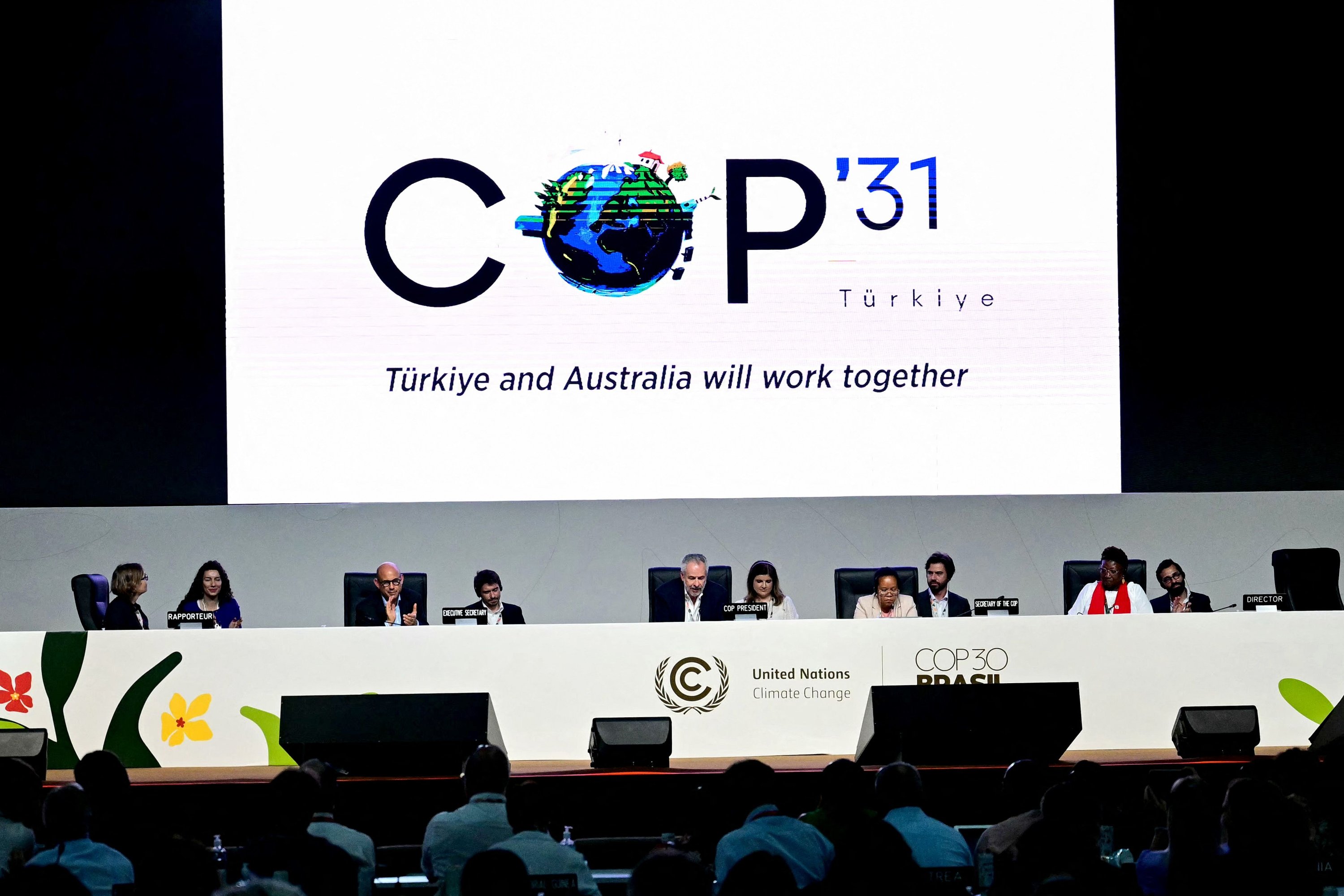
U.N. Environment Programme (UNEP) Executive Director Inger Andersen on Monday said they aim to build "deep cooperation" with Türkiye, which has secured the right to host next year's U.N. climate summit.
Türkiye was announced as the host of the COP31 summit last month after overcoming a long impasse with Australia, which will lead the negotiation process at the conference. This year's COP30 meeting took place in Brazil.
The annual COP, or Conference of the Parties, is the main global forum for driving action on climate change. The host matters because they set the agenda and lead the diplomacy needed to reach global agreements.
Recalling that the Paris Agreement is nearing its 10th anniversary, Andersen said there has been progress, although not everything that was hoped for was achieved in the fight against climate change.
"And next year, in beautiful Türkiye, we will see further progress," she told Anadolu Agency (AA) on the sidelines of the U.N. Environment Assembly (UNEA) in Nairobi.
"The next step is for Türkiye, together with its Australian partners and our Brazilian friends, to help lead the road map for a phase-out of fossil fuels. We already see 80 countries saying 'we are in,' but there is much more work to be done," Andersen said, according to a Turkish transcript of the interview.
Türkiye's upcoming COP31 presidency opens significant opportunities for cooperation with UNEP, she noted.
"Türkiye is a strong country. It is located in a magnificent position. In many respects, it is a true bridge between east, west, north, and south. It is a country with every kind of ecosystem, from deserts to mountains to the sea. We are eagerly looking forward to establishing a deep cooperation with Türkiye because Türkiye is a country that demonstrates strong resolve," Andersen added.
She cited what she described as the strong leadership of first lady Emine Erdoğan in the zero-waste agenda.
"This directly links to the issues I emphasized, such as pollution, waste, and chemicals. Türkiye is a country that has embraced biodiversity protection and aims to move forward decisively," Andersen said.
"While it is rich in renewable energy sources derived from hydroelectricity, it also offers great opportunities in wind energy due to its magnificent wind speeds. We also look forward to actively participating in this process when the COP presidency mandate begins."
Ankara and Canberra had both submitted bids in 2022 to host COP31 and had refused to stand down before last month's deal, which set out that Türkiye will serve as the venue while delegating negotiating responsibilities to Australia.
According to Andersen, the partnership represents "a new page in multilateral leadership" and could serve as a learning opportunity for the international community.
"The cooperation between the two countries actually covers the entire region. Türkiye and Australia will host COP31 together. This is perhaps a new page we have opened in multilateral leadership. I hope this will be a learning opportunity for all of us," she noted.
Andersen pointed out that both countries are active in the coal sector and stated a need to move away from high-carbon dioxide-emitting energy sources in the long term, but that the employment dimension creates complexity for such countries.
That's why, she says, COP31 is an opportunity.
"As a host, I expect Türkiye to focus heavily on this area and make a strong assertion. The entire world will examine its Nationally Determined Contribution (NDC) to see what it genuinely promises and whether it delivers. Thus, Türkiye will be under more intense global scrutiny by the entire world," she noted.
"That's how things work when you are the COP president. This also applies to Australia, which is a coal producer. Let's not forget they are together in this process. Therefore, both countries have the opportunity to show their road maps for the phased transition away from fossil fuels," she added.
"I hope they see this as a real opportunity to use it as an example of an economy that accepts that this sector is now a closing sector."
Andersen stressed that the world's most urgent climate priority remains emission reduction, but added that pollution and biodiversity loss must be addressed simultaneously.
At the UNEA, she expects a strong message that environmental multilateralism remains robust and that countries are committed to joint action to protect the planet. Smart environmental policies, Andersen noted, can support both economic growth and job creation.
She also highlighted that the use of artificial intelligence for sustainability and environmental protection is on the agenda, adding that this technology can offer solutions "for the good," but that the environmental impacts, such as the metals, rare earth elements, energy and water consumption used in its production, must also be taken into consideration.