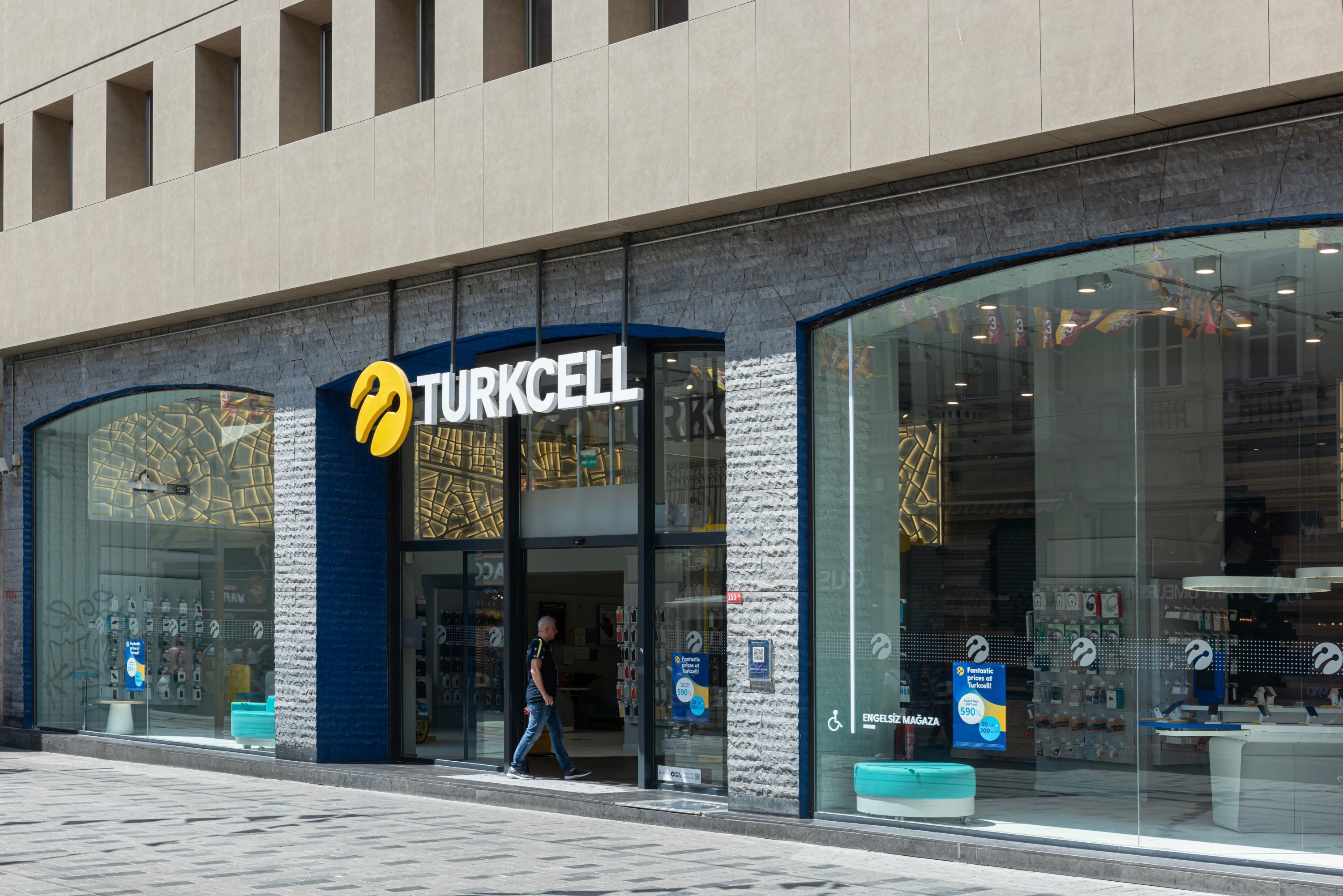
Turkcell's partnership with Google Cloud to build hyperscale data centers in Türkiye is expected to contribute about $5 billion (TL 214.23 billion) annually to the Turkish economy while ensuring that locally generated data remains stored and processed domestically, according to Turkcell CEO Ali Taha Koç.
Under the recently announced agreement, Türkiye will become Google Cloud's 43rd region globally, gaining access to advanced cloud and artificial intelligence (AI) services through what the companies describe as a fully compliant "Sovereign Cloud" infrastructure aligned with local regulations.
The project, which follows nearly two years of negotiations, is being positioned by both sides as a milestone in Türkiye’s digital transformation.
The data centers will be built in the capital Ankara, with construction expected to begin in the first quarter of 2026 and full capacity planned by 2028. Turkcell said the facilities are expected to improve efficiency across sectors, including public institutions, finance, startups and heavy industry.
"From next-generation AI models to cybersecurity, data backup and analytics, we will provide access to more than 200 services to everyone in Türkiye," Koç said in an interview with Anadolu Agency (AA) on Wednesday.
Although Turkcell currently operates the country’s largest data center capacity at 50 megawatts (MW), Koç said that partnering with a global provider was necessary to reach international scale and standards.
"Whatever exists in Google Cloud’s other 42 regions will exist in Türkiye in exactly the same way," he said. "That was our condition, and it was accepted.”
The Ankara facilities will function as a single cloud region composed of three synchronized but independent data centers, designed to ensure redundancy and operational resilience in the event of disruptions.
Data will be encrypted and stored across all three sites, with encryption keys controlled exclusively by customers.
"This investment allows us to say clearly that 'Türkiye’s data will stay in Türkiye,'" Koç noted.
He said the Sovereign Cloud model would allow government institutions and financial entities to use cloud services while meeting strict security and regulatory requirements.
Hosting the data centers domestically will also reduce latency, enabling faster access to cloud services nationwide.
"The closer you are to the data center, the more efficient the service," he further said, adding that the project would help position Türkiye as a regional digital hub where data is stored, processed and converted into economic value.
Koç also said the pay-as-you-use cloud model would be particularly significant for startups by removing the need for large upfront information technology investments.
"Instead of building infrastructure for 1 million users when you only have 10,000 today, companies will pay only for what they use," he said.
He added that the approach would shorten development cycles, support scalability and improve cost efficiency for entrepreneurs and newly established firms.
"We estimate that this investment will generate about $5 billion in economic value for Türkiye each year," Koç said.
Similarly, Koç said rapid growth in data generation driven by 5G, and eventually 6G, would make hyperscale data centers a critical part of national infrastructure.
Emerging technologies such as machine-to-machine communication, smart cities and what he described as the "Internet of Senses" will require constant data processing, he said.
"With smart cities, everything from homes and meters to traffic lights will be connected," Koç said. "By applying AI models to this data, we will add intelligence to our cities through these data centers in Türkiye."
Energy use remains a key consideration for the project, Koc said, adding that Turkcell is expanding renewable energy investments to meet future demand.
The company operates an 18-megawatt wind power plant in Izmir and has commissioned 63 megawatts of solar capacity as part of a planned 210-megawatt solar portfolio, including a facility recently opened in Van province.
Turkcell plans to invest about $240 million in renewable energy generation and has set a target of achieving net-zero emissions by 2050.
"As Türkiye’s Turkcell, we will continue to use our sun and wind," Koç maintained. "When these data centers are operational, we intend to meet their energy needs with renewable sources and move steadily toward our net-zero goal."