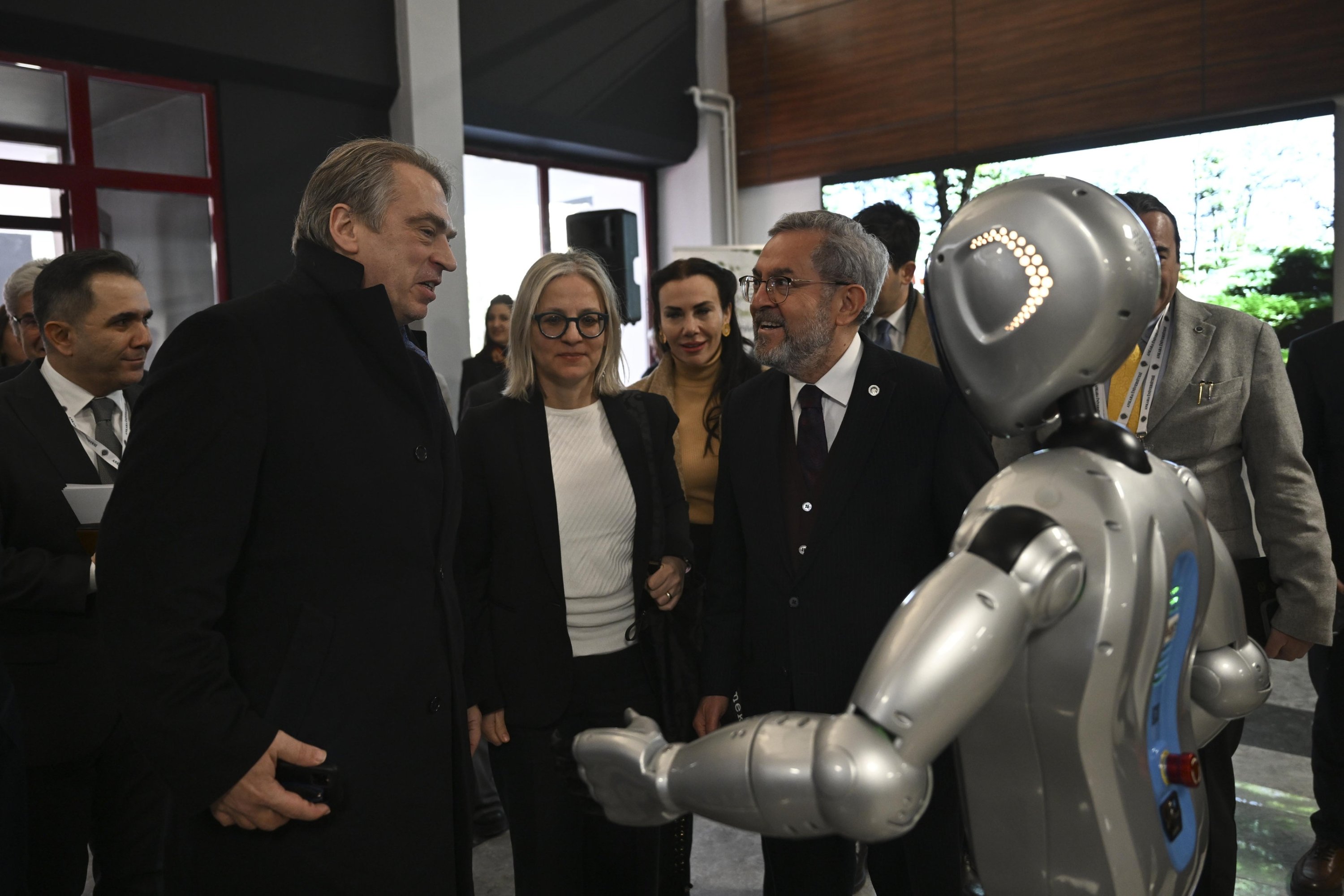
Using artificial intelligence (AI) technologies in different areas, including the engineering, defense and health sectors, was widely discussed at a recent fair held in the Turkish capital of Ankara.
The two-day event organized by Ankara University aimed to foster collaboration between academia, industry and public institutions in the field of AI.
On the second day of the Interdisciplinary Artificial Intelligence Project Fair, academics, engineers, health professionals and IT experts discussed the positive and negative effects of AI in the engineering and health sectors.
Tanyel Çakmak, an expert in technology development at the Turkish Aerospace Industries (TAI), explained that transformation in the defense industry began in 2004.
She said there are limitations in technology transfer between countries due to security concerns, underlining the importance of developing and using indigenous technology instead of depending on external supplies.
"The Atak helicopter and the Altay battle tank came out as a result of innovative ideas produced by our own engineers," she said, adding that Türkiye has started working on a sixth-generation fighter jet that will be integrated with AI.
Kaan Atalay, an expert in technology development at TAI, said AI is one of the top agenda items for Türkiye's largest aerospace manufacturer.
Atalay said they aim to reduce the number of manned-dependent flights as AI-based programs detect threats in enemy airspace and even decide the amount of ammunition to use.
For the after-sales process, he said the AI-focused maintenance and simulation using digital twins helped them increase profit and sustainability.
Tuğba Soyer, an expert in technical order management at MAN Türkiye, said the accuracy and sustainability of data play a very important role in getting results.
MAN is a manufacturing and engineering company based in Munich, with its primary output being commercial vehicles and diesel engines.
She said they produce different vehicles for state officials and football teams based on special requests. "Time is precious, and we try to convert manual work into automation," she said.
Abdurrahim Toktaş, an expert in AI and data engineering, gave examples of how AI technologies could be used in engineering.
He said Bugatti, a Volkswagen Group brand, designed brake systems for its cars, and Tesla reduced failures and error rates by 30% using AI advantages.
Software engineering expert Murat Karakuş highlighted the positive effects of AI in testing codes and increasing productivity.
"AI has made software development processes more efficient in less time and cost reduction for companies," he said, warning about bias-based data and the problem of decreasing creative thinking skills.
Bahadir Aktuğ, a geoscience expert, said robots could perform skilled jobs such as doctors, lawyers and pilots.
He said there will be systems that are specialized in certain areas of problems in the future.
Caner Koç, an expert in agriculture and environmental sciences, explained that agricultural land is shrinking, and the population engaged in agriculture is aging.
He said AI will increase efficiency in the remaining part of the farmland and use high-tech robots, tractors and tools to plant and harvest the land instead of using human efforts.
He added that they focus on minimizing inputs in agriculture and maximizing yield, such as using less fertilizer and minimum pesticide but getting maximum output.
Baran Erdoğan, a cyber security expert at the SecureComputing company, said managing data quality is very important, and those who control the data will also control the results.
Noting that there are many coders in Türkiye without the testing discipline, he said his company tries to increase software engineering quality by benefitting from AI technologies.
Murat Efe, an expert in electrical and electronic engineering, said the sense of success has become artificial, leading to dissatisfaction on an individual and institutional basis.
"It leads to perception disorder," he said, adding that using and developing technology would be beneficial if we realize how we achieve success.
Doctors, health professionals, academics, start-up representatives, engineers and IT personnel discussed the effects of AI on the health sector during the afternoon session.
Ayten Kayı, an expert in thoracic surgery, said she was "optimistic” and "pragmatic" about using AI technologies, which could contribute to the clinical decision-support process for doctors.
"One of the advantages of AI is that it does not get tired. It works day and night. It helps in reading symptoms, providing early diagnosis," she said, adding that AI could lead to serious ethical problems, such as negative overdiagnosis or unconscientious decisions.
However, Ihsan Doğan, a brain and nerve surgery expert, said he was on the "opposite side" as AI is not reliable at the moment, citing research papers and articles.
"Who is responsible for the possible errors in the reports (of AI)? The doctor, the software developer or the hospital manager? The human being is the decision maker at the center of this business," he said, underlining the importance of not losing human values.
Haydar Ankışhan, an expert in stem cell and regenerative medicine, said AI reduces our research skills and creativity but speeds up daily life.
"We develop artificial intelligence inspired by nature, taking into account many different situations," he said and explained his project about early detection of high blood pressure from natural speech sounds with a graph diffusion network.
Tuğba Haklı, co-founder of Retinow Health Technologies, said her company developed software based on diabetic individuals after completing a clinical study.
Noting that blindness from diabetics is preventable at an early stage, she said they integrated AI into the system to reduce doctor density and increase accuracy.
Alparslan Koçubez, a genomics expert from Refgen biotechnology, said they are setting new standards for research and development and production in genomics, engaging in DNA sequencing analysis, which could save lives by early diagnosis.
Noting that rare diseases can be diagnosed in seven years, he said AI could accelerate the diagnosis process and help follow-up treatments to determine if it will recur.
Ibrahim Sevki Bayrakdar, a radiologist and the CEO of Craniocatch AI Solutions in Dentistry, said even with limited data, AI’s visual assessment and development of trauma detection are more successful than those of a newly graduated physician.
However, he said AI can be a second eye and assistant for doctors.
Mehmet Ortaburun, software developer at Sisoft Healthcare Information System, said a radiologist processes 250,000 images in 40 years, but AI can provide a proportional diagnosis in a short time.
Expressing gratitude for the increase in publications on AI in the health sector, he said it would be more fruitful when articles turn into products.
In his closing speech, Ankara University’s rector, Necdet Ünüvar, thanked every participant for contributing to the two-day event.