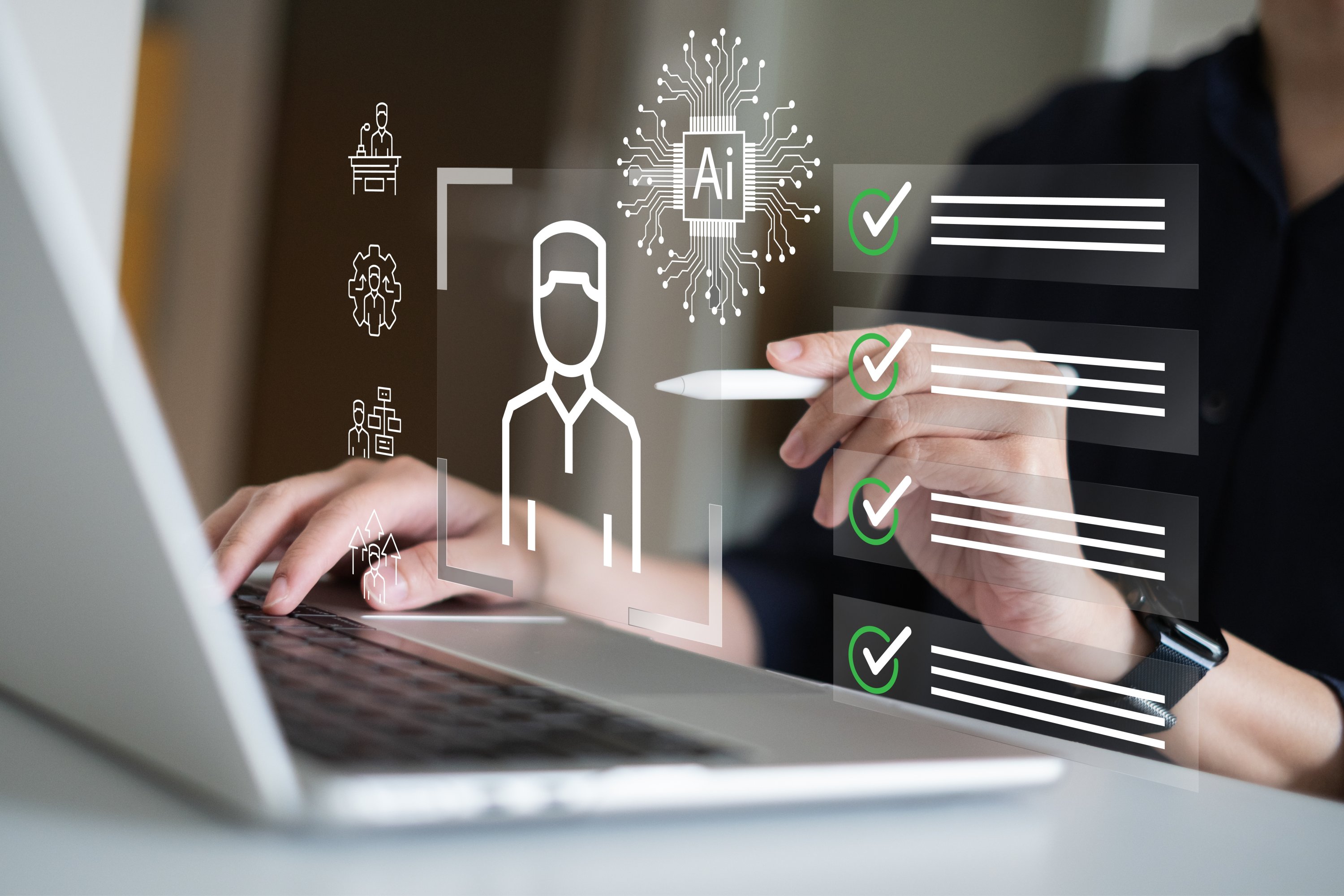
For years, one phrase defined job seekers in Türkiye: "I'll do any job." It symbolized flexibility, determination and a willingness to work.
Today, that familiar expression is evolving into something new: "I'll do it with AI."
The shift may seem subtle, but it captures one of the most significant transformations taking place in the labor market.
It's no longer enough to say, "I'll do whatever job comes my way." What really makes a difference is being able to answer the question, "How can I do it with AI?"
In Türkiye, that transformation appears to be happening fast among job candidates.
According to a survey conducted by recruitment platform 24 Saatte Iş (Job in 24 Hours) among 1,036 respondents, 41% use artificial intelligence to prepare their resumes, 34% rely on AI while searching for jobs and 20% use it to prepare for interviews.
In other words, the modern equivalent of "I'll do any job" increasingly comes with an AI-generated CV.
The "Artificial Intelligence and the Workplace" survey suggests that corporate adoption has yet to catch up with individual enthusiasm.
Only 13% of respondents say artificial intelligence is used regularly within their companies, while 61% report that it is not used at all in their workplace, according to the study.
In other words, while job seekers are ready to say, "I'll do it," organizations don't yet have the infrastructure to say, "I'm having it done."
Even so, 61% of participants believe AI has already made them more productive. This is evidence that individual transformation is occurring much faster than that of organizations.
The cost of this gap is also reflected in salaries.
According to PwC's AI Jobs Barometer, employees with AI-related skills are seeing salary growth that is 42% faster than workers without those capabilities.
Mert Yıldız, co-founder of 24 Saatte Iş, says the findings illustrate a clear divide between candidates and employers.
"Our research paints a very clear picture. Job seekers have made artificial intelligence a natural part of their careers. Four out of every 10 people prepare their resumes using artificial intelligence, and one out of every three people uses this technology to support their job search. In contrast, the use of AI in companies is still not at the desired level," said Yıldız.
He argues that this mismatch will become one of the defining competitive challenges over the coming years.
"Artificial intelligence will not take people's jobs away; however, employees who use AI effectively will outpace those who do not. According to PwC's AI Jobs Barometer data, employees with AI skills experience a 42% higher rate of salary growth," Yıldız noted.
"In today's business world, the new common language is no longer English – it is AI literacy. This competency is the most powerful lever in next-generation career management."
According to industry experts, this new reality rests on three core competencies. These include the ability to provide the right prompts (prompt engineering), critical thinking that allows one to question the information provided by AI, and an understanding of efficiency that saves time by delegating routine tasks.
This trio is no longer just a luxury certification but is becoming a fundamental requirement in hiring processes.
There are concrete figures behind this shift.
According to data from Monster, an international human resources platform, the share of candidates listing AI-related skills on their resumes has climbed from 3.7% to 12.8% in a relatively short period.
Put differently, applicants who used to say, "I'm willing to do any job," are now being replaced by those who say, "I know how to use AI to do the job better."
The shift is also becoming visible in hiring requirements.
A report published by the National Association of Colleges and Employers (NACE) in spring 2026 found that more than one-third of job postings aimed at recent graduates and entry-level candidates now explicitly require AI literacy.
Meanwhile, 72% of business leaders surveyed believe AI proficiency has become as fundamental as traditional literacy itself.
Every company positions artificial intelligence differently in its own transformation efforts.
At Türk Telekom, AI technology plays a critical role in the transformation of both its human resources and network infrastructure.
As part of its Development Hub initiative, Türk Telekom has launched AI Camp '26, a training program designed to cultivate highly skilled AI professionals.
The program is open to final-year undergraduate students and recent graduates who completed their studies within the previous year, are under the age of 25 and are not currently employed.
Following an evaluation process that includes online assessments and interviews, the selected participants attended an intensive in-person program held at the company's Ataköy campus in Istanbul between June 22 and July 3.
During the ten-day certified bootcamp, participants worked on real-world business challenges under the guidance of mentors from Türk Telekom's Human Resources and Data Science teams.
Beyond technical training, the program provides opportunities to build professional networks and gain internship experience, helping participants establish a strong foundation at the start of their careers.
The initiative is offered free of charge, with the company covering both transportation and accommodation expenses.
The impact of artificial intelligence is not limited to human resources programs. AI-powered systems can automatically detect network faults and traffic congestion before rerouting data without requiring human intervention. These intelligent automation capabilities have increased operational efficiency by 26%.
Türk Telekom's artificial intelligence initiatives also encompass the social impact dimension.
The EyeMo project, unveiled in January 2026, stands out as a fully domestically developed, AI-powered image processing solution that enables individuals who cannot use their hands due to muscle disorders such as ALS and stroke to control their computers and peripheral devices using eye movements.
Gökhan Evren, deputy general manager in charge of information technologies at Türk Telekom, says such projects, developed through the company's university-industry partnerships and R&D efforts, are part of its vision to bring digital transformation to all segments of society.
This trend aligns with a broader pattern across Türkiye.
According to the "Digital 2026 Global Overview" report by We Are Social and Meltwater, Türkiye ranks first in the world in AI-driven web traffic originating from ChatGPT, with a remarkable rate of 94.49%, significantly higher than the global average of 80.92%.
The steps Türk Telekom has taken, both through its programs to cultivate young talent and its operational AI applications, demonstrate that the company has placed its digital transformation at the center of its human resources strategy, rather than viewing it solely as an infrastructure investment.
The amount of data on smartphones is increasing, but security measures are lagging behind. That makes it essential to take precautions against the growing volume of personal data and prepare as if your phone might be lost.
With smartphone losses becoming more common during the summer travel season, it's critical to prepare for worst-case scenarios involving our devices, which carry an ever-increasing amount of personal data.
New global research from cybersecurity company Kaspersky highlights changes in internet usage habits. According to the study, 58% of users now prefer to use their smartphones as their primary device for accessing the internet; computers have taken a back seat.
This shift is even more pronounced among Generation Z, where 67% of respondents aged 18 to 28 said their mobile phone is their main device for accessing the internet.
As mobile devices have replaced computers, the volume of sensitive data stored on these devices has also expanded rapidly.
According to the survey, 63% of users store their personal photos and videos on their phones, while 49% keep contact information. Another 37% retain messaging histories, and 34% store official documents such as passports or identity cards.
Around 40% of respondents keep banking or payment information and login credentials on their smartphones. Meanwhile, 30% store gaming accounts, 27% retain email accounts and another 27% keep AI chatbot conversation histories. Calendar information is stored by 20% of users, while 13% of respondents keep access credentials for corporate systems.
"Smartphones have become digital assistants that touch every aspect of our lives," said Anton Kivva, a cybersecurity expert at Kaspersky. "The information entrusted to these devices has gone far beyond photos and messages. The real challenge today is no longer what we store, but how well we protect it."
Kaspersky experts recommend three basic measures to help users protect their data.
Smartphones should not be the sole storage location for important information. Without a backup or cloud synchronization, data may not be recoverable if the device is lost or malfunctions. Tools like Kaspersky Password Manager offer a special "Secret Vault" feature for storing sensitive documents, such as scanned ID documents, in addition to passwords and financial information.
During the first quarter of 2026, Kaspersky blocked more than 2.67 million attacks carried out via malware, adware and unwanted mobile software, while more than 306,000 malicious installation packages were detected.
Experts recommend using multilayered security solutions like Kaspersky Premium, which scan app downloads and block phishing links in real time.
Keeping location services enabled is the top priority here; both Android and iOS have built-in tools that can locate a lost phone and remotely wipe its data if necessary, while the Kaspersky for Android app offers this functionality through its "Where's My Device" feature.
Enabling regular backups is also crucial, as it ensures that photos, videos, documents and contacts can be restored even if the device is lost or stolen. Additionally, setting the phone to lock automatically as soon as the screen turns off protects the device from thieves or cyberattackers when it is not in use.
Finally, the device must be physically secured; it is recommended that phones not be left unattended in public areas or in easily accessible places such as on tables or in back pockets.