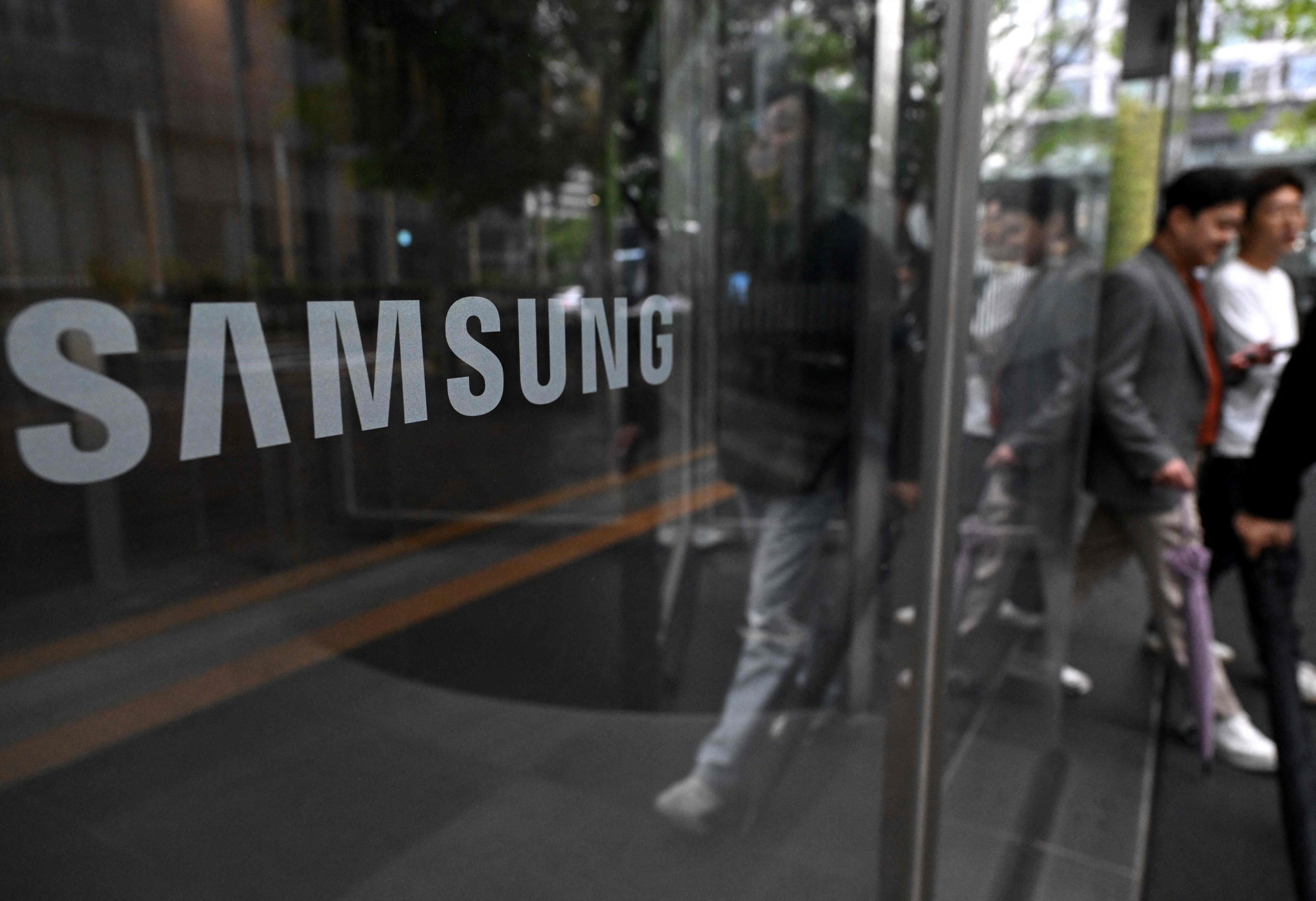
South Korean electronics giant Samsung Electronics and its workers' union resumed talks Wednesday with the country's labor minister mediating, in what was a last-ditch attempt to avert a major strike.
The labor union at the world's top memory chipmaker had said it would begin a strike on Thursday after talks over bonuses broke down, raising concerns about potential disruption to semiconductor production.
The walkout was expected to dwarf a 2024 strike that drew about 6,000 workers, as anger flares among staff over how the company distributes its massive profits from an artificial intelligence-fuelled boom.
But negotiations between management and the union mediated by the labor minister would resume on Wednesday afternoon, the ministry said.
Samsung reported a roughly 750% annual jump in first-quarter operating profit while its market capitalization topped $1 trillion for the first time in May.
The union had called for the scrapping of a bonus cap set at 50% of annual salaries and for 15% of operating profit to be allocated to bonuses.
"Around 10:00 pm on May 19, the labor union agreed to the mediation proposal put forward by the National Labor Relations Commission; however, management expressed its refusal," it said in a statement earlier Wednesday.
"The labor union will lawfully commence a general strike tomorrow as scheduled."
According to the union's lawyer, around 50,500 workers were set to walk off production lines for 18 days starting Thursday after negotiations with management broke down.
In response, Samsung's management said the talks failed because "acceding to the labor union's excessive demands would risk undermining the fundamental principles of the company's management."
The standoff has raised concerns in South Korea, where semiconductors account for about 35% of exports and are a key pillar of the economy.
The presidential office had expressed "deep regret" over the collapse of talks earlier, urging both sides to continue negotiations given the strike's potential economic impact.
President Lee Jae Myung also told a cabinet meeting that collective labor action should remain within "certain limits".
Experts say even a partial halt in Samsung's operations could prove damaging, although the union argues that production stoppages have already occurred in the past for reasons related to maintenance and equipment inspections.
The government could invoke emergency mediation powers to halt industrial action and trigger mediation if it is deemed a threat to the national economy.
But Tom Hsu, an analyst at Taipei-based research firm TrendForce, said the potential impact of the strike, if it goes ahead, may be limited.
"Due to the high level of automation in front-end facilities, TrendForce expects Samsung's DRAM and NAND Flash production to remain at full capacity," he told AFP.
"Any potential impact from the strike is likely to be confined to non-memory business segments."
A Suwon court this week largely granted Samsung Electronics an injunction requiring staffing and operations to be maintained at normal levels during any walkout, to prevent potential damage to the company's safety-related and other facilities.
Kim Sung-hee, director of Workers' Institute for the Industrial and Labour Policy, said that while the strike could cause losses, "they are unlikely to be irreversible".
The strike, if it happens, does not mean it would "automatically trigger an economic crisis", he told AFP.
Samsung Electronics shares inched up 0.18% by the close in Seoul on Wednesday.
Samsung is a major producer of chips used in everything from artificial intelligence to consumer electronics.
The company said this year it had begun mass production of next-generation high-bandwidth memory chips, HBM4, seen as a key component for scaling up the vast data centres needed for AI development.
The dispute has unfolded against the backdrop of an AI boom that is benefiting South Korean tech groups, boosting national growth and the stock market.
Both Samsung and its domestic rival SK hynix posted record profits in the first quarter, driven by global demand for AI chips.
Long staunchly anti-union, late founder Lee Byung-chul once vowed never to allow unions "until I have dirt over my eyes."
Samsung Electronics' first labor union was formed in the late 2010s.