As both the number and complexity of cyberattacks worldwide are rapidly increasing alongside artificial intelligence-powered attack techniques, one of Türkiye's leading telecoms and tech companies, Türk Telekom, is also giving AI an increasingly central role in its strategies.
While millions of distributed denial-of-service (DDoS) attacks occur worldwide every day, AI-powered hacking techniques have increased these attacks both in number and in effectiveness.
In parallel, global cybersecurity spending is expected to exceed $520 billion annually in 2026, while spending in Türkiye is projected to reach approximately $285.8 million by 2029.
Türk Telekom is striving to be a key player in this evolving threat and market landscape, both as a provider of protection and as a developer of technology.
The company currently serves more than 5,000 organizations with over 50 products and services. Thanks to its AI-powered systems, it blocks thousands of phishing, DDoS and malware attacks every month before they reach these organizations.
At the heart of the company's cybersecurity approach lies one of Türkiye's largest cybersecurity centers.
The center employs nearly 130 engineers holding internationally recognized certifications including CCNA, CCNP, SANS and CEH, and provides uninterrupted service 24 hours a day, seven days a week. It is also accredited by TF-CSIRT, Türkiye's national cybersecurity incident response framework.
One of the center's most notable features is its focus on detecting and preventing attacks before they occur using AI-powered threat hunting systems.
Company executives describe this approach not only as a technical defense but also as a matter of digital sovereignty; ensuring that data remains within Türkiye's borders and is processed using domestic software stands out as a key component of this vision.
The services in Türk Telekom's portfolio span a wide range, from network security to the application layer, and from endpoints to cloud infrastructure.
DDoS prevention systems, an advanced threat prevention service (APT) that uses sandbox technology to defend against previously unseen attack types, web application firewalls and data leakage prevention solutions are among the cornerstones of this portfolio.
The company states that it has reduced attack response times by leveraging artificial intelligence capabilities in areas such as incident management, endpoint detection and response, and intelligence gathering.
Launched in 2025, Türkiye's first telecommunications-based Secure Access Service Edge (SASE) infrastructure also brings together end-user security compatible with remote work arrangements, identity and access management, and xOT security solutions for industrial control systems.
Türk Telekom's investments are not limited to technological infrastructure.
While the company adopts a multilayered approach ranging from threat hunting to quantum cryptography, it also places special emphasis on developing human resources.
The Cybersecurity Camp, which has been held for years, offers young talents early-stage training opportunities in cyberattacks, defense, cryptography and reverse engineering.
Participants who successfully complete the camp are awarded the "Turk Telekom Cybersecurity Camp Training Certificate."
The camp, now in its sixth year, also includes "Capture the Flag" competitions, allowing participants to test their skills by identifying and exploiting vulnerabilities in controlled environments.
Under a cooperation protocol signed with the Istanbul Chamber of Industry (ISO), the company is developing joint projects in the fields of artificial intelligence, the Internet of Things (IoT), cloud computing and cybersecurity.
Job postings for 2026 also highlight a strong demand for experts in big data, artificial intelligence, cybersecurity and cloud technologies.
The global cybersecurity ecosystem has entered an era of autonomous cyber warfare, driven by the unchecked integration of artificial intelligence (AI) in both offensive and defensive operations.
In its latest cyber espionage analyses, Kaspersky's Global Research and Analysis Team (GReAT) uncovered a dangerous cyber espionage operation targeting the Middle East, Türkiye and Africa (META) region.
The recently published data reveals that Türkiye has become the most critical target in the region.
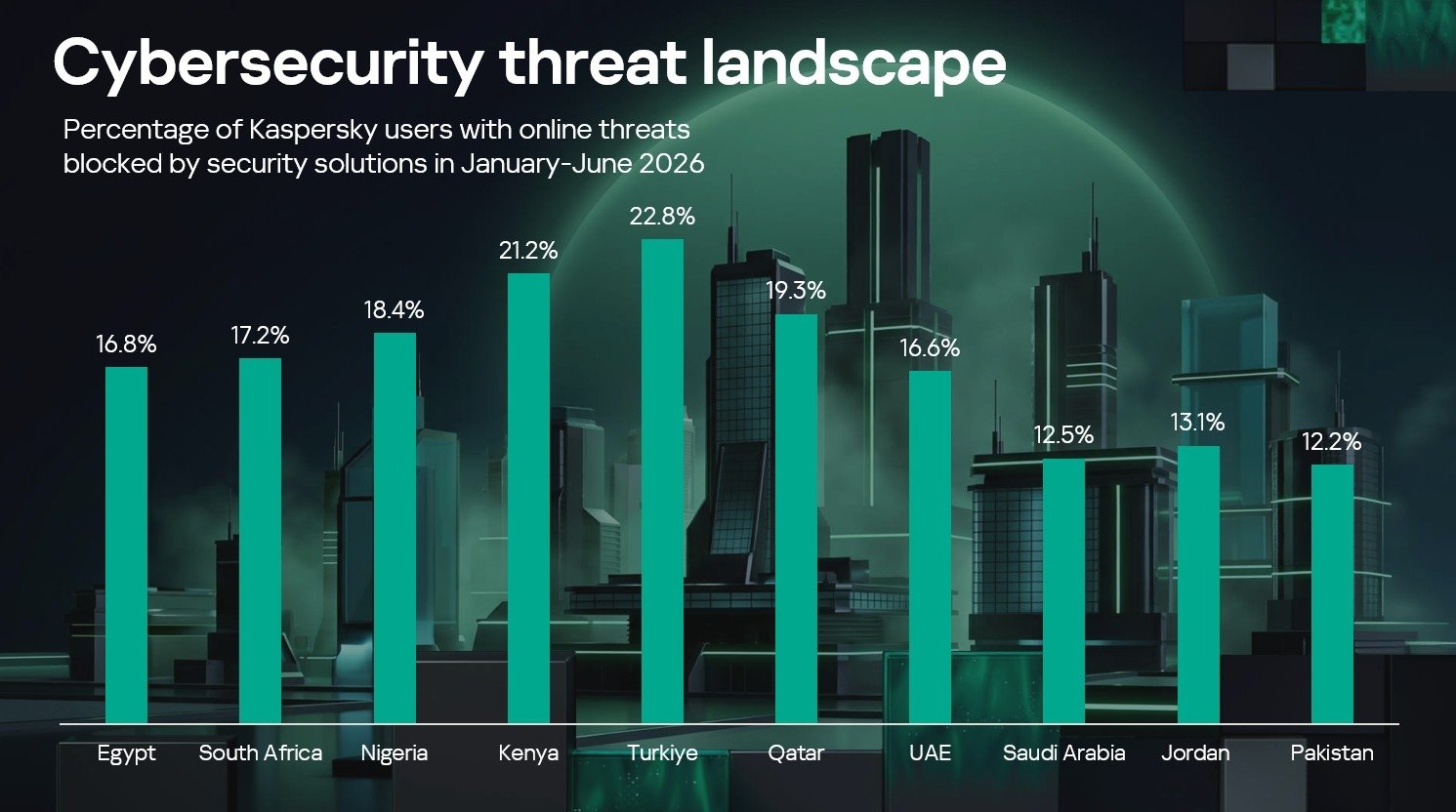
According to data collected by Kaspersky's security solutions, nearly one in four internet users in Türkiye encountered and blocked at least one online threat during the first six months of 2026.
This rate was the highest among the 10 countries included in the comparison and placed Türkiye well ahead of the rest of the region.
Sergey Lozhkin, head of Kaspersky GReAT for the Asia-Pacific and META regions, notes that the world of cybersecurity has been in a state of constant evolution over the past 20 years.
Today, he says, the direction of this evolution has shifted entirely toward artificial intelligence.
According to Lozhkin, cybercrime organizations, particularly ransomware groups, are now conducting preliminary intelligence-gathering activities against target organizations entirely through automated AI systems.
Using artificial intelligence, the profiles of company employees, HR departments and senior executives are analyzed in a matter of seconds to create fake employee accounts on professional social networks, primarily LinkedIn.
Nearly 100% of the preparatory stages for these targeted social engineering traps in 2025 and 2026 are said to have been carried out entirely with AI support.
Traces of AI are clearly evident not only in "stealer" malware developed by ordinary criminal groups but also in the sophisticated targeted attack code used by state-sponsored cyber groups.
As attacks accelerate, the balance of cybersecurity budgets has been thrown into disarray.
Companies are shifting their budgets toward this area after witnessing the tremendous efficiency gains provided by artificial intelligence. However, due to high costs, annual budgets for integrating AI into cybersecurity can be depleted in as little as two to three months, much like an addiction.
Kaspersky's Lozhkin states that those who do not effectively utilize AI in cybersecurity software will definitely lose the game. He noted that he had increased his personal productivity tenfold thanks to AI agents that incorporate his 15 years of cybersecurity expertise.
According to Lozhkin, over the next two to three years, the cyber world will become a battleground for "AI vs. AI" wars, with virtually no human intervention.
The effects of autonomous cyber warfare are also directly reflected in geographic data.
According to Kaspersky's "Cybersecurity Threat Landscape" data covering the January-June 2026 period, Türkiye ranked first in the META region as the country most exposed to cyber threats.
It said 22.8% of users in the country had online threats blocked by security solutions.
When Nvidia, Microsoft and Arm simultaneously posted "A new era of PC" across social media, it was more than a marketing campaign. Now, beginning in late 2026 and expanding through early 2027, the first PCs powered by Nvidia's N1X processor are expected to arrive from manufacturers including Lenovo, Asus, MSI, HP, Dell and Microsoft's Surface lineup.
Imagine you have a car that's been using the same engine for years to get around town: it's powerful but a bit of a gas guzzler, it overheats, and the battery (fuel) runs out quickly.
One day, the manufacturer comes along and says, "We're replacing this engine with a brand-new one that not only uses much less fuel but also features an ‘AI brain' with nearly supercomputer-level processing power."
The list of partners featured in Nvidia's Computex announcement was quite extensive. The brands set to launch the first devices powered by the Arm-based N1X processor will be Dell, Asus, Lenovo, MSI, HP and Microsoft's Surface line.
According to Nvidia's own statement regarding the timeline, the first devices are expected to hit the market in the fall of 2026, approximately September or November.
However, some industry sources expect them to be ready in time for the 2026 holiday shopping season, with a wider variety of models not expected until the first months of 2027.
Let's take a quick look at the technical side of the chip: The N1X combines a 20-core Arm processor (think of it as your computer's "muscles") with a Blackwell-architecture graphics unit – the "AI brain" – on the same chip, at the level of a desktop-class RTX 5070.
Instead of being two separate rooms connected by cables, as is typical in a classic laptop, these two components live right next door to each other on the same chip and can exchange 300 GB of data per second.
The result: higher AI and graphics performance while consuming less power.
The first devices will come in the form of extremely thin laptops, just 14 millimeters thick (about half a centimeter!), and some small desktop models.
In other words, Nvidia is primarily targeting content creators, AI developers, and users looking for thin-and-light laptops with this chip; this isn't a classic "for every budget" launch.
Of course, there's also the other side of the coin: The N1X runs on the Arm architecture, not x86. This can require "translation" (emulation), especially for older games that haven't been adapted for Arm and certain professional software.
Just like reading a menu in a foreign country with a translation app, it usually works, but sometimes there can be lag or glitches.
A challenge similar to Apple's move with its own chips is coming to the laptop world, where Intel and AMD have reigned for years. This time, the challenger is Nvidia, which is already the king of the graphics card side of the game.