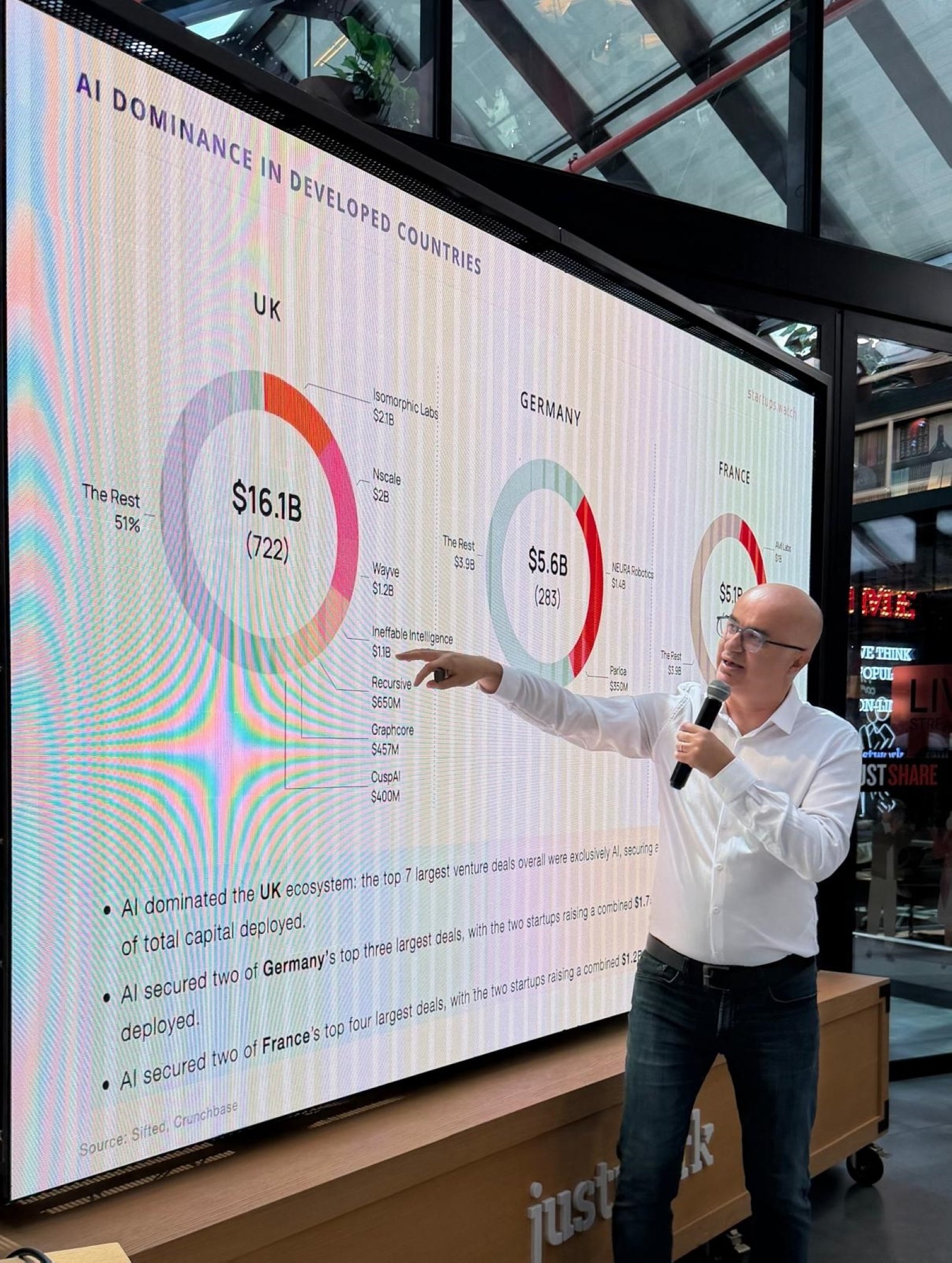
A total of $172 million was invested across 87 funding rounds in Türkiye during the first half of 2026, according to new data released by industry monitor startups.watch. The figures highlighted both the continued strength of the country's gaming ecosystem and the challenges facing other sectors seeking growth capital.
The findings were presented at startups.watch's 2026-Q2 Türkiye startup ecosystem event, where industry participants discussed current market trends and the future direction of the country's venture capital landscape.
According to the report, six startups alone, namely Grand Games, TaleMonster Games, Fimple, Lucida, Dataroid and Brix, accounted for 75% of all investment capital raised during the period.
Commenting on the findings, startups.watch founder Serkan Ünsal said the gaming industry continues to be the primary driver of Türkiye's startup market.
Of the $172 million invested during the first six months of the year, $111.4 million flowed into gaming startups, representing nearly 65% of total funding activity.
"There is an elephant in the room that nobody talks about," Ünsal said. "At the moment, gaming startups are still carrying the entire ecosystem."
The contrast is particularly striking in financial technology, or fintech, historically one of Türkiye's strongest startup verticals. After attracting $220.4 million in investment during 2025, the sector secured only $16.6 million in the first half of 2026.
While artificial intelligence continues to dominate venture capital flows across Europe, Türkiye remains at a much earlier stage of development.
Ünsal noted that 49% of the $16.1 billion invested in the United Kingdom during the first half of the year was concentrated in just seven large AI companies. By comparison, 33 Turkish AI startups raised a combined $28.6 million during the same period.
According to Ünsal, Türkiye is still in the early stages of building its AI ecosystem. To compete internationally, the country will eventually need to produce large-scale funding rounds measured in hundreds of millions, or even billions, of dollars.
Among the speakers at the event was Tuğrul Tekbulut, founder of Logo Software and a serial entrepreneur, who shared lessons from the international growth journey of cybersecurity company Timus Networks.
Tekbulut argued that while Turkish startups generally have little difficulty securing seed funding, many encounter significant financing challenges once they reach Series A and growth stages.
He described this challenge using what he called the "waiter-height" problem, a situation in which companies become too large for early-stage investors but remain too small to attract the attention of major international growth investors.
"For seed investors, you become an expensive company," Tekbulut said. "But when you approach international investors, you often fall below their preferred investment window. You end up stuck in between."
Tekbulut emphasized that Turkish entrepreneurs are capable of building globally competitive technologies, but argued that domestic venture capital firms must become more willing to support startups through riskier growth phases.
According to him, investors need to accept the possibility of failure while providing the larger pools of capital required to build internationally scalable businesses.
He also shared insights from Timus Networks' successful exit strategy, explaining that the company separated its domestic and international operations. The business retained its activities in Türkiye, Azerbaijan and the Turkish Republic of Northern Cyprus (TRNC) while selling its global operations at a higher valuation.
TT Ventures, the venture capital arm of Türk Telekom, is increasingly focusing its startup investments on artificial intelligence technologies as the telecommunications industry expands beyond network infrastructure into technology development and venture investing.
Startups that have graduated from TT Ventures' Pilot accelerator have collectively raised $58 million from investors, while their combined portfolio value has exceeded $600 million.
As AI becomes a central driver of the global economy, telecom operators worldwide are evolving from infrastructure providers into technology developers and startup investors.
While major international operators are committing billions of dollars to AI initiatives, TT Ventures has established itself as one of Türkiye's leading corporate venture investors through its Pilot accelerator program and broader investment activities.
Since its launch, the program has provided a total of $3.2 million in cash funding and investment support to 131 startups. Of these, 78 graduates have gone on to secure a combined $58 million in follow-on funding from external investors.

Together, those companies are now valued at more than $600 million.
As TT Ventures launches the 14th term of the Pilot, the primary focus will be on artificial intelligence, generative AI, cybersecurity, cloud technologies, digital health, mobility, energy technologies and next-generation communications solutions.
Beyond providing early-stage funding, the program offers startups access to Türk Telekom's broad customer base, opportunities for commercial partnerships, mentoring, technical infrastructure and support for international expansion.
The surge in investor interest in AI startups over the past two years has also shaped TT Ventures' investment strategy.
The company sees significant opportunities for startups developing generative AI solutions across customer experience, network management, cybersecurity, operational automation and enterprise productivity within the telecommunications sector.
As a result, AI-driven startups are expected to feature prominently among applicants in the new accelerator cohort.
For telecom operators, artificial intelligence is no longer viewed only as an emerging technology but also as a strategic investment opportunity. Alongside deploying AI to optimize networks, enhance customer service, detect fraud and manage data centers, operators are increasingly investing directly in the startups developing these technologies.
A generative AI solution developed by Cerebrum Tech for Doğa Sigorta is now handling workloads equivalent to twice that of five employees, illustrating how artificial intelligence is reshaping operations across the insurance industry by improving efficiency rather than replacing expertise.
Banking, financial services and insurance are among the sectors being transformed most rapidly by artificial intelligence. One example is the solution jointly developed by Doğa Sigorta and its technology partner Cerebrum Tech to streamline internal operations and improve employee productivity.
The platform, called ODIS (Focused Digital Communication Processing System), uses AI to instantly compile responses to complex customer and agency inquiries by bringing together policy information, claims histories and other relevant records.
According to Bahar Eren of Doğa Sigorta's Information Technologies Department, creating insurance policies requires employees to follow a large number of complex rules, making the process highly labor-intensive when handled manually.
Explaining the company's digital transformation efforts, Eren said Doğa Sigorta set out to create a digital twin of these operational processes. The AI platform, developed with Cerebrum Tech and in use for approximately eight months, has significantly exceeded initial expectations.
"We originally implemented this application to distribute the workload of five employees," Eren said. "Today, it is capable of handling work equivalent to twice the workload of those five people on its own. That has been a tremendous achievement for us."
Eren said the system has reduced the time employees spend gathering engineering and operational data to around one minute.
The biggest benefit, she added, is that employees are no longer required to work beyond regular office hours.
She also offered a practical lesson for organizations embarking on similar AI projects, noting that preparing and organizing the data required to train AI models can take as much time and effort as software development itself.
Tolga Tunç, an executive at Cerebrum Tech, said the company was building agentic AI infrastructure that was becoming directly integrated into organizations' daily operations and decision-making processes.
For highly regulated industries such as finance and insurance, data sovereignty is a critical consideration, he said. Through a partnership with NGN, Doğa Sigorta's data is processed within a secure domestic infrastructure without leaving Türkiye, he added.
Tunç summarized the project's collaborative approach by saying, "We didn't provide Doğa Sigorta with insurance expertise – they provided us with insurance expertise, while we contributed the AI know-how."
He explained that Cerebrum Tech's team effectively attended a crash course in insurance, learning industry terminology and operational practices directly from company employees before developing the solution.
According to Tunç, one of the main reasons employees adopted the platform so quickly was that it integrates directly into existing workflows rather than requiring users to switch to separate applications or interfaces.
He also addressed the growing cost of operating large AI models, including hardware requirements and API token consumption.
Tunç argued that AI should evolve beyond being viewed simply as an emerging technology and instead deliver measurable business outcomes by increasing revenue, improving productivity and reducing operating costs.
Artificial intelligence is becoming an increasingly popular tool for planning holidays and business trips, but its growing role is also creating new cybersecurity risks.
While users are turning to AI to save time and find better travel deals, security experts warn against phishing attacks, fake information and the careless sharing of personal data.
Global cybersecurity company Kaspersky has released the findings of a study examining why active AI users are increasingly relying on chatbots to manage important tasks such as vacation and travel planning.
The research suggests that AI has become an indispensable travel assistant for many consumers, while highlighting the need for greater vigilance against cyber threats and misinformation.
Today, travelers can generate highly personalized itineraries tailored to their preferences in just a few clicks using AI-powered assistants.

However, cybersecurity experts caution that information provided by chatbots should always be verified through trusted sources. Previous cases have shown that travelers who relied exclusively on AI-generated recommendations without conducting independent research have encountered inaccurate information and travel disruptions.
One of the biggest risks involves hyperlinks generated by AI systems. In some cases, chatbots may produce links leading to malicious or phishing websites.
Experts recommend scanning links with reputable cybersecurity solutions that include phishing protection, such as Kaspersky Premium, before clicking on them.
AI is increasingly being used not only to gather travel information but also to assist with hotel reservations, transportation bookings and other travel-related transactions.
As a result, users may be asked to share sensitive personal information, including their name, contact details and payment information, with AI-powered services.
According to Kaspersky's research, however, many users remain cautious about entrusting their personal data to AI systems. Despite the convenience these tools offer, concerns over data privacy and security continue to represent one of the biggest barriers to wider adoption of AI-driven travel planning.