German travelers flying to far destinations in Asia and Africa are increasingly choosing Istanbul and Gulf airports over Frankfurt and Munich, driven by higher European climate charges and rising German aviation costs, according to a report on Monday.
"Air travelers generally have a wide range of options on which airline to take to a long-haul destination," said the report by German aviation organizations, adding that Istanbul, Doha, and Dubai are increasingly preferred as their fares are lower and their connections are wider.
Transfers through non-EU hubs rose to 54% of all passenger traffic from Germany to the Far East and Southeast Asia in 2024, according to the joint study by the Federal Association of German Aviation Industry (BDL) and the German Aerospace Center (DLR). Those figures were up from 43.8% in 2019 and 33.7% in 2010.
Connecting traffic through airports in Türkiye and the Gulf saw the sharpest gains, more than doubling from 12.6% in 2010 to 28.2% in 2024.
Over the same period, direct flights from Germany and transfers through domestic hubs combined tumbled from 56% to 36%.
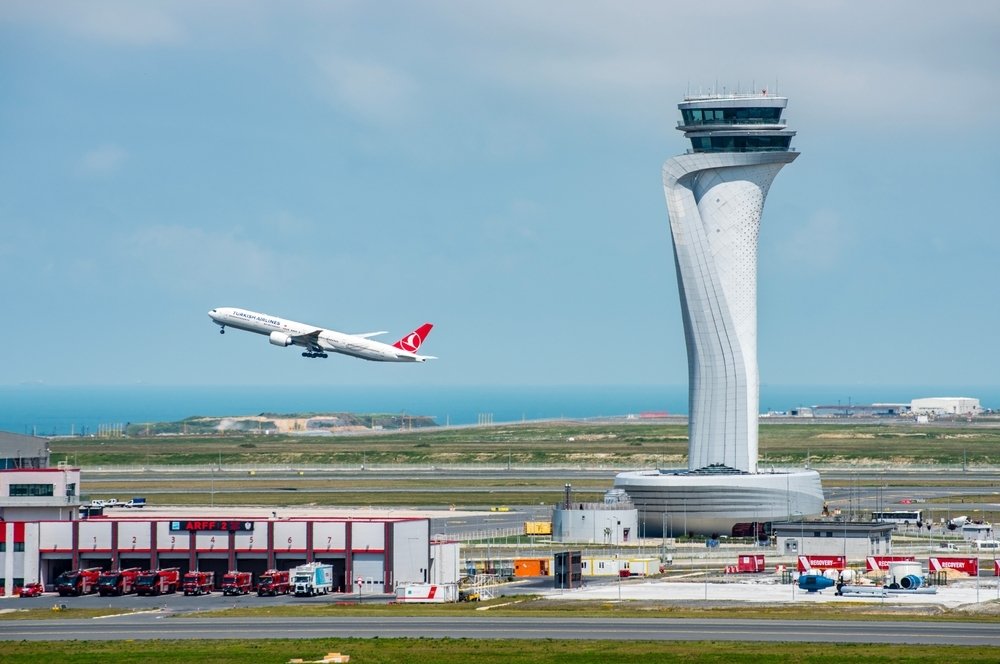
The report singled out Turkish Airlines and Istanbul’s new mega-airport, alongside the Gulf’s leading hubs-Dubai and Doha as key drivers of the shift.
Beyond offering lower fares, these hubs often streamline travel itineraries-allowing passengers to reach destinations as far as Australia with a single layover, compared to two connections when flying via Western Europe.
Rising climate charges, higher government taxes, and mounting operating fees have steadily inflated ticket prices for flights originating in Western Europe.
Facing broad carrier choices-such as flying Lufthansa via Frankfurt, Turkish Airlines via Istanbul, or Emirates via Dubai-price-sensitive travelers are routinely opting for more affordable non-EU options, according to the report.
The same shift was not limited to flights toward Asia and was also visible on routes between Germany and Africa, where, excluding Mediterranean states, transfers through Türkiye and the Gulf climbed from 11% in 2010 to 23.4% in 2019 and 32% in 2024.
The report also said Germany’s position as a leading air-freight hub was at risk, because more cargo bound for the country is being handled at airports abroad. "Frankfurt Airport, for instance, has lost its top spot in Europe to Istanbul Airport,” it said.
BDL Chief Executive Joachim Lang warned that Germany is slowly disconnecting from international air networks as passengers and cargo are shifting to hubs outside Western Europe.
"For an exporting nation, this poses a serious challenge to its competitiveness as a business location," he said.
"Moreover, nothing is gained for the climate if emissions are merely shifted elsewhere. We need lower location costs and a level playing field on climate protection regulations so that the same conditions apply to all competitors."