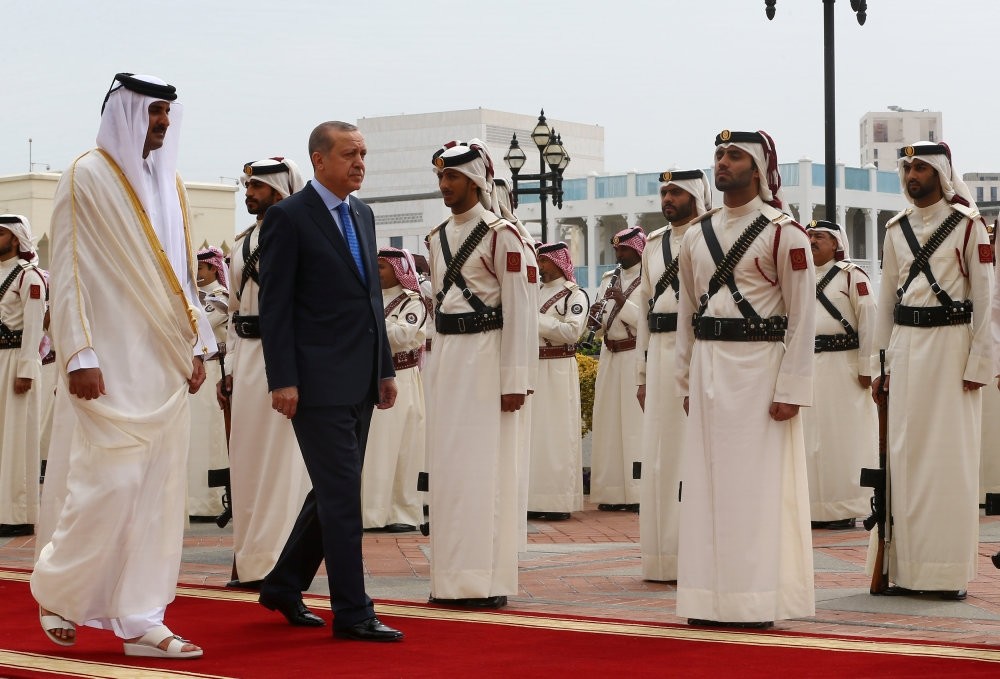
To provide permanent peace and stability in the Gulf and Middle East regions, strengthening economic relations and counterterrorism efforts as well as mutual collaboration among the regional countries is an absolute must
President Recep Tayyip Erdogan's recent visit to the three Gulf countries of Bahrain, Saudi Arabia and Qatar comes at a critical juncture in the Gulf region and the Middle East. The current global disorder and regional rivalry for power has taken its toll on the political architecture and ordinary citizens of the Middle East and the larger Muslim world. There is an urgent need to establish power equilibrium to address the pressing security and economic challenges and avoid new conflicts. This can happen only when the key stakeholders initiate a new period of intra-regional solidarity and claim their regional ownership.
The Gulf region, like the rest of the world, is not immune to the corroding effects of globalization gone astray. While global interdependence has brought blocks of countries in Europe and the United States closer to one another, it has dismantled old alliances and sowed seeds of conflict and war in other parts of the globe, including the Muslim world. Since the end of the Cold War, the search for a global balance of power has not produced a new order. The Bosnian war, the Rwanda genocide, Iraq's invasion of Kuwait and the first Gulf War, the U.S. led invasions of Afghanistan and Iraq following 9/11, the Russian annexation of Crimea, the wars in Libya, Yemen and Syria and the rise of militia groups and non-state actors, inter alia, point to the extremely fragile nature of the post-Cold War period. These conflicts, regardless of their reasons or manipulators, call for closer cooperation among Middle East nations. Furthermore, the rise of violent extremism in the form of al-Qaeda and Daesh on the one hand, and the deepening sectarian conflict between Sunni and Shia Muslims on the other, require a long-term vision and wise political leadership. Muslims cannot let violent extremism and sectarianism define their faith and destroy their future. Speaking at the International Peace Institute in Bahrain, President Erdoğan reiterated his commitment promoting peace and stability in the Middle East and warned, "We cannot leave our future at the mercy of others."
Regional ownership calls for dealing with the challenges and crises of the Middle East and the Muslim world through strengthened dialogue in the fields of security and economic cooperation. This does not mean turning our back on the rest of the world. No form of "third worldism" and turning inside would work in the increasingly sophisticated and multi-polar world in which we live. To the contrary, regional ownership encourages openness to the world, but this can generate a win-win situation only when regional problems are no longer there for others to manipulate to their advantage. Turkey pursues a policy of mutual empowerment with its neighbors and the larger Muslim world. It seeks regional solutions to regional problems. Getting our priorities right is a step in the right direction to cultivate win-win relationships that contribute to the growth and security of our peoples. Ending violent extremism and sectarian conflict is possible only when we realize that power equilibrium is in the interest of all parties. As we have seen in recent conflicts, seeking undue influence through proxies in other countries hurts everyone. No one can claim victory in self-defeating conflicts.
Over the last decade, Turkey developed a wide-ranging relationship with the Gulf countries. Its current trade volume with Gulf Cooperation Countries (GCC) is a little over $16 billion. Given the economic potential, this is not sufficient but can serve as a basis for further cooperation in trade, energy, tourism, the defense industry, science and technology and education. The Turkey-GCC High Level Strategic Dialogue mechanism established in 2008 in Jeddah has helped realize new potential but ought to be further activated to create new opportunities. Turkey pays close attention to the security priorities and economic outlook of the GCC countries and supports regional initiatives to resolve conflicts in Yemen, Bahrain, Lebanon, Iraq, Syria and elsewhere.
Talks concerning a free trade agreement between Turkey and the GCC are underway and can be signed this year under the Bahraini term presidency. This approach is reciprocated by the GCC countries, which understand Turkey's security concerns over the PKK and FETÖ and have declared both as terrorist organizations. Saudi Arabia, Qatar and Bahrain, in particular, have taken a number of steps to stop the activities of FETÖ institutions and individuals in their countries. Fighting Daesh and other terrorist organizations ideologically and militarily is also a common goal shared by all parties. Equally important are the joint efforts to prevent the coupling of Islam with violence and terrorism by extremists in the Muslim world and Western countries. Turkey, Saudi Arabia and Qatar are working closely to resolve the conflict in Syria and help establish peace and security in Iraq. Closer cooperation among the countries of the region will help us all utilize our own resources for the peace and welfare of our people. Global challenges require a global outlook, but this must be complemented by regional partnerships and alliances at the same time. Without an anchor point in one's own habitat, no one can sail safely in a world of disorder and instability.
About the author
İbrahim Kalın is the head of Türkiye’s National Intelligence Organization (MIT).
The views and opinions expressed in this article are solely those of the author. They do not necessarily reflect the editorial stance, values or position of Daily Sabah. The newspaper provides space for diverse perspectives as part of its commitment to open and informed public discussion.
Keep up to date with what’s happening in Turkey,
it’s region and the world.
You can unsubscribe at any time. By signing up you are agreeing to our Terms of Use and Privacy Policy.
This site is protected by reCAPTCHA and the Google Privacy Policy and Terms of Service apply.