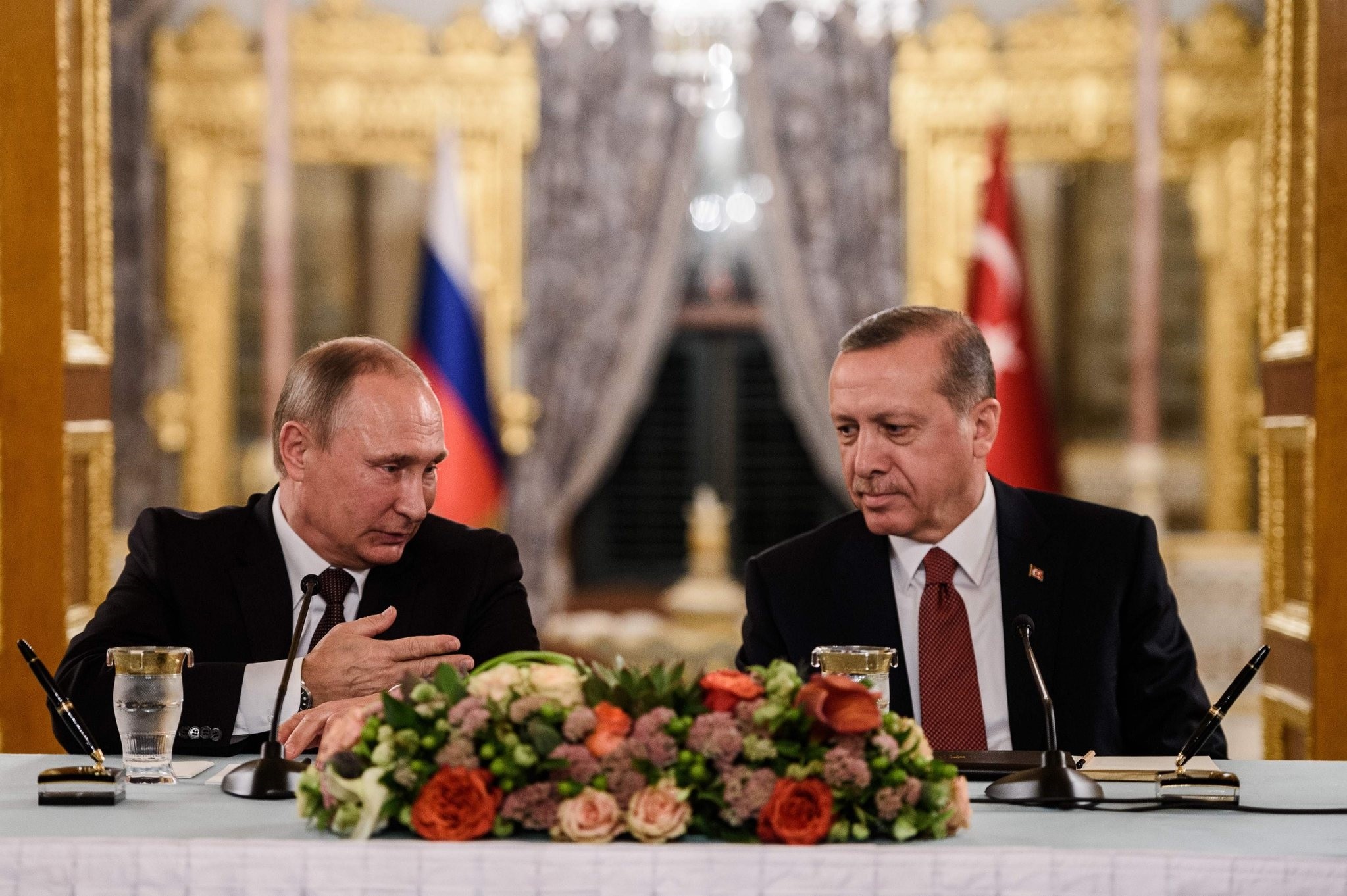
President Recep Tayyip Erdoğan and his Russian counterpart Vladimir Putin discussed the latest developments in Syria by phone late Thursday and agreed to investigate the recent chemical attack believed to have been carried out by the Assad regime, according to the Presidency.
During the conversation, the two leaders highlighted the importance of joint efforts by Ankara and Moscow to continue the work of the Geneva and Astana peace talks. The Idlib chemical attack on April 4, which killed more than 100 civilians and injured around 500 other people, topped Thursday's discussion, a Presidency source added.
Both leaders agreed to work together to sustain the Syria cease-fire in general and backed an investigation by the Organization for the Prohibition of Chemical Weapons (OPCW) into the Idlib incident.
Putin and Erdoğan also agreed that the normalization of ties between their two countries should be accelerated.
Meanwhile, Turkey's decision to purchase S-400 surface-to-air missile systems from Russia is to be finalized soon, Defense Minister Fikri Işık said on Thursday after meeting his U.S. counterpart James Mattis at the Pentagon.
Speaking to reporters before the meeting, Işık said Turkey urgently needs an air defense system, and the final decision to buy the S-400 systems will be made by President Erdoğan and Prime Minister Binali Yıldırım.
The S-400 was developed as an upgraded version of the S-300 series of surface-to-air missile systems. The system entered service in April 2007 and the first S-400 was deployed in combat in August 2007. According to sources within the defense industry, a regular S-400 battalion consists of at least eight launchers with 32 missiles and a mobile command post.
The system can engage all types of aerial targets, including aircraft, unmanned aerial vehicles (UAV) and ballistic and cruise missiles within a range of 400 kilometers (249 miles), at an altitude of up to 30 kilometers. The S-400 systems are capable of firing three types of missiles to create a layered defense, and the system can be deployed within five minutes, while simultaneously engaging 36 targets.
As a NATO-member, Turkey's procurement of the Russian S-400 system has raised concerns regarding the compatibility and integration of these weapons into the NATO infrastructure. Minister Işık clarified last month that Turkey will use the Russian systems without integration, noting: ''Russia's S-400 missile systems will not be integrated into the NATO system.''
Minister Işık also said the Russian missile system will be used to fulfill Turkey's immediate requirements, while stressing that the uncompromising attitude of NATO-member countries compelled Turkey to purchasing Russia's S-400 missile defense system.
The first foreign buyer of Russian S-400 missile systems was China and the corresponding contract between Moscow and its southeastern neighbor was reportedly signed in the spring of 2015. According to media reports, the deal cost $3 billion. In October 2016, Russia also signed an intergovernmental agreement on S-400 supplies with India.
Turkey's long-known desire to purchase a long-range air missile defense system has been a hot topic since 2013. In September 2016, Turkey's military procurement agency, the undersecretariat for the Defense Industry (SSM), chose the China Precision Machinery Import-Export Corporation's (CPMIEC) FD-2000 (HQ-9) long-range air and missile defense system over American and European competitors, after speculation that Turkey held talks with the French-Italian consortium Eurosam regarding the SAMP/T Aster 30 missile defense system.
President Recep Tayyip Erdoğan and his Russian counterpart Vladimir Putin discussed the latest developments in Syria by phone late Thursday and agreed to investigate the recent chemical attack believed to have been carried out by the Assad regime, according to the Presidency.
During the conversation, the two leaders highlighted the importance of joint efforts by Ankara and Moscow to continue the work of the Geneva and Astana peace talks. The Idlib chemical attack on April 4, which killed more than 100 civilians and injured around 500 other people, topped Thursday's discussion, a Presidency source added.
Both leaders agreed to work together to sustain the Syria cease-fire in general and backed an investigation by the Organization for the Prohibition of Chemical Weapons (OPCW) into the Idlib incident.
Putin and Erdoğan also agreed that the normalization of ties between their two countries should be accelerated.
Meanwhile, Turkey's decision to purchase S-400 surface-to-air missile systems from Russia is to be finalized soon, Defense Minister Fikri Işık said on Thursday after meeting his U.S. counterpart James Mattis at the Pentagon.
Speaking to reporters before the meeting, Işık said Turkey urgently needs an air defense system, and the final decision to buy the S-400 systems will be made by President Erdoğan and Prime Minister Binali Yıldırım.
The S-400 was developed as an upgraded version of the S-300 series of surface-to-air missile systems. The system entered service in April 2007 and the first S-400 was deployed in combat in August 2007. According to sources within the defense industry, a regular S-400 battalion consists of at least eight launchers with 32 missiles and a mobile command post.
The system can engage all types of aerial targets, including aircraft, unmanned aerial vehicles (UAV) and ballistic and cruise missiles within a range of 400 kilometers (249 miles), at an altitude of up to 30 kilometers. The S-400 systems are capable of firing three types of missiles to create a layered defense, and the system can be deployed within five minutes, while simultaneously engaging 36 targets.
As a NATO-member, Turkey's procurement of the Russian S-400 system has raised concerns regarding the compatibility and integration of these weapons into the NATO infrastructure. Minister Işık clarified last month that Turkey will use the Russian systems without integration, noting: ''Russia's S-400 missile systems will not be integrated into the NATO system.''
Minister Işık also said the Russian missile system will be used to fulfill Turkey's immediate requirements, while stressing that the uncompromising attitude of NATO-member countries compelled Turkey to purchasing Russia's S-400 missile defense system.
The first foreign buyer of Russian S-400 missile systems was China and the corresponding contract between Moscow and its southeastern neighbor was reportedly signed in the spring of 2015. According to media reports, the deal cost $3 billion. In October 2016, Russia also signed an intergovernmental agreement on S-400 supplies with India.
Turkey's long-known desire to purchase a long-range air missile defense system has been a hot topic since 2013. In September 2016, Turkey's military procurement agency, the undersecretariat for the Defense Industry (SSM), chose the China Precision Machinery Import-Export Corporation's (CPMIEC) FD-2000 (HQ-9) long-range air and missile defense system over American and European competitors, after speculation that Turkey held talks with the French-Italian consortium Eurosam regarding the SAMP/T Aster 30 missile defense system.