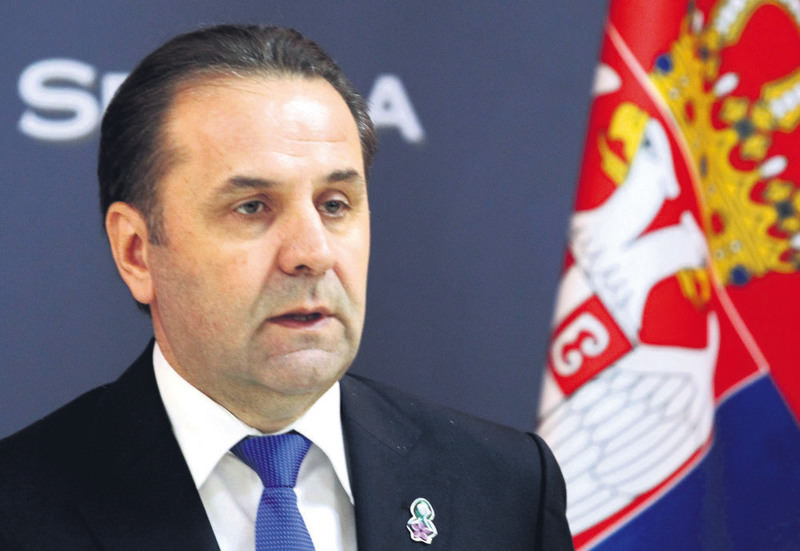
Serbian Deputy PM Ljajic invites Turkish investors
by Hayrettin Turan
BELGRADEDec 26, 2015 - 12:00 am GMT+3
by Hayrettin Turan
Dec 26, 2015 12:00 am
Aiming to become a trade hub through signing free trade agreements, wipe away the impact of long years of war and rear up its economy, Serbia introduced a series of reforms and enacted laws to attract foreign investors
The Balkan countries lost their energy as the 1990s were spent in wars and internal conflicts, yet they have been taking fast steps to sustain peace in the last few years. Serbia is one of the countries that has declared a kind of mobilization to ensure that its economy and image recover. Serbia is on the verge of a turning point as it has signed free trade agreements with the European Union, Russia, the Balkan countries and Turkey. In this framework, Serbia introduced a series of reforms and incentives to attract foreign investors. Various companies were privatized to reduce the unemployment rate of around 20 percent, which is Serbia's greatest problem, and foreign investors are provided great convenience.
Daily Sabah met with Rasim Ljajic, the native-Bosnian Deputy Prime Minister of Serbia, before Prime Minister Ahmet Davutoğlu's official visit next week. The leader of the Social Democratic Party of Serbia, a partner in the coalition government, Ljajic sent warm messages to Turkish businessmen, saying, "We are ready to give all the support we can."
Daily Sabah: What can you tell us about the economy of Serbia for those who do not know Serbia very well?
Rasim Ljajic: Serbia's economy suffered greatly from wars and other incidents. The inflation went up to 300 or even 400 percent in the 1990s. Our relations were also badly influenced. We can say the overall cost of the wars to Serbia was more than $30 billion. That's why we are working on the recovery of our economy, and we initiated the privatization process a few years ago. Very large factories and enterprises have been privatized. The process is still ongoing but will be completed by the end of 2016. We have started to reap the fruits of the reforms made. Inflation started to decrease, and we have been able to lower it to 3 or 4 percent. The budget deficit went from 7.9 percent to 3.5 percent. We are currently in the consolidation process. We have changed the laws on investment and employment completely. We have also introduced laws for privatization. We have made changes to the bankruptcy law and introduced new regulations. We are currently working on the law for foreign investors, and it will be enforced soon. Our greatest problem is unemployment. Unemployment is a huge problem and is around 17.9 percent. Our second problem is failure to complete the privatization process. We have more than 500 enterprises which will be privatized.
D.S.: What is the total volume of privatization and the revenue generated to date?
R.L.: Very low revenue, very, very low. Why? Because the valuable enterprises have already been sold. The remaining enterprises are in a very bad condition. They are not that valuable. They work at less capacity.
In some Balkan countries, there were several practices. Businessmen were asked "to pay the salaries of workers, insurance premiums, taxes, electricity and water bills that were unpaid by companies that had gone bankrupt or were about to go bankrupt," and they were promised "to be given those companies." Were such methods implemented in Serbia or will they be implemented during the privatization process?
If the privatization process is completed or cancelled, then there could be companies on the verge of bankruptcy. In such a situation, investors will buy these companies. There is a model that we have been using to date. We also tell some of the investors, "The company is ours, but you can take and use it for 99 years." In other words, it is a type of build, operate and transfer model. We are ready to give these companies to investors. However, we have certain conditions. There needs to be a certain investment cost, and the company should create a certain amount of employment.
D.S.: What kind of companies are these 500 enterprises to be privatized? In which sectors do they operate?
R.L.: There are chemistry, metal and textile facilities. The number of food factories is low. These are more or less the companies in which old technology is used. We are talking about large, public enterprises in former Yugoslavia.
D.S.: So you are going to rent these facilities for 99 years?
R.L.: This is only one of the models. We will first look into what we can sell. We are going to implement other models for those that cannot be sold.
D.S.: Turkish companies also took part in the privatization process. What is the latest situation?
R.L.: We see serious and widespread interest shown for the first time by Turkish investors. For example, a company called Teklas Kauçuk (Teklas Rubber) came and purchased a plant here. There are also companies from the automotive sector. They are going to open factories in Serbia in the automotive industry to produce spare parts for automobiles. Romanian companies also came for this sector. There are several companies seriously interested in the textile industry. They are going to make an acquisition according to one of these methods through the end of the year. I hope we sign an agreement with them. The entry of Halkbank in Serbia paved the way for other Turkish investors.
D.S.: You have contributed significantly to the acquisition of Canska Bank by Halkbank...
I wanted Halkbank to come to Serbia, and I fought for it because I believed that other Turkish companies would come once Halkbank entered the market, and that's what happened. Halkbank purchased around 75 percent of Čačanska Bank for around 10 million euros. It is going to increase capital, and they will do so by acquiring the shares of small-scale shareholders. I would like to especially emphasize a few things. As a very strong bank in Turkey, Halkbank made an investment in Čačanska Bank. This operation builds confidence in Turkish investors. There is also going to be competition in the banking sector. Halkbank in Macedonia provides SMEs loans of up to 30 percent of the whole banking sector. We expect the same to be offered in Serbia. We believe that Halkbank can give significant support to SMEs. We also expect Halkbank to open around 100 branch offices all around Serbia.
D.S.: How did Turkish investments influence Turkey-Serbia relations?
In addition to Halkbank, Beko also opened an office in Belgrade, serving as the headquarters for the whole Balkan region. The Beko office for the former Yugoslavian countries is in Belgrade. These investments have had a positive impact on Turkey-Serbia relations. For example, Turkish TV series are the ones watched the most here. Serbian tourists who visit Turkey come back with positive impressions. In other words, they have depicted a picture of Turkey different from what people used to think. For example, the total number of Serbian tourists who visited Turkey in 2014 was 180,000. It is more than 200,000 people this year. Turkey is the first destination after Greece for Serbian tourists. The number of Turkish tourists who visited Serbia in the first seven months of this year has increased by 40 percent, and 27,530 Turkish citizens visited Serbia in the first half of the year. It is interesting that the Turkish Pharmacists Conference was held for the first time in Belgrade, and it lasted 15 days. Another important thing is that around 150,000 Turkish TIRs pass through Serbia every year on their way to Europe. The similarities between our cultures are quite high. This means Serbian people have started to like Turkey, and Turkish people have started to like Serbia.
Keep up to date with what’s happening in Turkey,
it’s region and the world.
You can unsubscribe at any time. By signing up you are agreeing to our Terms of Use and Privacy Policy.
This site is protected by reCAPTCHA and the Google Privacy Policy and Terms of Service apply.