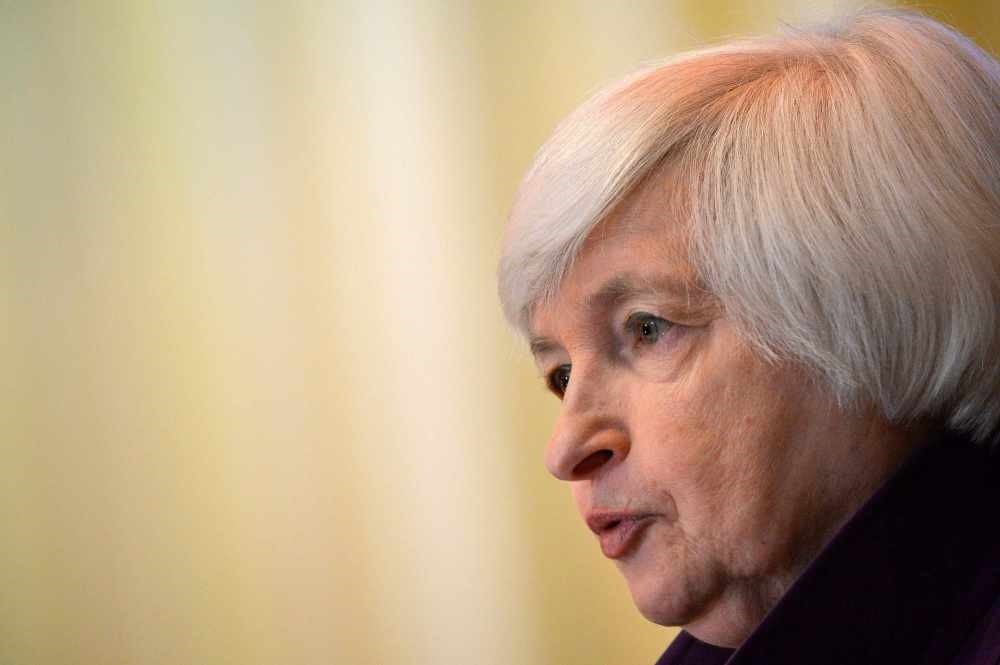
After the latest messages coming out of the U.S. Fed and weak economic data, the U.S. Fed is expected to retain its policy rate. However, the possibility of a rate hike this year is seen more likely
The latest statements by U.S. Federal Reserve (Fed) authorities coupled with weak economic data point to a possible gathering in Washington for the two-day Federal Open Market Committee (FOMC) meeting.
FOMC members who remained silent for a week as required by law are now revealing in their latest statements that the U.S. economy is moving toward with "the right consistency" for an interest rate hike while some FOMC members emphasized the idea of a cautious approach.
Ten FOMC members will decide which party - known as "hawks" and "doves" in their respective markets - will dominate the other. Of the 10 members who have the right to vote, seven of them including Fed Chair Janet Yellen who has a say in monetary policies made "dovish" remarks, while the remaining three made "hawkish" statements.
After a long period of silence, Yellen said during a conference in Jackson Hole on Aug. 26 that "Indeed, in light of the continued solid performance of the labor market and our outlook on economic activity and inflation, I believe the case for an increase in the federal funds rate has strengthened in recent months."
Although Yellen's message consolidated the possibility of an interest rate hike before the end of the year, it did not give a clue about timing. The markets interpreted the message, saying that the wait-and-see strategy might be maintained at the September meeting.
Global investors expect that Yellen will point to a specific meeting as she did last year before launching an interest rate hike. Early last October, Yellen gave a clear signal for the timing of an interest rate hike, saying that the December meeting would be a vivid possibility for an interest rate increase.
In his latest press statement on Aug. 30, Fed Vice Chair Stanley Fischer highlighted that the U.S. economy was closer to the achievement of objectives, saying that the employment data and sectoral indicators would determine whether interest rates would be increased in the September meeting.
The U.S. ISM Manufacturing Index, which was announced days after Fischer's speech, remained below 50 percent, disclosing that the industrial sector shrank for the first time in six months. Moreover, data from non-farm payrolls rose by 151,000 in August, falling short of expectations. The ISM Non-Manufacturing Index dropped to 51.4 percent in August, marking the lowest expansion since February 2010. Such data strengthened the possibility that Fischer might avoid rushing for an interest rate hike.
Federal Reserve Bank of New York President William C. Dudley, who has the permanent right to vote unlike other Fed state presidents, has remained silent for a month. In a statement on Aug. 19, Dudley said it would be possible to see a hike in interest rates in September. However, he has fallen into the same bloc with Yellen and Fischer during all FOMC meetings so far. As such, he is expected to be another FOMC member in the wait-and-see bloc.
Lael Brainard, a member of the Fed's Board of Governors, takes the lead among hawkish members who will struggle to act patiently and cautiously for an interest rate hike. In her last speech before the week of silence, she alleviated investors by signaling that she would object to an increase of interest rates in the September meeting.
Daniel Tarullo, another member of the Fed's Board of Governors, pointed to questions surrounding the U.S. economy on Sept. 9, saying that he sees a bleak outlook on the interest rate hike in the immediate future.Fed Governor Jerome Powell thinks that the bank must maintain its patient and cautious attitude. Federal Reserve Bank of St. Louis President James Bullard, who was one of the hawkish members last year, changed sides this year.
Federal Reserve Bank of Boston President Eric S. Rosengren, who appears in the press far less than other regional members, is expected to suggest the Fed turn dovish by hiking interest rates, instead of turning hawkish devoid of increasing interest rates.
Federal Reserve Bank of Cleveland President Loretta J. Mester, who has the right to vote in FOMC meetings, is one of the hawkish members. She said in early September that the U.S. labor market reached the full employment level, adding that the gradual rise of the currently low interest rates would be quite convincing.Federal Reserve Bank of Kansas City President Esther George, who is also one of the most hawkish FOMC members, might vote for the rise of interest rates in the September meeting as she did in the previous January, March, April and July meetings. As Rosengren, she believes that the current interest rates are rather low and this bears significant risks.
The latest statements of FOMC members having the right to vote and last week's weak economic data reveal that dovish policies will be stronger in the September meeting. If Rosengren, George and Mester support the interest rate hike by relying on the latest inflation report, this might add a new one to the rising gaps in the Fed.
Many analysts expect FOMC to highlight a hawkish discourse in the meeting minutes in an attempt to evaluate the two meetings before the presidential elections and prepare markets to this end.
FOMC's long-awaited interest rate decision and new economic projections which will give clues to the rate of hikes will be announced on Wednesday. After this, Yellen will hold a press conference to assess the meeting decisions.
Keep up to date with what’s happening in Turkey,
it’s region and the world.
You can unsubscribe at any time. By signing up you are agreeing to our Terms of Use and Privacy Policy.
This site is protected by reCAPTCHA and the Google Privacy Policy and Terms of Service apply.