
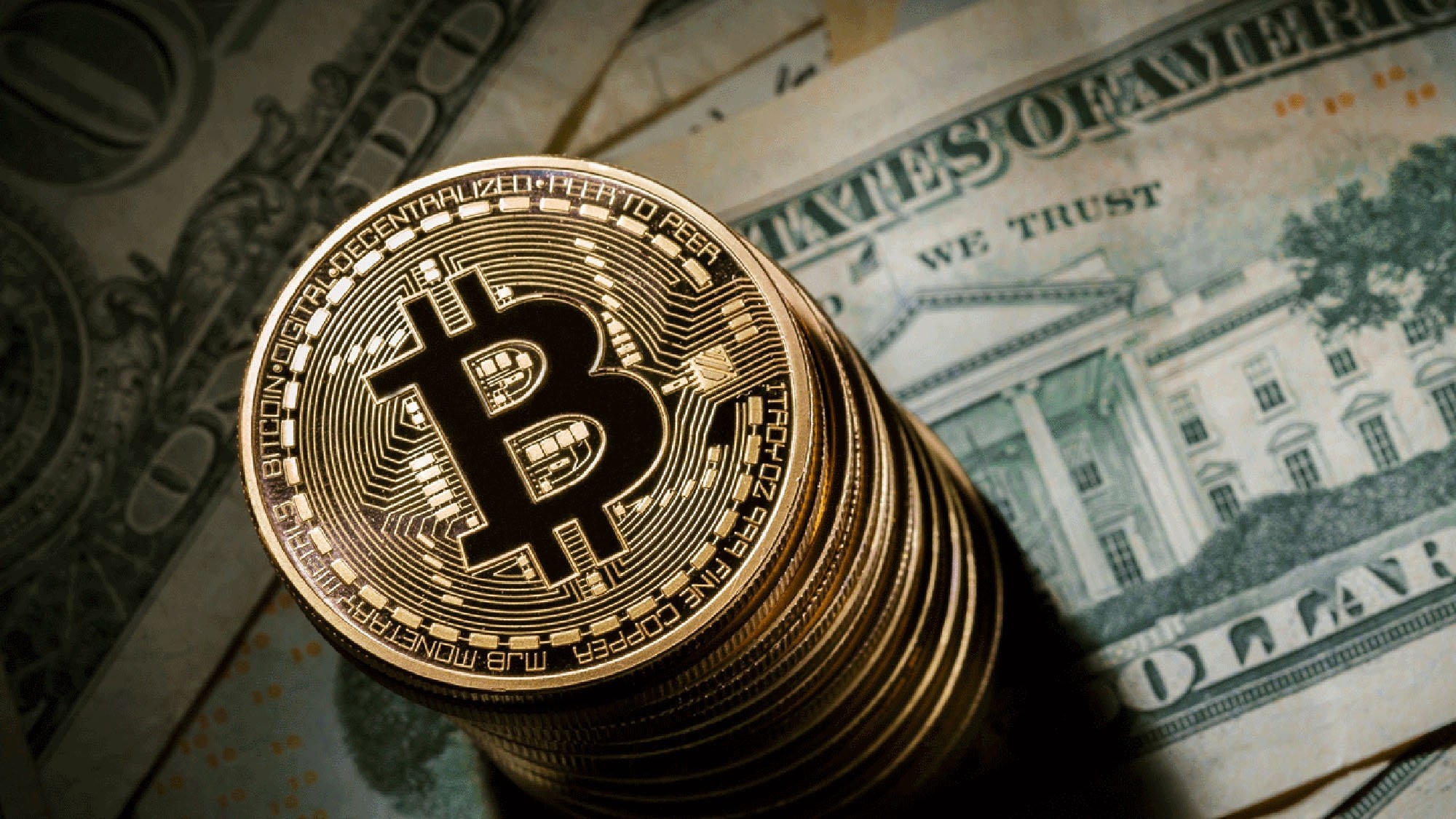
Bitcoin climbed above $8,700 to a record high Saturday following increased investor interest around the U.S. Thanksgiving holiday and Black Friday shopping. Nevertheless, it is precisely the lack of oversight that opens up the users of cryptocurrencies such as bitcoin to risks and dangers, analysts warn. "Bitcoin? It's about 'Uber-izing' currency, about not having a central bank that decides the price," said Ludovic Subran, chief economist at credit insurer Euler Hermes, referring to Uber, the ride-hailing app that has set the cat among the pigeons in the taxi sector in recent years.
"Yes, it's exactly that: it bypasses a central regulatory authority. That's the genius of this invention," agreed Yves Choueifaty, founder of the Paris-based asset management firm Tobam, which this week launched the first European fund investing in bitcoin. Bitcoin is not regulated, but is traded on specialist platforms. It has no legal exchange rate and no central bank backing it. Launched in 2009 as a bit of encrypted software written by someone using the Japanese-sounding name Satoshi Nakamoto, bitcoin is controlled and regulated by its community of users. Investors are already referring to it as "digital gold," as the bitcoin soared to a new record high of more than $8,000 this week, a staggering rise in value from just under $1,000 at the beginning of the year.
"We have no need for central banks," said Yves Choueifaty, suggesting that institutional investors may be behind the recent sharp gains, even if insisted that there was "no bitcoin bubble." The growing interest in bitcoin is catching mainstream attention: the CME Group of Chicago, one of the world's biggest exchanges, has decided to launch a bitcoin futures marketplace. And prestigious U.S. universities are offering courses in blockchain technology, on which cryptocurrencies are based. Virtual currencies could also prove attractive to economic players in countries such as Zimbabwe or Venezuela, whose fiat currencies have been ravaged hyper-inflation. Caracas, for example, has had to issue a new 100,000-bolivar bill, when just a year ago, the biggest-denomination banknote was 100 bolivars.
"Think of countries with weak institutions and unstable national currencies. Instead of adopting the currency of another country - such as the U.S. dollar - some of these economies might see a growing use of virtual currencies. Call it dollarization 2.0," said the head of the International Monetary Fund, Christine Lagarde, recently. Economists also suggest the bitcoin could be of interest to developing countries where individuals often find it easier to access the internet than traditional bank accounts. Nevertheless, central banks and the big financial institutions are concerned that virtual currencies can be used for illicit purposes and are highly speculative by nature.
"It's the exact definition of a bubble," the head of Swiss banking giant Credit Suisse, Tidjane Thiam, warned recently in comments that immediately sparked an uproar on social media among bitcoin's supporters. The head of the French central bank or Banque de France, Francois Villeroy de Galhau, warned in the summer: "People are using the bitcoin today are clearly doing it at their own risk and at their own peril."
Nobel laureate, Jean Tirole, also insisted that the current bitcoin boom was a "bubble."
"It's something that has no intrinsic value," he told reporters on the sidelines of a conference in Paris this week. "It could collapse from one day to the next. I would be completely against French banks, for example, investing in bitcoin."
Euler Hermes economist Subran called on the financial authorities to make potential investors more aware of the risks.
"There's a lot of money to be made. And a lot of money to be lost," he said. "We're seeing more and more people wanting to venture there, but they're not fully aware of the risk."
Bitcoin has regularly suffered abrupt falls, for example, in cases of friction between the members of the community who oversee it and the members who produce it, when the regulatory authorities issue any warnings, or if there are data hacks. But more often than not, bitcoin quickly makes up any losses and some investors are predicting it will soon top the $10,000 level. Back in 2011, it had struggled to pass $1.


