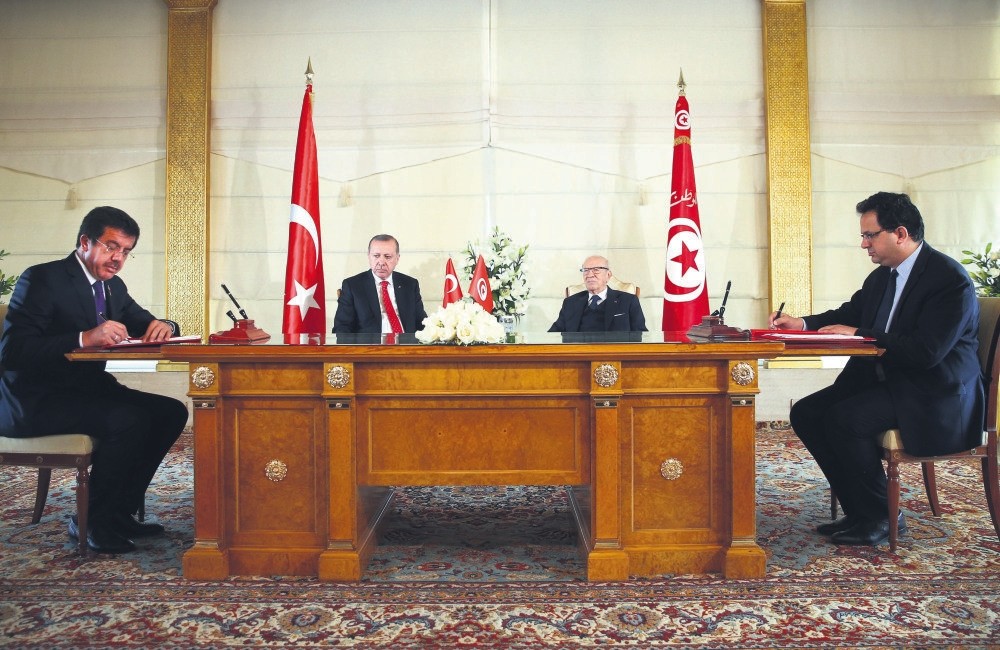
Tunisia, the last stop on President Recep Tayyip Erdoğan's three-country African tour, demonstrated the common will of both countries to further develop and improve bilateral economic ties. The willingness was sealed by four accords in military cooperation, financial aid, mutual encouragement of investments and environmental cooperation. The visit to Tunisia highlighted the bigger role of the Turkish private sector, which has so far invested more than $1 billion, to contribute to the improvement of bilateral economic ties, as they will have more support from the Turkish government.
Speaking at a joint press conference with Tunisian President Beji Caid Essebsi, President Erdoğan highlighted that Turkey's economic relations with Tunisia will be developed and the current volume of bilateral trade, which hovers around $1.25 billion, will be expanded. "We will encourage our private sector to make more investments in Tunisia," Erdoğan said. Turkey will stand by Tunisia in overcoming the economic bottleneck it struggles with, Erdoğan emphasized. "I would like to particularly underline that Turkey as the friend-in-need for Tunisia will always support it," the president said. Elaborating on topics discussed in delegation meetings, President Erdoğan said the meetings were dominated by regional issues.
Both parties have agreed to give momentum to high-level visits between Turkey and Tunisia.
"We are determined to improve our cooperation in commerce, energy, agriculture, tourism and investments," Erdoğan pointed out as the two countries agreed to expand the scope of economic relations.
Tunisia's stability and development is not independent of Turkey's development, the president emphasized. Turkey allocated $300 million in loans to Tunisia and another $300 will also be provided.
"Boosting a balanced trade volume will continue to be one of the priorities for our bilateral economic agenda," Erdoğan said. The president also highlighted that the two countries must work to deepen the tourism partnership. He also remarked that Turkey might import olive oil from the country.Tunisia has one of most diversified economies and highest life standards in Africa. Its economy primarily relies on tourism, the service sector, agriculture, textiles and oil and phosphate production. As part of the agreement signed with the EU to eliminate customs on industrial products, it exports to EU countries with an exemption for customs.
In 2016, the bilateral trade volume between Turkey and Tunisia reached $1.1 billion. Turkish exports to the country were $910 million and imports were $214 million.
Turkey mainly exports textile products, ready-to-wear items and vehicles to Tunisia while it imports fertilizers, inorganic chemicals and ready-to-wear items.
Turkey's leading airport operator, TAV Airports operates two airports in Tunisia, Monastir Habib Bourgujba and Endfidha-Hamammet.
Tunisian President Essebsi also said both parties discussed a broad range of topics, including economic, social and cultural relations.
With President Erdoğan's visit to the country, Essebi emphasized, bilateral relations will further prosper as the two countries have significant economic ties.
A free trade agreement, which forms the fundamental basis for bilateral trade relations between Turkey and Tunisia, entered into force in July 2005. The Second Session of the Partnership Council stemming from the free trade agreement took place in Tunisia in December 2010, according to the Economy Ministry.
To complete the legal framework of bilateral commercial and economic relations, Turkey and Tunisia have signed a number of agreements, including the Agreement on Enhancing Economic and Technical Cooperation (1992), the Bilateral Investment Promotion and Protection Agreement (1991) and the Double Taxation Prevention Treatment (1986).
Moreover, the last meeting of the Business Council of the two countries was held on Dec. 4, 2015 in Istanbul.
On Dec. 25, 2012, a joint declaration on the establishment of the High-Level Strategic Cooperation Council (HLSCC) between Turkey and Tunisia was signed in Ankara by then-Prime Minister Erdoğan and then-Prime Minister Hamadi Jebali. With this political declaration, the two countries laid the legal foundation for a closer bilateral cooperation mechanism and agreed to cooperate in political, security, military, economy, science, technology, economy and trade fields.
The first meeting of the HLSCC was held on June 6, 2013 in Tunisia and 21 agreements and action plans in various areas of cooperation, as well as 24 sister city protocols, were signed.
The Ministry of Foreign Affairs data reveal Turkey's support for successive Tunisian governments after the Jasmine Revolution of January 2011 and materialized this support with credit extended to Tunisia worth $500 million, consisting of a $100 million grant, a $200 million loan and a $200 million credit line from Turkish Eximbank.