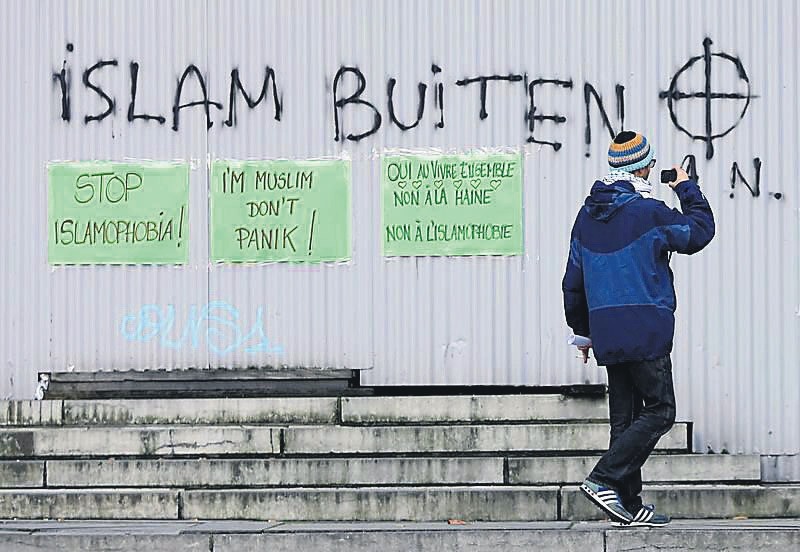
An increased presence of far-right populist rhetoric in European politics has recently exposed the rise of anti-migrant and anti-Muslim tendencies in the public sphere. It drew attention to the threat that has come to dominate Europe and diminish the role of democratic values across the continent. "We can say that the current situation is the tip of the iceberg," said Enes Bayraklı, a foreign affairs specialist at the Foundation for Political, Economic and Social Research (SETA), who is the co-author of the annual European Islamophobia Report (EIR) published by SETA.
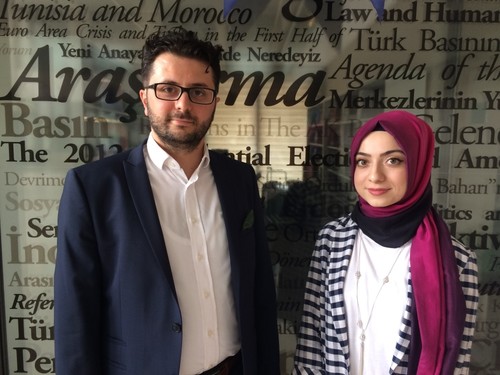
Enes Bayraklı (L) with Daily Sabah reporter Şeyma Nazlı Gürbüz
Bayraklı indicated that despite the increase in the visibility of Islamophobia as a problem thanks to social media and a rising awareness among Muslim communities, there are also many incidents not being reported or examined.
The rise in violence against migrants in general, and Muslims and Turks in particular, has become more visible in recent years, especially due to the flow of refugees fleeing conflict zones in the Middle East and North Africa.
Speaking to Daily Sabah, Bayraklı stated that, currently, Islamophobia has replaced anti-Semitism.
"Today we see that Islamophobia has started to play the role that anti-Semitism did in past. In the past, the 'others' in Europe were the Jews and there was a collective hatred against them. Yet, today in Europe, being an anti-Semitic has a price. It is a negative condition. Being Islamophobic, on the other hand, is not a negative condition. In contrast, you gain profit from it politically. Thus, today, there is an argument whether or not Islamophobia is the new anti-Semitism in Europe. Yes, we can easily say that this is true."
Despite the fact that Islamophobia is considered a hate crime in Europe, it does not have its own separate category that anti-Semitism has. That is to say, there are no disincentive laws against the commitment of Islamophobia as a crime, a fact which results in the increase of anti-Islamic rhetoric as well as attacks within European society.
Despite these demonization attempts to portray Muslims as terrorists, studies actually reveal that after 9/11, for instance, more people were killed in far-right terrorist attacks than the attacks claimed to be done by Muslims.
"Far-right terrorism is actually increasing in Europe right now and in the near future we will see that this terror will produce serious violence in Europe. Yet, unfortunately, this fact is not reflected in media reports, not even slightly," Bayraklı said.
Stating that Islamophobia is actually a threat to Europe's main values, Bayraklı added that the doors of hatred have opened via Islamophobic attitudes.
"When you act in such a hateful way to the other, you cannot know where it will stop. Thus, those who will be affected by this first will be the others in Europe, the ones who think differently to the rest of society. The doors of hatred have opened. After World War II, far-right parties were suppressed and were not able to act freely. But today, they are on the rise again. They have become the mainstream again and have started to lead European politics. The other parties, unfortunately, think that they can stop the far-right only with far-right rhetoric. This leads to a further escalation of the situation. It means that you acknowledge the agenda of the far-right," he said.
Germany's Bundestag, which is the lower house of parliament, agreed to a draft a law last month that will prevent civil servants, judges, and soldiers in Germany from wearing full-face veils at work as part of security measures they call a "precaution" to prevent extremist attacks, which is a great example of the acceptance of the far-right agenda by a leader like Merkel according to Bayraklı.
Meanwhile, Norway's anti-immigrant and libertarian Progress Party (FrP) also voted on Tuesday to ban circumcision for boys under the age of 16 and bar hijabs in public schools.
According to the annual EIR report of SETA, which covers 27 European countries and monitors the developments of Islamophobia in these countries and analyzed by 31 prominent scholars who specialize in racism, gender and Islamophobia studies, Muslim women are 70 percent more like to be the victim of Islamophobia than Muslim men.
"Women who wear the hijab are particularly visible in public. It is clear that they are Muslims. So they are the ones who are attacked the most.
Even in Turkey, those who were attacked most were women wearing the hijab.
This is based on the perception that Islam does not value Muslim women. There is the idea of Muslim women being prisoners who should be liberated. Thus discriminatory attitude towards Muslim women is being legitimized by this perception. "We are liberating you by banning the hijab," they say. This kind of attitude objectifies women and takes women's freedom of will out of their hands. "It is a pure orientalist attitude," Bayraklı said.
When there is an incident of discrimination, hate crimes and hate speech, a number of different response mechanisms are actually available, but none of these are familiar to the vast majority of Muslim citizens in European countries.
According to Bayraklı, Islamophobia should be recognized as a crime in itself and statistics in regard to it should be recorded regularly, which would provide data that can be compared and contrasted.
"As a matter of fact, Islamophobia is not something that depends on Muslims. It is Europe's dominating powers' problem to be solved. They should solve it. I am not the source of this problem as a Muslim. The source of the problem is them," he said.
"Still, there are some things that Muslims can do to overcome this situation. The first thing is to place Islamophobia on the agenda of the international community, by constantly monitoring and reporting incidents, through lobbying channels in different countries, making them acknowledge Islamophobia as a crime. Another thing to do is to raise the awareness of Muslim communities in Europe and to direct them to report any incident to the authorities. It should turn into a civil rights movement. It must be recognized that this is a human rights issue," Bayraklı concluded.