Daily Sabah logo

Politics
Diplomacy Legislation War On Terror EU Affairs Elections News Analysis
TÜRKİYE
Istanbul Education Investigations Minorities Expat Corner Diaspora
World
Mid-East Europe Americas Asia Pacific Africa Syrian Crisis Islamophobia
Business
Automotive Economy Energy Finance Tourism Tech Defense Transportation News Analysis
Lifestyle
Health Environment Travel Food Fashion Science Religion History Feature Expat Corner
Arts
Cinema Music Events Portrait Reviews Performing Arts
Sports
Football Basketball Motorsports Tennis
Opinion
Columns Op-Ed Reader's Corner Editorial
PHOTO GALLERY
JOBS ABOUT US RSS PRIVACY CONTACT US
© Turkuvaz Haberleşme ve Yayıncılık 2026

Daily Sabah - Latest & Breaking News from Turkey | Istanbul

  • Politics
    • Diplomacy
    • Legislation
    • War On Terror
    • EU Affairs
    • Elections
    • News Analysis
  • TÜRKİYE
    • Istanbul
    • Education
    • Investigations
    • Minorities
    • Expat Corner
    • Diaspora
  • World
    • Mid-East
    • Europe
    • Americas
    • Asia Pacific
    • Africa
    • Syrian Crisis
    • Islamophobia
  • Business
    • Automotive
    • Economy
    • Energy
    • Finance
    • Tourism
    • Tech
    • Defense
    • Transportation
    • News Analysis
  • Lifestyle
    • Health
    • Environment
    • Travel
    • Food
    • Fashion
    • Science
    • Religion
    • History
    • Feature
    • Expat Corner
  • Arts
    • Cinema
    • Music
    • Events
    • Portrait
    • Reviews
    • Performing Arts
  • Sports
    • Football
    • Basketball
    • Motorsports
    • Tennis
  • Gallery
  • Opinion
    • Columns
    • Op-Ed
    • Reader's Corner
    • Editorial
  • TV

Smallpox virus found in child mummy could rewrite disease history

by

WASHINGTON Dec 09, 2016 - 12:00 am GMT+3
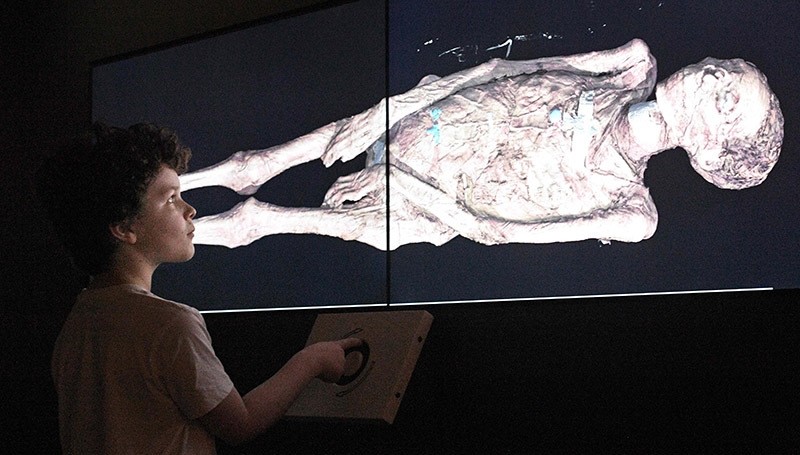
A young boy looks at a three-dimensional image of a CT scan of an Egyptian mummy at a joint British-Australian exhibition in Sydney on December 8, 2016. (AFP Photo)
by Dec 09, 2016 12:00 am

The discovery of smallpox DNA in a 17th century child mummy may shorten the timeline of the deadly infectious disease's history, according to a study published Thursday.

Specimens of the smallpox-causing variola virus now exist only in secured laboratory freezers. The highly contagious and sometimes fatal disease was finally eradicated in the late 1970s through a worldwide vaccination campaign.

But the origins of the virus remain unknown.

The discovery of the smallpox virus within the DNA of a skin sample of the mummy child, found in a crypt underneath a Lithuanian church, could shed light on how it began and developed, researchers said in the study published in the US scientific journal Current Biology.

"There have been signs that Egyptian mummies that are 3,000 to 4,000 years old have pockmarked scarring that have been interpreted as cases of smallpox," said first author Ana Duggan, a postdoctoral fellow at the McMaster University Ancient DNA Center in Canada, in a statement.

"The new discoveries really throw those findings into question, and they suggest that the timeline of smallpox in human populations might be incorrect."

The researchers reconstructed the entire genome of the ancient strain of the virus and compared it with versions of the variola virus genome dating from the mid-1900s and before its eradication in the late 1970s.

They concluded that all the samples shared a common viral ancestor that originated sometime between 1588 and 1645. During that time, exploration, migration and colonization would have helped spread smallpox around the globe.

Study co-author Hendrik Poinar, the director of the Ancient DNA Center at McMaster University, said that conclusion casts doubt on the documented historical evidence that dates back to Egypt's Ramses V up to the 1500s.

"Are these indeed real cases of smallpox, or are these misidentifications, which we know is very easy to do, because it is likely possible to mistake smallpox for chicken pox and measles," Poinar said.

In addition, the researchers were able to identify from the 17th century virus distinct periods of viral evolution.

A clear instance of evolution occurred around the time of English physician and scientist Edward Jenner, the 18th century pioneer of the smallpox vaccine, the world's first vaccine.

During this period, the variola virus apparently split into two strains, variola major and variola minor.

That suggests, the researchers said, that vaccination may have changed the selection pressures acting on the virus and caused it to split into two strains.

"Now we know all the evolution of the sampled strains dates from 1650, but we still don't know when smallpox first appeared in humans, and we don't know what animal it came from, and we don't know that because we don't have any older historical samples to work with," said co-author Edward Holmes, a professor at the University of Sydney in Australia.

"Our historical knowledge of viruses is just the tip of the iceberg."

  • shortlink copied
  • Last Update: Dec 09, 2016 11:28 am
    KEYWORDS
    world
    The Daily Sabah Newsletter
    Keep up to date with what’s happening in Turkey, it’s region and the world.
    You can unsubscribe at any time. By signing up you are agreeing to our Terms of Use and Privacy Policy. This site is protected by reCAPTCHA and the Google Privacy Policy and Terms of Service apply.
    No Image
    'Teddy Bear father' distributes plushies in Paris
    PHOTOGALLERY
    • POLITICS
    • Diplomacy
    • Legislation
    • War On Terror
    • EU Affairs
    • News Analysis
    • TÜRKİYE
    • Istanbul
    • Education
    • Investigations
    • Minorities
    • Diaspora
    • World
    • Mid-East
    • Europe
    • Americas
    • Asia Pacific
    • Africa
    • Syrian Crisis
    • İslamophobia
    • Business
    • Automotive
    • Economy
    • Energy
    • Finance
    • Tourism
    • Tech
    • Defense
    • Transportation
    • News Analysis
    • Lifestyle
    • Health
    • Environment
    • Travel
    • Food
    • Fashion
    • Science
    • Religion
    • History
    • Feature
    • Expat Corner
    • Arts
    • Cinema
    • Music
    • Events
    • Portrait
    • Performing Arts
    • Reviews
    • Sports
    • Football
    • Basketball
    • Motorsports
    • Tennis
    • Opinion
    • Columns
    • Op-Ed
    • Reader's Corner
    • Editorial
    • Photo gallery
    • DS TV
    • Jobs
    • privacy
    • about us
    • contact us
    • RSS
    © Turkuvaz Haberleşme ve Yayıncılık 2021