
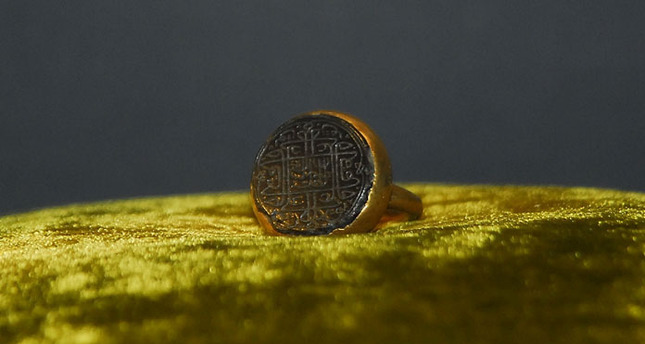
In the Islamic world, imperial seals are referred to as "mühür," which derives its origin from the word "mühre," meaning ornamental bead because imperial seals were generally made of precious stones such as agate, jade or crystalized quartz. Indeed, it requires great effort to write a few words on a very small surface and place a delicate handle on it, and any official document without a seal was not recognized as original.
The seal of Prophet Muhammad was made of agate, the same type of gemstone fitted on his ring. During the reign of Uthman bin Affan, the third caliph in Medina, the seal was lost and caused political chaos throughout Islamic society. At the time of the Abbasids, the caliphs assigned viziers by handing over an imperial seal. Certain historical accounts suggest Solomon, the son of David, initiated this tradition by giving his seal to his famous vizier Asaf. In the following periods, Turkish emperors continued this practice as well.
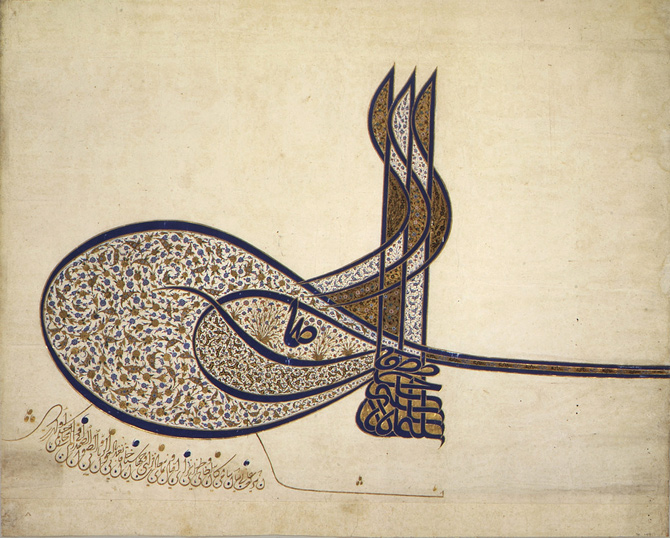
Aside from imperial seals, Ottoman sultans commissioned artisans to design unique "tughras," a calligraphic monogram or signature, when they succeeded to the throne. It was affixed to all official documents, indicating that what was declared were the statements of the emperor. Laws and other documents about assignments, land allocation and dismissal came into force with the sultan's signature. A senior "nişancı" (marksman) was responsible for affixing the tughra on documents.

The Seal Bearer's Bazaar
In addition to the emperor, almost everyone used official or personal handmade seals. Nearly all of them looked like each other with little variation, but they were used as a signature to avoid forgery and ensure authenticity. Sometimes seals featured names and lines from famous poems and quotes. Certain statesmen used to employ "mühürdars" (private secretaries) who took care of their official documents.
In those times, women also employed interesting practices regarding seals. Elegant pouches were designed to keep their seals and every woman used to have a few seals contained in their dowries. Those who engraved seals were called "hakkak" (engraver), and their shops were generally located in Istanbul's Beyazıt district. The bazaar where they opened their shops was called "Hakkaklar Çarşısı" or "Mühürcüler Çarşısı" (The Engravers/Seal Bearer's Bazaar). Over time, seal engraving declined, and the "sahaf" (second-hand booksellers), whose shops were destroyed during World War I, moved to the bazaar – which is why the bazaar is now called "Sahaflar Çarşısı" (The Second-Hand Booksellers Bazaar).
Engravers made seals from brass and embellished them with precious stones. Some decades ago, it was possible to come across seal engravers in Anatolia. However, only those who know how to read and write used seals. When the Arabic alphabet was replaced with the Latin alphabet during the founding of the Turkish Republic, the art of seal engraving lost its attraction. In certain Arabic-speaking countries and India, Muslims still use seals, however.
A famous historical account about seals recounts the following: One day, a jinn took the seal of Solomon, the King of Israel, and masqueraded as the emperor on his throne. Nobody realized that he was a jinn, but then the jinn accidentally dropped the seal into the sea and a fish swallowed it. While fishing, Solomon caught the fish and took back his seal. Thus, the famous saying in Turkish, "Mühür kimdeyse Süleyman odur!" (He who holds the seal becomes Solomon) took its origin from this story.


