
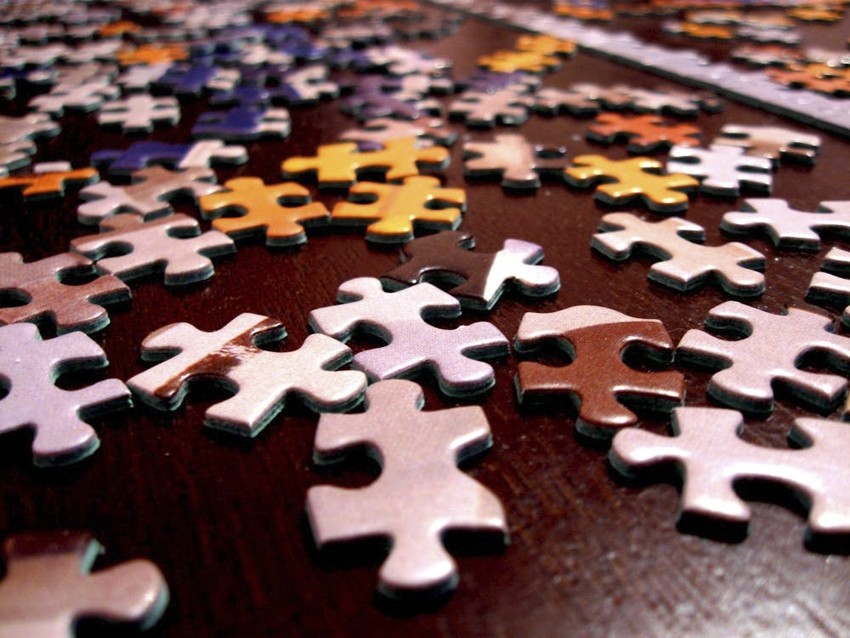
Some people say that the jigsaw puzzle is a metaphor for life: A symbol of the challenges we face in our jobs, relationships and health that often leave us confused and overwhelmed. These challenges are easily likened to the fragmented jigsaw puzzle, with its many disconnected pieces and no clear starting point.
Yet, while physically piecing a jigsaw puzzle together in a powerfully creative meditative state, our minds start to subconsciously shift towards focusing the confusion towards creating solutions. We start taking a more holistic and balanced view of our lives, considering all the little pieces as small challenges rather than impossibilities, as we begin to understand how these little fragments fit together to create a bigger picture.
As we begin to make connections between the things that may have previously seemed unrelated to us, we begin to notice patterns. Finally, as slowly as the jigsaw puzzle takes shape, the different parts of our
lives start coming together to form a sensible picture.
This may raise the question: How can a jigsaw puzzle help me form a sensible picture of my life? Well, research is revealing the quantifiable benefits of jigsaw puzzling into adulthood. Putting together puzzles engages the mind and is a form of mental gymnastics that can actually promote longer life expectancy, better quality of life, even reducing the risk of certain types of mental illnesses including memory loss, dementia and even Alzheimer's.
When we sit down to solve a jigsaw puzzle, both the right and left sides of our brain become simultaneously activated. The left side of the brain, our analytical side, sees all of the separate pieces and begins to sort them out logically. The right cortex of the brain, responsible for our creative side, analyzes the bigger picture and works intuiti
vely. Both sides of our brain are required to function properly in order for us to successfully put the pieces of a puzzle together.
So, by exercising both sides of the brain at the same time, we create definitive "connections" between the left and right sides of the brain as well as connections between individual brain cells. These connections increase our ability to learn, comprehend and recall information.
In addition, completing a puzzle, or even piecing together two pieces of a puzzle successfully, encourages production of the chemical dopamine that is produced in the brain and increases our ability to learn and memorize information.
In short, we can say that jigsaw puzzling is a unique activity that allows us to achieve a state of creative meditation, while providing a fun activity that imparts on us a sense of accomplishment. The benefits that this activity has on the brain are becoming clearer with modern research and the positive effects could be even more powerful in strengthening the subconscious, helping us piece together this puzzle we call life.
Jigsaw puzzle 101
- Jigsaw puzzles have been around for nearly 250 years. An English cartographer named John Spilsbury created the very first jigsaw puzzle in 1767, when he chopped up a wooden map and challenged people to reassemble it. He named his creation a "dissected map" and it quickly became a popular tool for teaching geography.
- Adult jigsaw puzzling became quite popular during the Great Depression, as it was a cheap and easy way to pass the time during long periods of unemployment.
- In 2011, a university in Vietnam made the world's biggest jigsaw puzzle, which is believed to comprise of 551,232 pieces.
- The largest commercial jigsaw puzzle went on sale in 2011 and contained 32,256 pieces.
- The Guinness World Record for completing Guinness's official 250-piece jigsaw is 13 minutes and seven seconds.
- Stave Puzzles released a jigsaw puzzle in 1989 with no solution, much to the rage of many avid puzzlers who unknowingly strove to complete it.
- Although it may seem odd, it will take you four times as long to complete a 1,000 piece jigsaw as it will to do a 500-piece jigsaw. This is because each time you double the number of pieces you quadruple the difficulty.
- Before starting a 4,000 piece jigsaw, keep in mind that it will take you 64-times longer to complete it than it takes you to complete a 500 piece one


