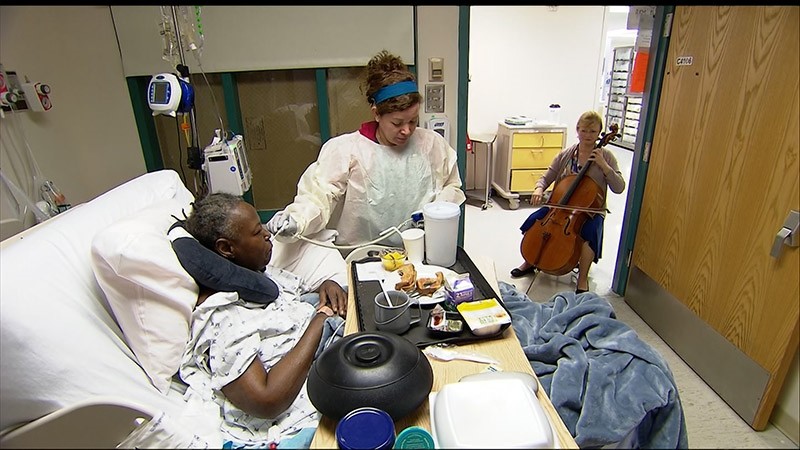
Music increasingly is becoming a part of patient care, not only as a means of comfort but also to aid faster recovery as scientists realize music's healing power.
While some hospitals have invited musicians regularly to play music to comfort recuperating patients, medical centers have just recently begun exploring how music might be used as a treatment.
The U.S. National Institutes of Health is bringing together musicians, music therapists and neuroscientists to tap into the brain's circuitry and figure out how music works its magic.
"The brain is able to compensate for other deficits sometimes by using music to communicate," said NIH Director Dr. Francis Collins, a geneticist who also plays a mean guitar.
To turn that ability into a successful therapy, "it would be a really good thing to know which parts of the brain are still intact to be called into action. To know the circuits well enough to know the back-up plan," Collins added.
Scientists aren't starting from scratch. Learning to play an instrument, for example, sharpens how the brain processes sound and can improve children's reading and other school skills. Stroke survivors who can't speak sometimes can sing, and music therapy can help them retrain brain pathways to communicate. Similarly, Parkinson's patients sometimes walk better to the right beat.
But what's missing is rigorous science to better understand how either listening to or creating music might improve health in a range of other ways — research into how the brain processes music that NIH is beginning to fund.
"The water is wide, I cannot cross over," well-known soprano Renee Fleming belted out, not from a concert stage but from inside an MRI machine at the NIH campus.
The opera star — who partnered with Collins to start the Sound Health initiative — spent two hours in the scanner to help researchers tease out what brain activity is key for singing. How? First Fleming spoke the lyrics. Then she sang them. Finally, she imagined singing them.
"We're trying to understand the brain not just so we can address mental disorders or diseases or injuries, but also so we can understand what happens when a brain's working right and what happens when it's performing at a really high level," said NIH researcher David Jangraw, who shared the MRI data with The Associated Press.
To Jangraw's surprise, several brain regions were more active when Fleming imagined singing than when she actually sang, including the brain's emotion center and areas involved with motion and vision. One theory: it took more mental effort to keep track of where she was in the song, and to maintain its emotion, without auditory feedback.
Jangraw notes a saying in neuroscience: Neurons that fire together, wire together. Brain cells communicate by firing messages to each other through junctions called synapses. Cells that regularly connect — for example, when a musician practices — strengthen bonds into circuitry that forms an efficient network for, in Fleming's case, singing.
But that's a healthy brain. In North Carolina, a neuroscientist and a dance professor are starting an improvisational dance class for Alzheimer's to tell if music and movement enhance a diseased brain's neural networks.
Well before memory loss becomes severe, Alzheimer's patients can experience apathy, depression and gait and balance problems as the brain's synaptic connections begin to falter. The NIH-funded study at Wake Forest University will randomly assign such patients to the improvisation class — to dance playfully without having to remember choreography — or to other interventions.
The test: If quality-of-life symptoms improve, will MRI scans show correlating strengthening of neural networks that govern gait or social engagement?
Proof may be tough. An international music therapy study failed to significantly help children with autism, the Journal of the American Medical Association recently reported, contradicting earlier promising findings. But experts cited challenges with the study and called for additional research.
Unlike music therapy, which works one-on-one toward individual outcomes, the arts and humanities program at Georgetown Lombardi Comprehensive Cancer Center lets musicians-in-residence play throughout the hospital. Palliative care nurses often seek out musicians for patients anxious or in pain. They can watch monitors, matching a tune's tempo to heart rate and then gradually slowing.
Julia Langley, who directs Georgetown's program, wants research into the type and dose of music for different health situations: "If we can study the arts in the same way that science studies medication and other therapeutics, I think we will be doing so much good."