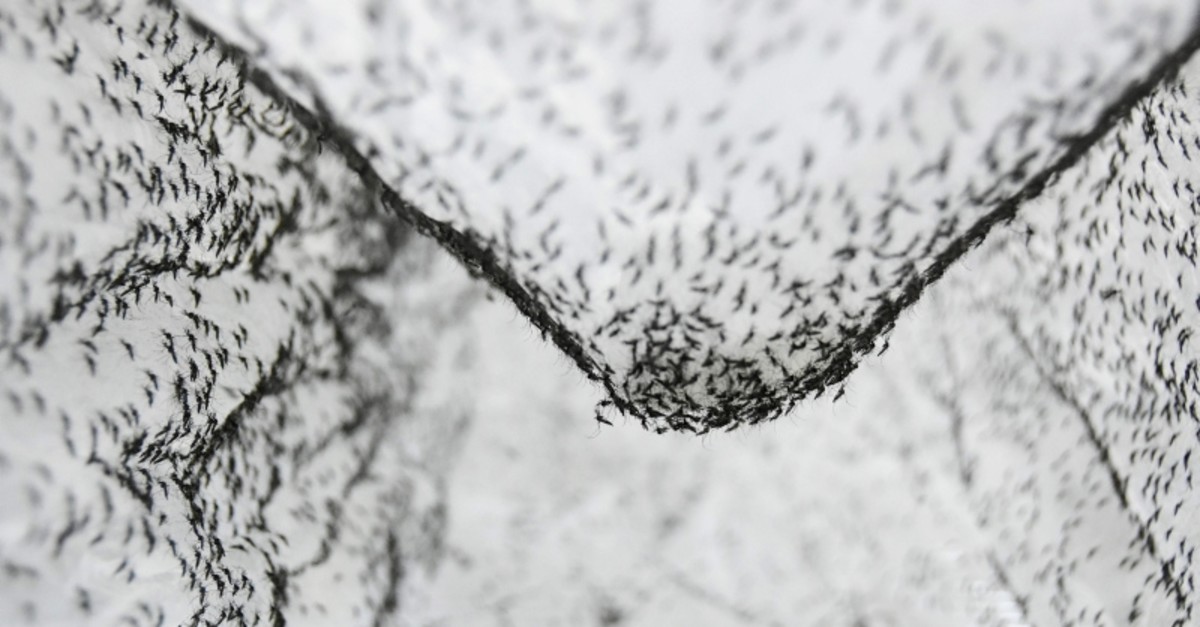
A breakthrough technique harnessing two methods to target disease-carrying mosquitoes was able to effectively eradicate buzzing biters in two test sites in China, according to research published on Thursday.
The mosquitoes targeted are a type that is particularly difficult to control called Aedes albopictus -- more popularly known as the Asian tiger mosquito -- which are a major vector for diseases including Zika and dengue.
The study "demonstrates the potential of a potent new tool," wrote Peter Armbruster, a professor at Georgetown University's department of biology, in a review of the work.
Researchers harnessed two population control methods: the use of radiation -- which effectively sterilizes mosquitoes -- and a strain of bacteria called Wolbachia that leaves mosquito eggs dead on arrival.
They conducted a two-year trial at two sites on river islands in Guangzhou, where Asian tiger mosquitoes are to blame for the highest dengue transmission rate in China.
The results were "remarkable," wrote Armbruster: the number of hatched mosquitoes eggs plunged by 94%, with not a single viable egg recorded for up to 13 weeks in some cases.
And the average number of female mosquitoes -- which transmit disease to humans when they bite -- caught by traps fell by between 83 and 94%.
In some cases, none were detected at all for up to six weeks.
The results were also borne out by a decline of nearly 97% in bites suffered by locals -- which in turn shifted attitudes among residents, who were initially skeptical of the project's plan to release more mosquitoes into the local area.
The research builds on two existing methods: radiation-based sterile insect technique (SIT) and incompatible insect technique (IIT).
SIT works by releasing radiation-sterilized male mosquitoes into an environment to mate with wild female mosquitoes, reducing the size of the population over time as females fail to reproduce.
But irradiation of male mosquitoes tends to reduce both their mating competitiveness and their survival rates, undermining the technique's effectiveness.
The IIT method involves a bacteria called Wolbachia. When males infected with it mate with female mosquitoes that aren't infected, their eggs don't hatch.
The technique doesn't work if the female mosquitoes are infected with the same Wolbachia strain, and successful mating by mosquitoes that both carry the bacteria undermines the technique by producing more female mosquitoes infected with Wolbachia that are resistant to the process.
Preventing the release of Wolbachia-infected female mosquitoes is difficult, with sex-sorting techniques usually resulting in a "female contamination rate" of about 0.3%.
To overcome that, researchers decided to subject their Wolbachia-infected lab-reared mosquitoes to low-level irradiation, which rendered the females sterile but left the males able to reproduce.
This allowed the team to avoid the onerous sex-screening process and meant they could release significantly more mosquitoes at a time: in some cases more than 160,000 male mosquitoes per hectare, per week.
Lead researcher Zhiyong Xi, a professor at Michigan State University's department of Microbiology and Molecular Genetics, compared the technique to "producing insecticide."
"Our goal is to use this technique to build a protected area that is disease vector-free," Xi told AFP.
Armbruster, in a review commissioned by the journal Nature that published the research on Thursday, said the study produced "striking results."
That the trial "almost eliminated notoriously difficult-to-control vector mosquitoes from the test sites is remarkable," he wrote.
The results weren't a universal success -- populations in areas with more traffic, near construction or roads, shrank less than those in isolated zones, likely as mosquitoes migrated in from elsewhere.
But Xi said the technique still holds promise if "natural barriers" like highways are used to limit the arrivals of outside mosquitoes.
And he said it could be used against mosquitoes that carry disease, including malaria.
The next steps will involve developing a "highly effective and practical release strategy" suited for urban settings," he said.