
Daily Sabah logo

Politics
Diplomacy Legislation War On Terror EU Affairs Elections News Analysis
TÜRKİYE
Istanbul Education Investigations Minorities Expat Corner Diaspora
World
Mid-East Europe Americas Asia Pacific Africa Syrian Crisis Islamophobia
Business
Automotive Economy Energy Finance Tourism Tech Defense Transportation News Analysis
Lifestyle
Health Environment Travel Food Fashion Science Religion History Feature Expat Corner
Arts
Cinema Music Events Portrait Reviews Performing Arts
Sports
Football Basketball Motorsports Tennis
Opinion
Columns Op-Ed Reader's Corner Editorial
PHOTO GALLERY
JOBS ABOUT US RSS PRIVACY CONTACT US
© Turkuvaz Haberleşme ve Yayıncılık 2025

Daily Sabah - Latest & Breaking News from Turkey | Istanbul

  • Politics
    • Diplomacy
    • Legislation
    • War On Terror
    • EU Affairs
    • Elections
    • News Analysis
  • TÜRKİYE
    • Istanbul
    • Education
    • Investigations
    • Minorities
    • Expat Corner
    • Diaspora
  • World
    • Mid-East
    • Europe
    • Americas
    • Asia Pacific
    • Africa
    • Syrian Crisis
    • Islamophobia
  • Business
    • Automotive
    • Economy
    • Energy
    • Finance
    • Tourism
    • Tech
    • Defense
    • Transportation
    • News Analysis
  • Lifestyle
    • Health
    • Environment
    • Travel
    • Food
    • Fashion
    • Science
    • Religion
    • History
    • Feature
    • Expat Corner
  • Arts
    • Cinema
    • Music
    • Events
    • Portrait
    • Reviews
    • Performing Arts
  • Sports
    • Football
    • Basketball
    • Motorsports
    • Tennis
  • Gallery
  • Opinion
    • Columns
    • Op-Ed
    • Reader's Corner
    • Editorial
  • TV

Rare fossil footprints show human chasing giant sloth

by

BOURNEMOUTH, England Apr 26, 2018 - 12:00 am GMT+3
No Image
by Apr 26, 2018 12:00 am

Scientists have uncovered evidence of ancient humans engaged in a deadly face-off with a giant sloth, showing for the first time how our ancestors might have tackled such a formidable prey.

Standing over 2 meters tall, with forelegs tipped with claws, giant sloths lived until around 11,000 years ago. Most scientists believe over-hunting by humans eventually led to their extinction.

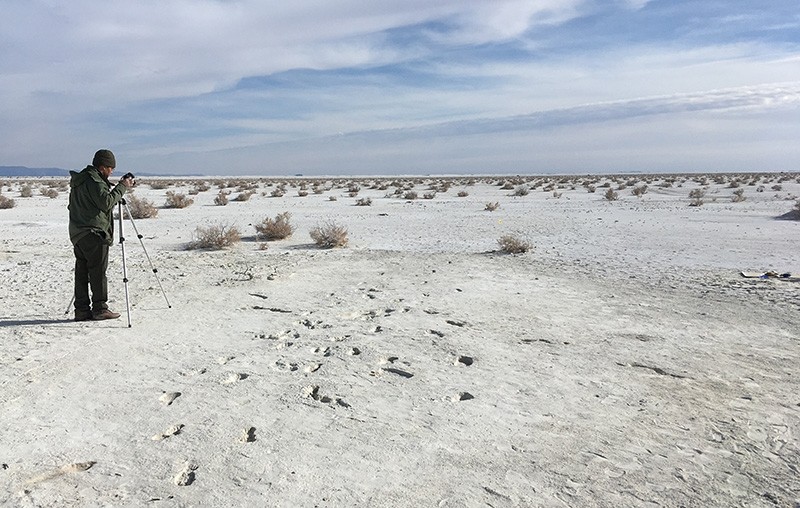
Fossilised footprints in the salt flats of White Sands National Monument, in the southwestern U.S. state of New Mexico, reveal humans walking in the exact footsteps of a giant sloth and then confronting it, possibly hurling spears.

"The story that we can read from the tracks is that the humans were stalking; following in the footsteps, precisely in the footsteps of the sloth," said Matthew Bennett, one of a team of scientists behind the discovery.
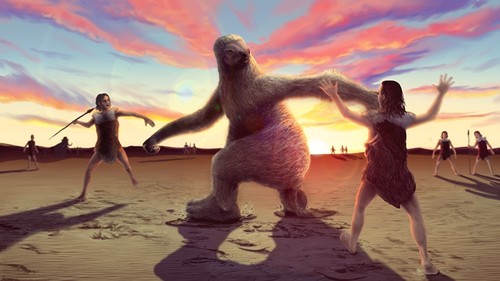

This undated handout illustration shows how human hunters stalked giant ground sloth to distract them before trying to land a killing blow. Supplied by Bournemouth University, Britain (Reuters Photo)

"While it was being distracted and turning, somebody else would come across and try and deliver the killer blow. It's an interesting story and it's all written in the footprints," said Bennett, a professor of environmental and geographical sciences at Bournemouth University in southern England.

At the White Sands National Monument, researchers identified what is known as "flailing circles" that show the rise of the sloth on its hind legs and the swing of its forelegs, likely in a defensive motion.

In addition to tracks of humans stalking the sloth, there are more human tracks further away. From this, scientists infer that the humans worked as a group, with a separate team distracting and misdirecting the sloth to outwit it.

The flailing circles are always associated with the presence of human tracks. Where there are no human footprints, the sloths walk in straight lines, but where human tracks are present the sloth trackways show evasion, with sudden changes in direction.

Thanks to new 3D modeling techniques, the fossilized footprints have been preserved using a system developed by Bennett. Using a standard digital camera to take images from 22 different angles, his computer algorithm builds up an ultra-precise 3D rendering of the footprint.

"What this evidence does is for the first time shows us how they might have tackled one of these big beasts and the fact that they were almost certainly doing it routinely is important," Bennett told Reuters at his university.

"Getting two sets of fossil footprints that interact, that show you the behavioral ecology, is very, very rare," he said.


About the author
Research Associate at Center for Islam and Global Affairs (CIGA) at Istanbul Sabahattin Zaim University
  • shortlink copied
  • Last Update: Apr 26, 2018 10:20 am
    KEYWORDS
    life
    The Daily Sabah Newsletter
    Keep up to date with what’s happening in Turkey, it’s region and the world.
    You can unsubscribe at any time. By signing up you are agreeing to our Terms of Use and Privacy Policy. This site is protected by reCAPTCHA and the Google Privacy Policy and Terms of Service apply.
    No Image
    Pictures of the Year: AA’s 'An open door to Europe' named finalist
    PHOTOGALLERY
    • POLITICS
    • Diplomacy
    • Legislation
    • War On Terror
    • EU Affairs
    • News Analysis
    • TÜRKİYE
    • Istanbul
    • Education
    • Investigations
    • Minorities
    • Diaspora
    • World
    • Mid-East
    • Europe
    • Americas
    • Asia Pacific
    • Africa
    • Syrian Crisis
    • İslamophobia
    • Business
    • Automotive
    • Economy
    • Energy
    • Finance
    • Tourism
    • Tech
    • Defense
    • Transportation
    • News Analysis
    • Lifestyle
    • Health
    • Environment
    • Travel
    • Food
    • Fashion
    • Science
    • Religion
    • History
    • Feature
    • Expat Corner
    • Arts
    • Cinema
    • Music
    • Events
    • Portrait
    • Performing Arts
    • Reviews
    • Sports
    • Football
    • Basketball
    • Motorsports
    • Tennis
    • Opinion
    • Columns
    • Op-Ed
    • Reader's Corner
    • Editorial
    • Photo gallery
    • DS TV
    • Jobs
    • privacy
    • about us
    • contact us
    • RSS
    © Turkuvaz Haberleşme ve Yayıncılık 2021