Daily Sabah logo

Politics
Diplomacy Legislation War On Terror EU Affairs Elections News Analysis
TÜRKİYE
Istanbul Education Investigations Minorities Expat Corner Diaspora
World
Mid-East Europe Americas Asia Pacific Africa Syrian Crisis Islamophobia
Business
Automotive Economy Energy Finance Tourism Tech Defense Transportation News Analysis
Lifestyle
Health Environment Travel Food Fashion Science Religion History Feature Expat Corner
Arts
Cinema Music Events Portrait Reviews Performing Arts
Sports
Football Basketball Motorsports Tennis
Opinion
Columns Op-Ed Reader's Corner Editorial
PHOTO GALLERY
JOBS ABOUT US RSS PRIVACY CONTACT US
© Turkuvaz Haberleşme ve Yayıncılık 2025

Daily Sabah - Latest & Breaking News from Turkey | Istanbul

  • Politics
    • Diplomacy
    • Legislation
    • War On Terror
    • EU Affairs
    • Elections
    • News Analysis
  • TÜRKİYE
    • Istanbul
    • Education
    • Investigations
    • Minorities
    • Expat Corner
    • Diaspora
  • World
    • Mid-East
    • Europe
    • Americas
    • Asia Pacific
    • Africa
    • Syrian Crisis
    • Islamophobia
  • Business
    • Automotive
    • Economy
    • Energy
    • Finance
    • Tourism
    • Tech
    • Defense
    • Transportation
    • News Analysis
  • Lifestyle
    • Health
    • Environment
    • Travel
    • Food
    • Fashion
    • Science
    • Religion
    • History
    • Feature
    • Expat Corner
  • Arts
    • Cinema
    • Music
    • Events
    • Portrait
    • Reviews
    • Performing Arts
  • Sports
    • Football
    • Basketball
    • Motorsports
    • Tennis
  • Gallery
  • Opinion
    • Columns
    • Op-Ed
    • Reader's Corner
    • Editorial
  • TV

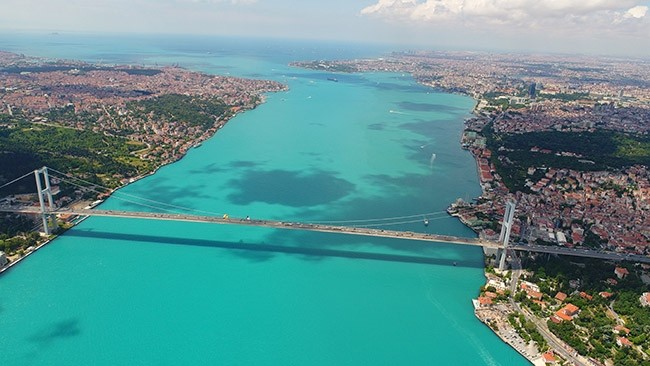
NASA scientists solve mystery behind turquoise-colored Bosphorus

by Daily Sabah

ISTANBUL Jun 14, 2017 - 12:00 am GMT+3
 IHA Photo
| IHA Photo
by Daily Sabah Jun 14, 2017 12:00 am

NASA has put an end to the confusion over the mysterious hues of the Bosporus, which have changed from dark blue to a bright turquoise color in recent days.

The turquoise color stretches along the Bosporus to a large portion of the western Black Sea, which puzzled residents and raised questions about pollution.

NASA explained that the color was caused by phytoplankton, single-celled microscopic organisms that make food from sunlight and nutrients in the water. The flow of the Danube and Dnieper Rivers into the Black Sea provides nutrients for the tiny creatures.

Turquoise swirls in the Black Sea. These eye-catching hues indicate the presence of organisms known as phytoplankton https://t.co/hKC0Te3TaW pic.twitter.com/151hZ04H7s

— NASA (@NASA) June 12, 2017

The Aqua satellite's Moderate Resolution Imaging Spectroradiometer (MODIS) captured its first images of the phytoplankton boom in the Black Sea on May 29.

Fishermen have predicted a rise in anchovy yields this year due to the plankton, which provide food for fish and shellfish. However, when in large groups, phytoplankton can suck oxygen from the water and damage other marine life.

The bright color itself is produced by the plankton's reflective plates, which when viewed from a distance lighten the normal color of the water.

After the perplexing phenomenon emerged, some took to social media to express fears that there had been a pollution spill while others even suggested the changing hues could be linked to the recent earthquake that rocked the Aegean region on Monday afternoon.

However, scientists said there is no mystery behind the color change, which is also accompanied by a pungent smell.

Ahmet Cemal Saydam, professor of environmental science at Hacettepe University, told the Doğan news agency that the cause of the change is a surge in the number of micro-organisms known as Emiliania huxleyi, or Ehux.

"This has nothing to do with pollution," he said, adding that this is particularly beneficial for the increased presence of anchovies, a popular dinner staple in Istanbul.

"Across the Black Sea there has been an explosion of Emiliania huxleyi which is a blessing for the Black Sea," he said.

One of the most successful life-forms on the planet, Emiliania huxleyi is a single-celled organism visible only under a microscope. Its astonishing adaptability enables it to thrive in waters from the Equator to the sub-Arctic.


  • shortlink copied
  • Last Update: Jun 14, 2017 6:43 pm
    KEYWORDS
    tÜrkİye
    The Daily Sabah Newsletter
    Keep up to date with what’s happening in Turkey, it’s region and the world.
    You can unsubscribe at any time. By signing up you are agreeing to our Terms of Use and Privacy Policy. This site is protected by reCAPTCHA and the Google Privacy Policy and Terms of Service apply.
    No Image
    Turkey's 22-day Arctic expedition team returns with samples
    PHOTOGALLERY
    • POLITICS
    • Diplomacy
    • Legislation
    • War On Terror
    • EU Affairs
    • News Analysis
    • TÜRKİYE
    • Istanbul
    • Education
    • Investigations
    • Minorities
    • Diaspora
    • World
    • Mid-East
    • Europe
    • Americas
    • Asia Pacific
    • Africa
    • Syrian Crisis
    • İslamophobia
    • Business
    • Automotive
    • Economy
    • Energy
    • Finance
    • Tourism
    • Tech
    • Defense
    • Transportation
    • News Analysis
    • Lifestyle
    • Health
    • Environment
    • Travel
    • Food
    • Fashion
    • Science
    • Religion
    • History
    • Feature
    • Expat Corner
    • Arts
    • Cinema
    • Music
    • Events
    • Portrait
    • Performing Arts
    • Reviews
    • Sports
    • Football
    • Basketball
    • Motorsports
    • Tennis
    • Opinion
    • Columns
    • Op-Ed
    • Reader's Corner
    • Editorial
    • Photo gallery
    • DS TV
    • Jobs
    • privacy
    • about us
    • contact us
    • RSS
    © Turkuvaz Haberleşme ve Yayıncılık 2021