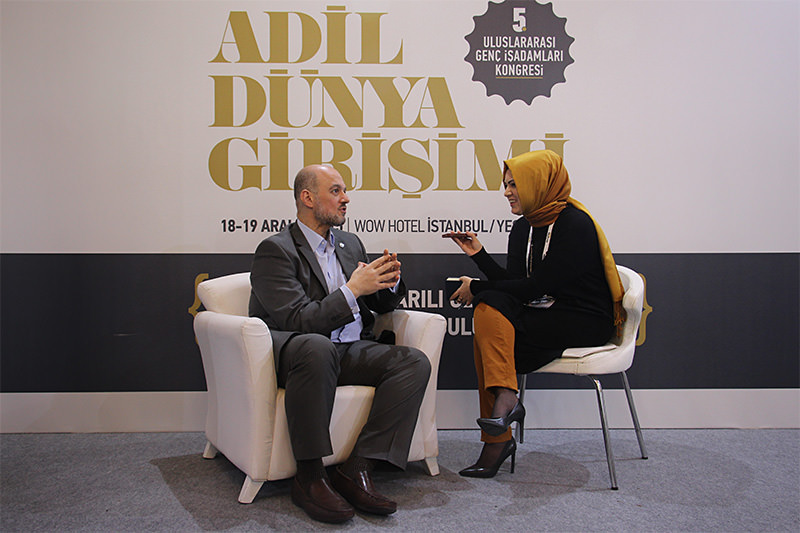
The 5th International Young Businessmen's Congress (IYBC), organized by the youth branch of the Independent Industrialist and Businessmen's Association (MÜSİAD), was held in Istanbul last week with many in attendance. Many notable speeches took place during the two-day conference, especially one by Dr. Anas Altikriti, the founder and CEO of the Cordoba Foundation – a U.K.-based research and advisory group. Altikriti spoke to Daily Sabah, and evaluated the political and diplomatic developments in the Middle East and Europe.
DS: Despite Ankara's attempts to ease tensions with Moscow, Russian President Vladimir Putin has said he sees no hope for repairing relations. Why does he behave so aggressively?
There is obviously the incident itself, which sparks the crisis – Turkey shooting down a Russian military jet in November. But you have to understand the context as a whole. You have to know when to understand exactly where the crisis fits in and what the consequences of the crisis will be. Unfortunately, when covering this particular issue now between Russia and Turkey, international media outlets are not paying full attention to the context or to the background; therefore, it is a matter of whether Turkey is right: Did the Russian plane penetrate Turkish airspace as though it was an isolated incident? And the fact of matter is that it was not an isolated incident. There is significant context to it. What Russia and Putin is trying to neglect is that Syria is very much a Turkish national interest. Syria shares a long border with Turkey. Turkey is housing millions of Syrian refugees. There are millions of people who are connected to Syria who pass through Turkish territories. Thus, the issue of Syria, Turkey's stance and what it does in order to keep the flames raging in Syria is very much something that concerns Turkey. In terms of the incident itself, I believe Putin in a sense almost wanted to it happen because Russia finds itself in a very isolated position internationally when it comes to Syria. All of a sudden, now Russia has found a legitimate reason to be in Syria and have a particular policy on Syria. It is now starting to complain to the world that it has been targeted by Turkey as a result of Syria; therefore, its presence in Syria is required. Basically I think Putin is stuck between the only two options he thinks he has. The first is the option that he must press ahead; he must be the winner in this particular context. He seems himself as a strong president that takes very strong stances and that thinks he is going to defend the national and regional interests of Russia. I thınk he is quite keen on that. But on the other hand, Putin is not stupid, and he realizes there was a price if he was to push forward.
DS: We read that a bunch of Russian officials said Russia will retaliate for the downing of the warplane via the Kurds. Instead of deploying Russian ground troops, will Putin support the Democratic Union Party (PYD) or PKK in Syria?
The global superpowers, the U.S. as well as Russia, and the way that they conduct wars in this region is by proxy through their third parties and their agents. In the case of Russia, the Kurds are very strong proxy in this particular scenario, and I think that they are heavily backed by Russia from one side but also sections of the Iranian state are also supporting the Kurds in order to create as many problems and instability as possible on the Turkish border. We have to recognize Turkey is targeted. It has been targeted internally and also externally. There are many regional powers and regional states who would like to see Turkey fail and go back to the old days of a military state that has no stability and has a very poor economy. I always give the example of when someone is trying to sell their car and the car looks very old, the best way to sell the car is to put it next to an even older car. This problem with Turkey in the region is that out of all the failed states, it is an excellent model state, which makes the rest of the region look very bad. It makes Iraq, Syria, Gulf countries and Egypt look very, very bad; therefore, there is a realization that there are some regional states as well as international powers, including Russia, who would like to see Turkey fail. Thus, we have those who want to keep Turkey busy with these issues. We have terrorist attacks within Turkey and also some incidents on the borders of Turkey to which the government must respond.
DS: What do would you like to say about Iran's existence in Iraq and Turkey deploying its ground troops in Mosul?
Iran has played an extremely negative role in Iraq for the past 13 years. Iran has been the main power besides the U.S. military presence up until 2009. The reality is that Iran was always the main power dictating and heavily influencing Iraqi politics, the Iraqi economy and Iraqi society. Through various manifestations, Iran proved itself to not be a friend of Iraq. That includes the Shiite population. It created the premise for the Iraqi government after the Iraqi government adopted sectarian policies, which broke up the country, made Iraq one of the worst failed states in the entire world and reduced it now to a poor country despite the fact that it is one of the richest in terms of oil revenue. However, it is now one of the poorest because it allowed its own allies to exercise corruption, steal billions and militarized Iraq – as the biggest expenditure for the Iraqi government over the past 13 years every year has been the security sector. Most of Iraq's budget is spent on security. Every Iraqi official has dozens of bodyguards; when Iraqi Prime Minister Haider al-Abadi goes to visit someone, he has to go in a convoy of about 40-50 cars. So, Iran has unfortunately played the same role in Syria because Iran sees Iraq as its front yard and Syria as being its strategic extension – the bridge to link it to Lebanon and the Mediterranean Sea. Therefore, we see a political project wherever Iran goes, and now it is happening in Yemen. Iran implements such projects under religious and ideological guise in order to spread its political agenda. So, wherever it goes, we see that country descend into instability and then into chaos and violence. Regarding the Turkish deployment, first of all, I made a comment a week ago when I was asked about al-Abadi's statements and threats against Turkey.
DS: Do you mean the "48 hours" given to Turkey to withdraw the troops?
It is a laughable joke. First of all, so many Iraqis on social media started a joke campaign and a hashtag about how Abadi all of a sudden became angry when the country was penetrated by all the countries in the world. You know, we have U.S. congressmen who arrived in their private jets without the knowledge of the Iraqi government. They just land at one of the military bases, meet whoever they want and then leave, and no one in the Iraqi government knows. Iraq has long been penetrated by everyone. By the way, these threats coincided two weeks ago with the penetration of at least 500,000 Iranians – so called pilgrims – who simply broke through the borders of Iraq and entered the country. No one has any control. They didn't come with any papers, they didn't show any passports, they didn't have any visas and no one knows how many there are exactly – the estimation is between 500,000 and 2 million, and no one knows where they are. So, people are asking Abadi, "If you want to talk about sovereignty, then you really need to take care of your borders because 500,000 people just crossed the border in one day and you could not do anything. So, that is one thing. The other thing is Abadi himself in 2014 pleaded with Turkey to intervene in order to save it from DAESH because it met his interests at that time. He pleaded with Turkey to intervene, send troops and do something. Now Turkey has, and Abadi is angry all of a sudden because now the interests have shifted. To be honest, I don't think anyone is taking Abadi's statements seriously; not even Iraqis are taking him seriously. Of course, Turkish intervention is annoying everyone simply because it comes at the wrong the time for them, and it comes at the time when this intervention spoils certain plans that are being implemented.
DS: Turkey is being accused of having a sectarian agenda by deploying troops to Mosul.
It is an accusation, one that claims Iran does not seem sectarian at all. I don't think anyone takes it seriously. Turkey has all the right in the world in the face of problem or in light of the fact that the Iraqi government has failed time and time again to confront the crisis of DAESH, which is only a few dozen miles from Turkish borders. Turkey has a real interest, and if any other country was in Turkey's place, it would do exactly the same.
DS: Egyptian Foreign Minister Sameh Shoukry's recently issued warm statements regarding relations with Turkey, saying: "We hope to mend the bilateral relations with Turkey and Egypt." How do you interpret this statement?
I think that ultimately politics is about fulfilling interests. It is not about morality, ethics or values, it is about interests. Any country in the region, especially a country that is suffering from incredible economic failure, cannot afford to sever the relations with Turkey. Turkey is a major regional power, and it is now becoming an international power. They cannot afford to stay away from Turkey forever. But I also think the Egyptians have been told, probably by the Saudis as a result of payments, that they need to make things good with Turkey. I think there is also pressure from the West to improve relations with Turkey. So, maybe it is an attempt to get Turkey to soften its line on Egypt, but generally speaking I don't take these statements seriously until I see actions in place.
DS: Let's talk about the U.K. Jeremy Corbyn, leader of the Labour Party, has become popular in Britain along with his policies. What about his stance on Syria? It is known that he is opposing the bombing of Syria unlike British Prime Minister Cameron. But on the other hand, he doesn't seem to be against Syrian President Bashar Assad's position.
Well first of all, Corbyn won the Labour Party elections a few months ago by one of the greatest margins ever. He is a very decent, disciplined and courageous person. He is a personal friend of mine because he and I we started the anti-war movement in 2001 against the troops in Afghanistan and then in Iraq. We have to realize that Corbyn belongs to the left, and we have a love-hate relationship with the Western left as an Islamic community. On wars, occupation in Iraq and Palestine, brilliant. But on issues of the Arab Spring, Libya and Syria, for instance, we unfortunately disagree. With Corbyn, because I had this close relationship with him over the years, I tell him about what happens whenever we meet, and I tell him: "Jeremy, you are taking your news from the wrong sources. When we demonstrated for Iraq, it wasn't because we loved Saddam [Hussein], it was because of the Iraqi people." And I tried to do the same thing with Syria. I said, "Listen, if you are against Britain bombing Syria, fine, and I agree with you because I don't think that the U.K. is ethical or principled when they bomb. They will bomb the wrong people. But never ever support Assad in the same we did with Iraq."
DS: What did he say in turn?Corbyn actually agrees with me. Look at the statement he made when he was interviewed by the BBC, chiefly: "We need to confront [DAESH] but also the Assad regime." Unfortunately, some people on the left think everything that they have to say whatever is opposite to what the U.S. says, and they don't take the consideration the complexities on the ground. They don't take into account the fact that the Syrian people ultimately want Assad gone. I want what the Syrian people want.
DS: What about Corbyn's approach to Turkey? I heard some of his supporting statements about the supporters of the Gülen Movement.It's an issue that we are trying to address. You have to realize that the left essentially comes from an ideological background. At the very heart of that ideological background is hatred toward anything religious. So, when they hear through their own sources – your friends here on the left – they tell them, "Oh, the headscarf is now being forced on all women and girls, and people can't speak their mind and can't drink alcohol. I also can't go on the beach in my bikini and I can't do this and can't do that." So, for those that think this way, this fits with their mindset and mentality. They still hear news that President Recep Tayyip Erdoğan is a new dictator and the Justice and Development Party (AK Party) is taking over Turkey, and they still have this in the back of their minds. Regarding the Gülenists, they have a very strong grip on Western media outlets. And the Gülenists made themselves look like political descendants who are being prosecuted because of their political ideology, which is very horrible – something that those on the left thrive on.
DS: And what do you think about the Gülenists?
It is a very, very dangerous phenomenon. It is something that threatens the very fabric of Turkey. The structure of the organization and its power and depth threatens to destabilize Turkey. When people or the media ask me about Shaykh Yusuf al-Karadawi, Sayyid Qutb or even my father, I always say as human beings, we make mistakes. So, I am sure that my father, al-Karadawi and others made mistakes, and I am sure that Erdoğan makes mistakes because that is how God created us. However, seeing – not hearing, seeing – what Erdoğan has done to Turkey, having transformed from a country that was a terrible country – I remember visiting Turkey in the '80s and '90s; it was so horrible that I hated coming to Turkey – to a country that I love visiting. The economic miracle that emerged in Turkey, especially at the time when the entire world is suffering from the economic crisis, has allowed the country to continue to flourish and bloom. And among the Muslim-majority countries, every country has been an utter failure on every level – economic, political, cultural, architectural, sports, music, everything. So, for that reason alone – and I don't know Erdoğan in person – I think he and the party deserve everyone's respect.