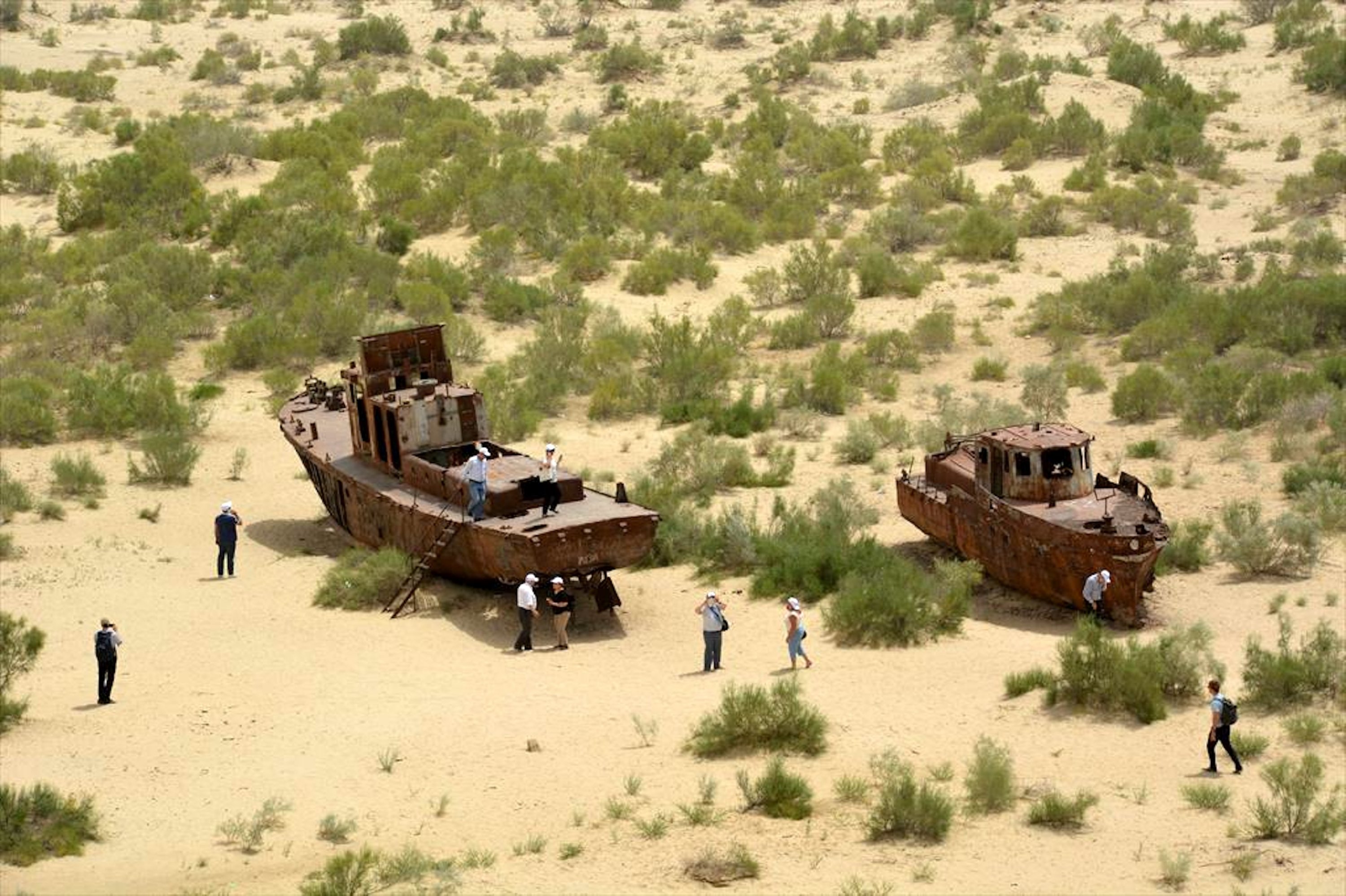
Once the world's fourth-largest lake, the Aral Sea, between Uzbekistan and Kazakhstan, has dried up since the 1960s, triggering a severe environmental crisis in Central Asia.
A report prepared by Anadolu Agency (AA) for World Wetlands Day, titled "Once a Lake, Now a Desert," details the characteristics of the Aral Sea, the causes of its desiccation, its environmental impact and the measures taken by the Uzbek government to mitigate the disaster.
During the Soviet era, between 1960 and 1990, the region was turned into a cotton production hub. Agricultural irrigation expanded from 4.5 million to 7 million hectares, significantly increasing water demand and reducing the inflow from the Syr Darya and Amu Darya rivers, which once sustained the lake.
Before the 1960s, the Amu Darya contributed 38.6 cubic kilometers of water annually, while the Syr Darya supplied 14.5 cubic kilometers. However, large-scale irrigation projects diverted most of this water to cotton fields, causing the Aral Sea to shrink rapidly. By the early 2020s, the lake’s surface area had diminished nearly ninefold, its water level had dropped threefold and its volume had declined fifteenfold.
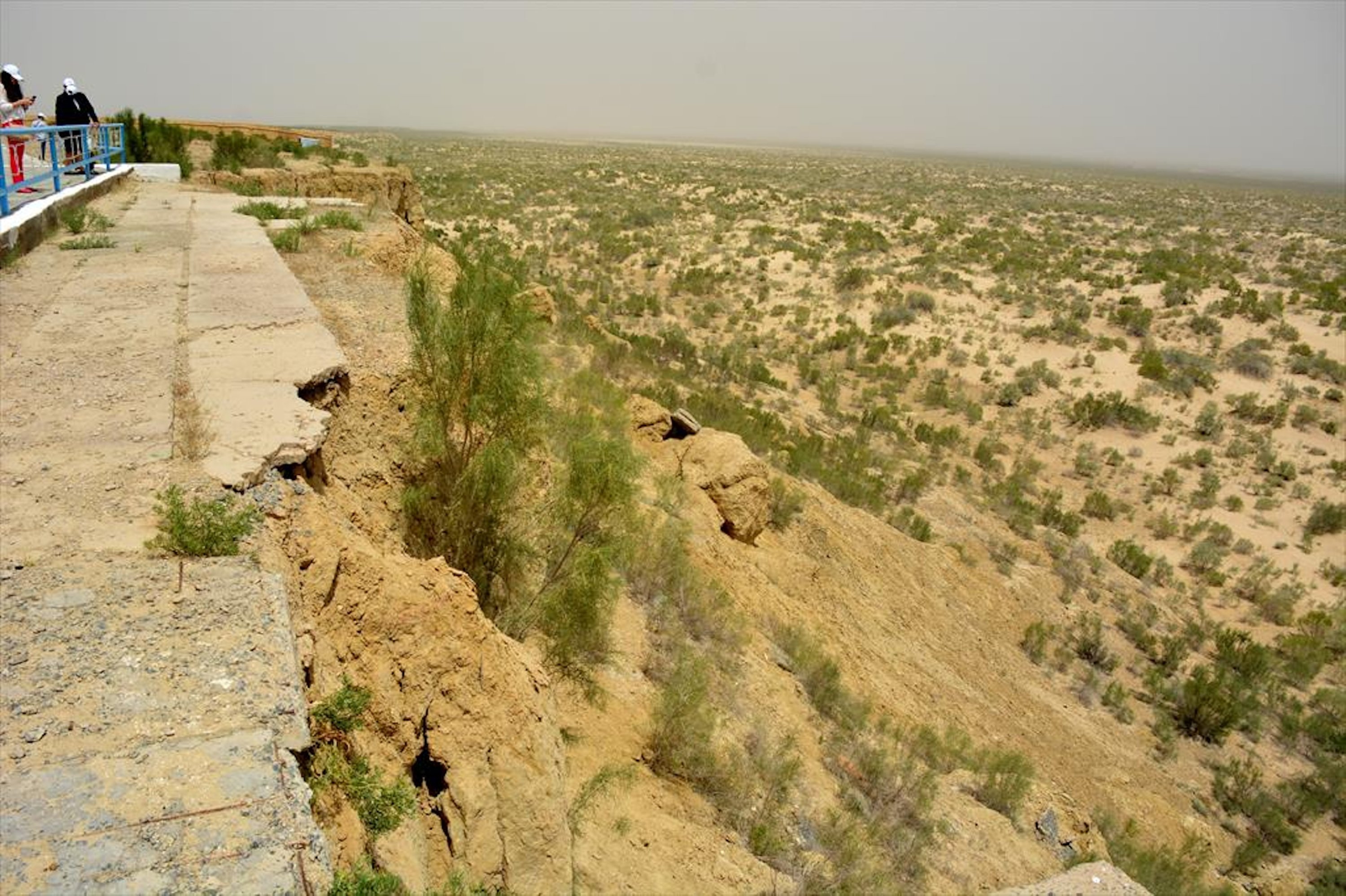
In 1960, the Aral Sea spanned 68,000 square kilometers, with a water volume of 1,083 cubic kilometers. Its length measured 426 kilometers, its width 284 kilometers and its deepest point reached 68 meters. Today, the lake’s surface has shrunk to 8,000 square kilometers, its water volume has fallen to 75 cubic kilometers and its maximum depth is just 20 meters. The lake continues to recede, with an annual depth loss of 80 to 110 centimeters.
The receding waters split the lake in two, leaving part in Uzbekistan and the other in Kazakhstan. Around 300 islands that once dotted the lake have merged with the surrounding land.
As the Aral Sea withdrew, its former seabed – spanning over 4 million hectares – transformed into the Aralkum Desert, often referred to as the world’s youngest desert. Each year, sandstorms across Central Asia carry approximately 100 million tons of salt-laden dust, worsening environmental conditions.
Scientists report that traces of these dust particles have been found in the Pamir Mountains, where they accelerate glacier melting. The lake's desiccation has increased soil erosion and air pollution, threatening human health, living conditions and biodiversity. The environmental catastrophe has affected the livelihoods of nearly 3 million people in the basin, contributing to the spread of diseases and rising infant mortality rates.
In the fishing town of Muynak, once a thriving port, agricultural land has been heavily salinized and the shoreline has receded by over 100 kilometers. As a result, agriculture and fisheries have collapsed, forcing many residents to migrate for better opportunities.
By the mid-20th century, the Aral Sea basin supported more than 300 plant species, 319 bird species, and 70 animal species. Nearly half of these have either vanished or migrated due to environmental changes. The lake once contained 34 species of fish, with an annual catch of around 60,000 tons. However, rising salinity – now 10 times higher than in the 1960s – has led to the near-total extinction of aquatic life.
Fish canneries in Muynak have shut down and abandoned fishing boats now litter the dried-up seabed, turning the area into a graveyard of rusting vessels. Meanwhile, camels roam the newly formed desert.
The former Vozrozhdeniya (Rebirth) Island, where the Soviet Union conducted biological weapons testing between 1954 and 1990, has merged with the mainland due to the lake’s contraction.
The desiccation of the Aral Sea has caused an estimated $100 million in annual economic losses. Regional governments have launched reforestation projects on the exposed seabed to counteract the effects, aiming to stabilize soil and reduce dust storms.
Uzbekistan has intensified afforestation efforts, planting desert-resistant species such as saxaul and tamarisk. In 2017, authorities initiated a "green belt" project, covering 70 kilometers of the dried-up lakebed with vegetation to curb salt and dust dispersion. The government aims to reforest the entire desiccated portion of the Aral Sea within a decade.
According to Zafar Eshankulov, an official from Uzbekistan’s Ministry of Ecology, Environmental Protection and Climate Change, around 2 million hectares of the dried lakebed – out of the 3.2 million hectares belonging to Uzbekistan – have already been reforested. He emphasized that these efforts have significantly reduced the spread of airborne dust and improved local environmental conditions.
The Aral Sea crisis remains one of the world’s most alarming ecological disasters, with ongoing efforts to mitigate its impact offering a glimmer of hope for the future.