Daily Sabah logo

Politics
Diplomacy Legislation War On Terror EU Affairs Elections News Analysis
TÜRKİYE
Istanbul Education Investigations Minorities Expat Corner Diaspora
World
Mid-East Europe Americas Asia Pacific Africa Syrian Crisis Islamophobia
Business
Automotive Economy Energy Finance Tourism Tech Defense Transportation News Analysis
Lifestyle
Health Environment Travel Food Fashion Science Religion History Feature Expat Corner
Arts
Cinema Music Events Portrait Reviews Performing Arts
Sports
Football Basketball Motorsports Tennis
Opinion
Columns Op-Ed Reader's Corner Editorial
PHOTO GALLERY
JOBS ABOUT US RSS PRIVACY CONTACT US
© Turkuvaz Haberleşme ve Yayıncılık 2025

Daily Sabah - Latest & Breaking News from Turkey | Istanbul

  • Politics
    • Diplomacy
    • Legislation
    • War On Terror
    • EU Affairs
    • Elections
    • News Analysis
  • TÜRKİYE
    • Istanbul
    • Education
    • Investigations
    • Minorities
    • Expat Corner
    • Diaspora
  • World
    • Mid-East
    • Europe
    • Americas
    • Asia Pacific
    • Africa
    • Syrian Crisis
    • Islamophobia
  • Business
    • Automotive
    • Economy
    • Energy
    • Finance
    • Tourism
    • Tech
    • Defense
    • Transportation
    • News Analysis
  • Lifestyle
    • Health
    • Environment
    • Travel
    • Food
    • Fashion
    • Science
    • Religion
    • History
    • Feature
    • Expat Corner
  • Arts
    • Cinema
    • Music
    • Events
    • Portrait
    • Reviews
    • Performing Arts
  • Sports
    • Football
    • Basketball
    • Motorsports
    • Tennis
  • Gallery
  • Opinion
    • Columns
    • Op-Ed
    • Reader's Corner
    • Editorial
  • TV
  • Life
  • Health
  • Environment
  • Travel
  • Food
  • Fashion
  • Science
  • Religion
  • History
  • Feature
  • Expat Corner

Climate change? Why have floods in Europe been so deadly

by French Press Agency - AFP

Berlin Jul 17, 2021 - 8:14 pm GMT+3
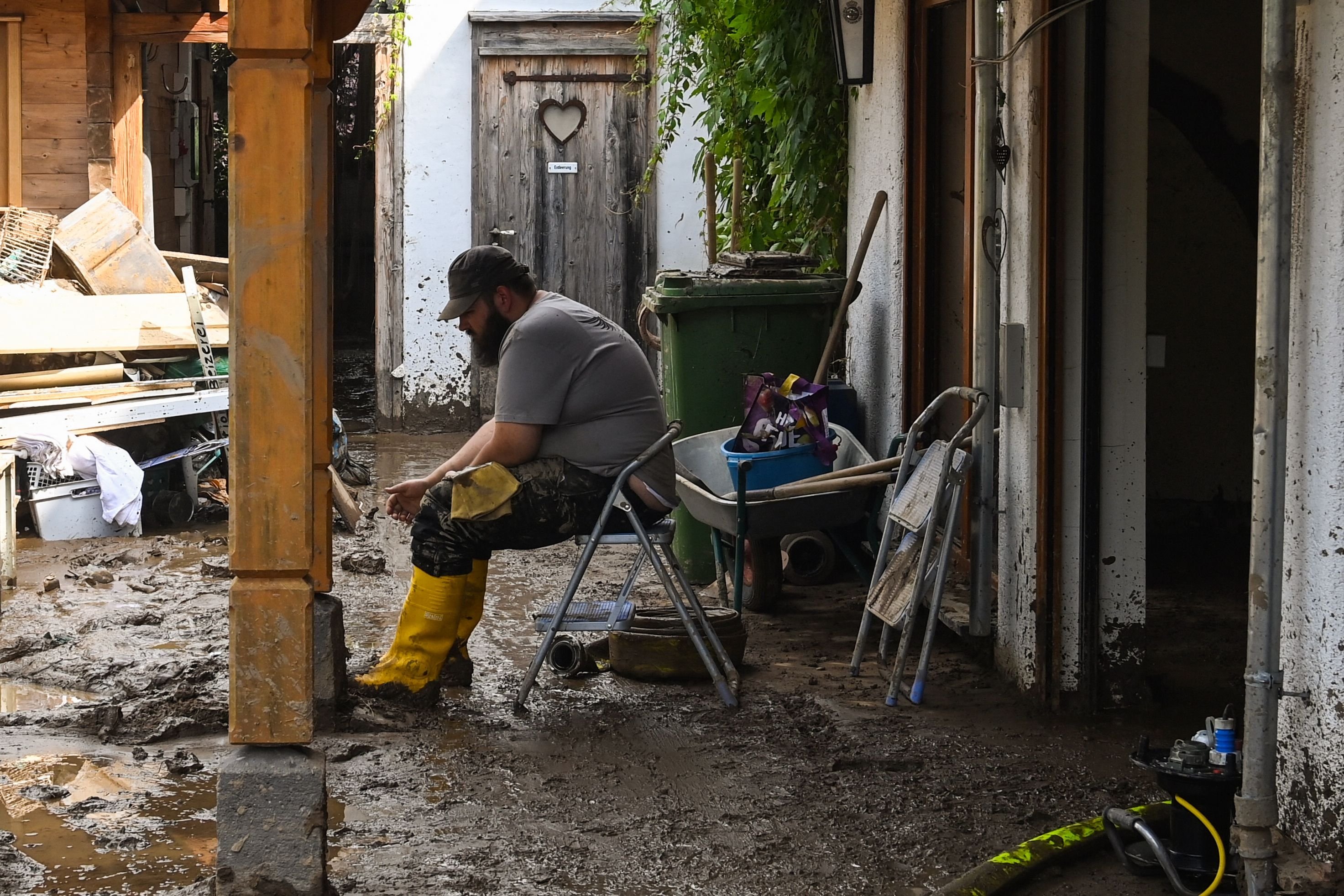
A man rests in a muddied courtyard in Insul near Bad Neuenahr-Ahrweiler, western Germany, on July 17, 2021. (AFP Photo)
by French Press Agency - AFP Jul 17, 2021 8:14 pm

The deadly flooding in Germany, Belgium and other parts of western Europe, that forced hundreds of people to be evacuated, was described as a "catastrophe," a "war zone" and "unprecedented."

With more than 150 people dead and the toll still climbing, many are asking: How did this happen and why has it been so bad?

Exceptional weather

"Masses of air loaded with water had been blocked at high altitude by cold temperatures, which made them stagnate for four days over the region," Jean Jouzel, a climatologist and former vice-president of the Intergovernmental Panel on Climate Change (IPCC), told Agence France-Presse (AFP).

Between 100 and 150 millimeters (4 and 6 inches) of rain fell between July 14 and 15, according to the German weather service – an amount that would normally be seen over two months.

Europe has been hit repeatedly by severe flooding before, but this week has been "exceptional in terms of both the amount of water and the violence" with which it was dumped, according to German hydrologist Kai Schroeter.

Global warming?

Many European politicians have squarely blamed global warming for the disaster, while Germany's far-right AfD has accused them of "instrumentalizing" the floods to promote a climate-protection agenda.

"We cannot yet say with certainty that this event is linked to global warming," Schroeter told AFP, but "global warming makes events like this more likely".

In technical terms, climate change means the earth is becoming warmer so more water is evaporating, which "leads to larger water masses in the atmosphere," increasing the risk of intense rainfall, he said.

The IPCC has also said global warming boosts the likelihood of extreme weather events.
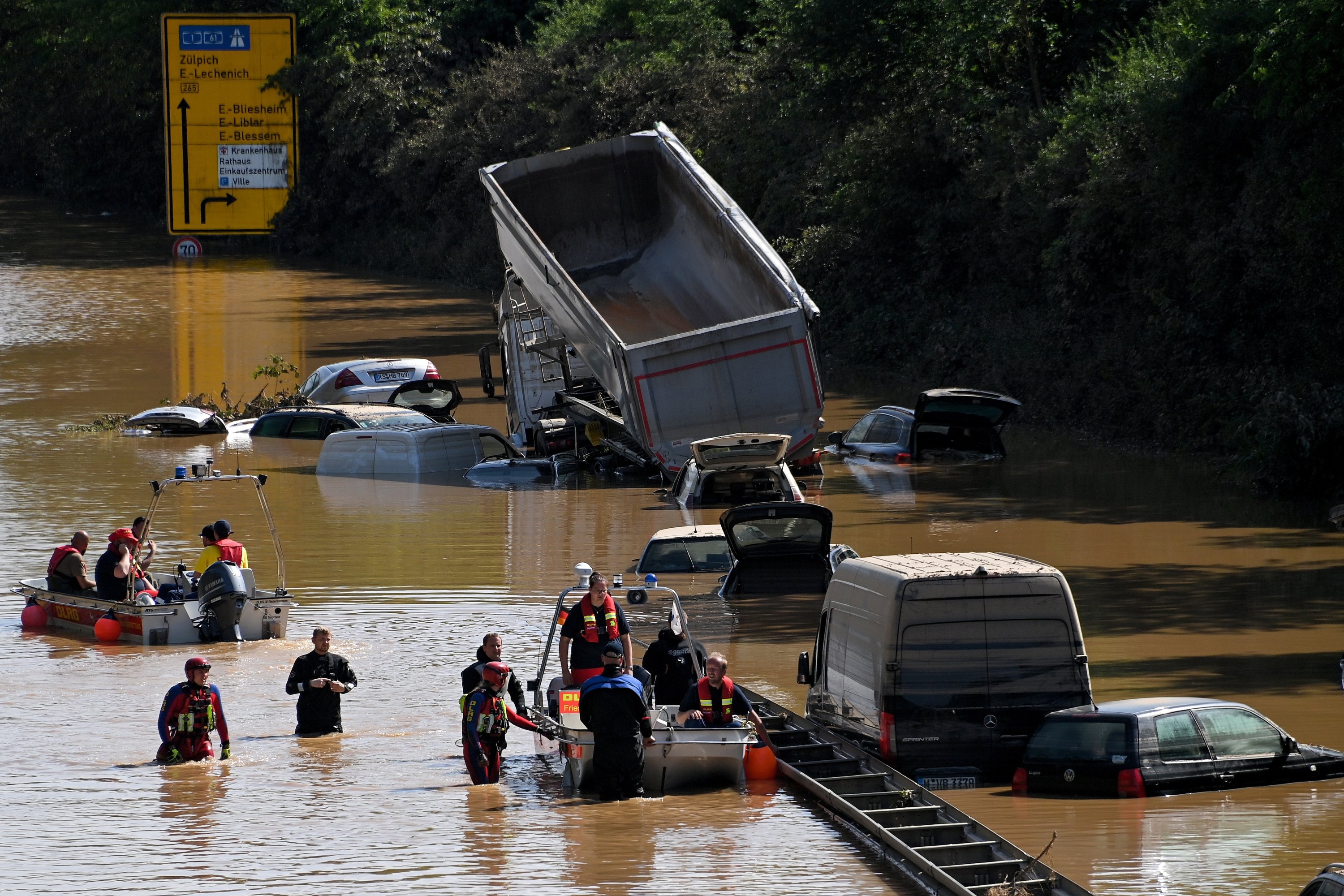
Rescue services clear wrecked cars and trucks from the B265 federal highway in Erftstadt, Germany, July 17, 2021. (EPA Photo)
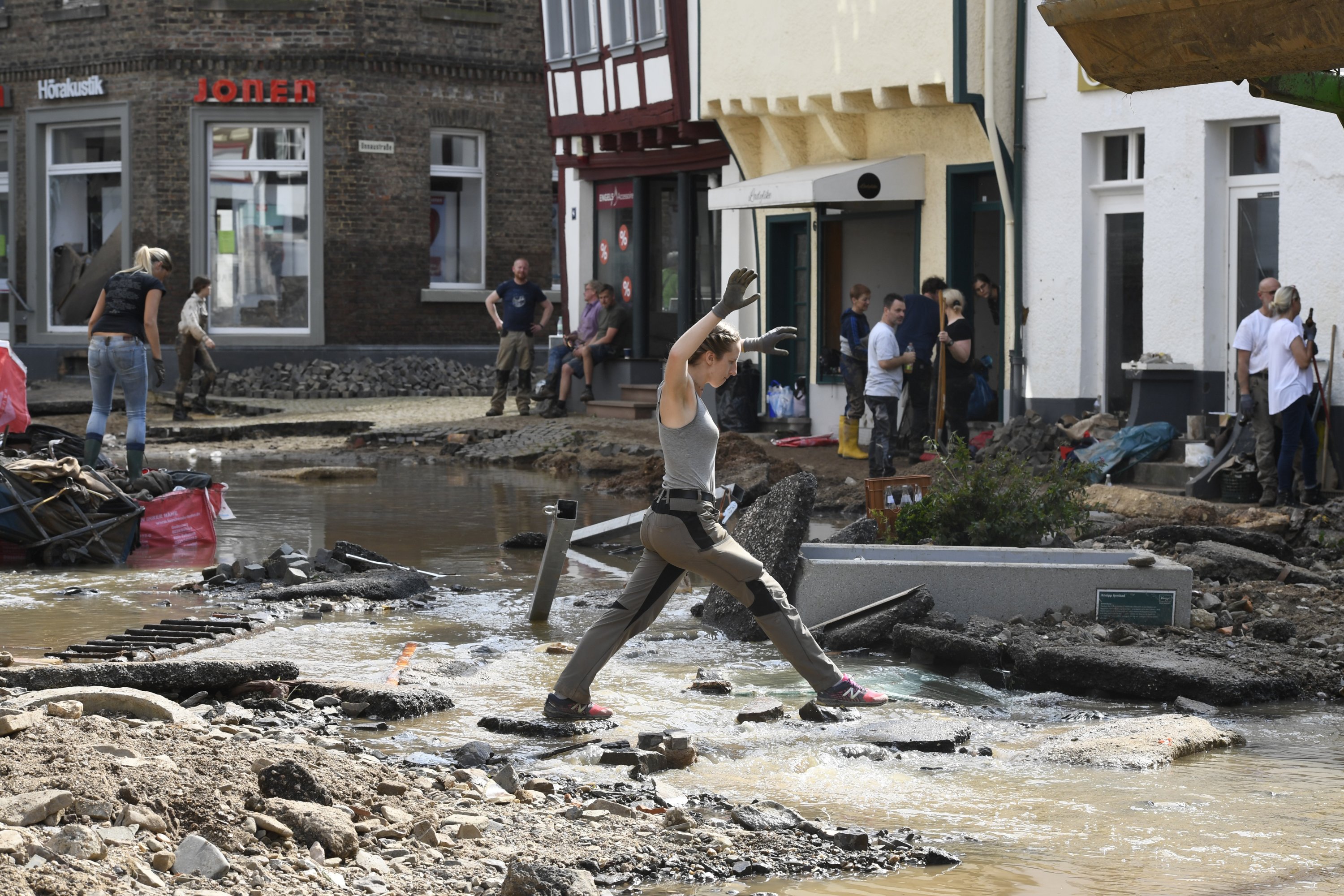
A voluteer jumps over flood water, in Bad Munstereifel, Germany, July 17, 2021. (Roberto Pfeil/dpa via AP)

Small rivers overwhelmed

The worst-hit areas have been those near small rivers or tributaries without flood defenses that have quickly become overwhelmed by the volume of rain and burst their banks.

"The Rhine is used to floods" and cities along it have built protections, unlike the towns and villages along the region's smaller rivers, Armin Laschet, head of the hard-hit North Rhine-Westphalia region, said.

"When rivers are slower and wider, the water rises less quickly and there is more time to prepare," said hydrologist Schroeter.

Lack of awareness

Local authorities have come under fire in Germany for not evacuating people soon enough.

"Forecasters ... issued warnings, yet the warnings were not taken seriously and preparations were inadequate," said Hannah Cloke, a professor of hydrology at the U.K.'s University of Reading.

Some residents were also simply unaware of the risks of such violent flooding, with dozens found dead in their cellars.

"Some victims underestimated the danger and did not follow two basic rules during heavy rainfall. Firstly, avoid basements where water penetrates. Secondly, switch off the electricity immediately," Armin Schuster, chairperson of the BBK, a state agency specializing in natural disasters, told the Bild daily.

Urban planning

Some experts have pointed to the dangers of poor urban planning and the increasing amount of concrete at the heart of a heavily industrialized, densely populated region of Europe.

The affected regions had already seen unusually high rainfall in recent weeks, meaning the soil was saturated and unable to absorb the excess water.

When the ground is covered with man-made materials like concrete, the soil is less able to absorb water, increasing the risk of flooding.

"Urbanisation ... has played a role. Would the toll have been as high 40 years ago?" Jouzel asked.


  • shortlink copied
  • Last Update: Jul 17, 2021 9:20 pm
    KEYWORDS
    natural disasters flooding germany climate crisis climate change global warming
    The Daily Sabah Newsletter
    Keep up to date with what’s happening in Turkey, it’s region and the world.
    You can unsubscribe at any time. By signing up you are agreeing to our Terms of Use and Privacy Policy. This site is protected by reCAPTCHA and the Google Privacy Policy and Terms of Service apply.
    No Image
    Israeli police clash with Palestinians in Jerusalem during Ramadan
    PHOTOGALLERY
    • POLITICS
    • Diplomacy
    • Legislation
    • War On Terror
    • EU Affairs
    • News Analysis
    • TÜRKİYE
    • Istanbul
    • Education
    • Investigations
    • Minorities
    • Diaspora
    • World
    • Mid-East
    • Europe
    • Americas
    • Asia Pacific
    • Africa
    • Syrian Crisis
    • İslamophobia
    • Business
    • Automotive
    • Economy
    • Energy
    • Finance
    • Tourism
    • Tech
    • Defense
    • Transportation
    • News Analysis
    • Lifestyle
    • Health
    • Environment
    • Travel
    • Food
    • Fashion
    • Science
    • Religion
    • History
    • Feature
    • Expat Corner
    • Arts
    • Cinema
    • Music
    • Events
    • Portrait
    • Performing Arts
    • Reviews
    • Sports
    • Football
    • Basketball
    • Motorsports
    • Tennis
    • Opinion
    • Columns
    • Op-Ed
    • Reader's Corner
    • Editorial
    • Photo gallery
    • DS TV
    • Jobs
    • privacy
    • about us
    • contact us
    • RSS
    © Turkuvaz Haberleşme ve Yayıncılık 2021