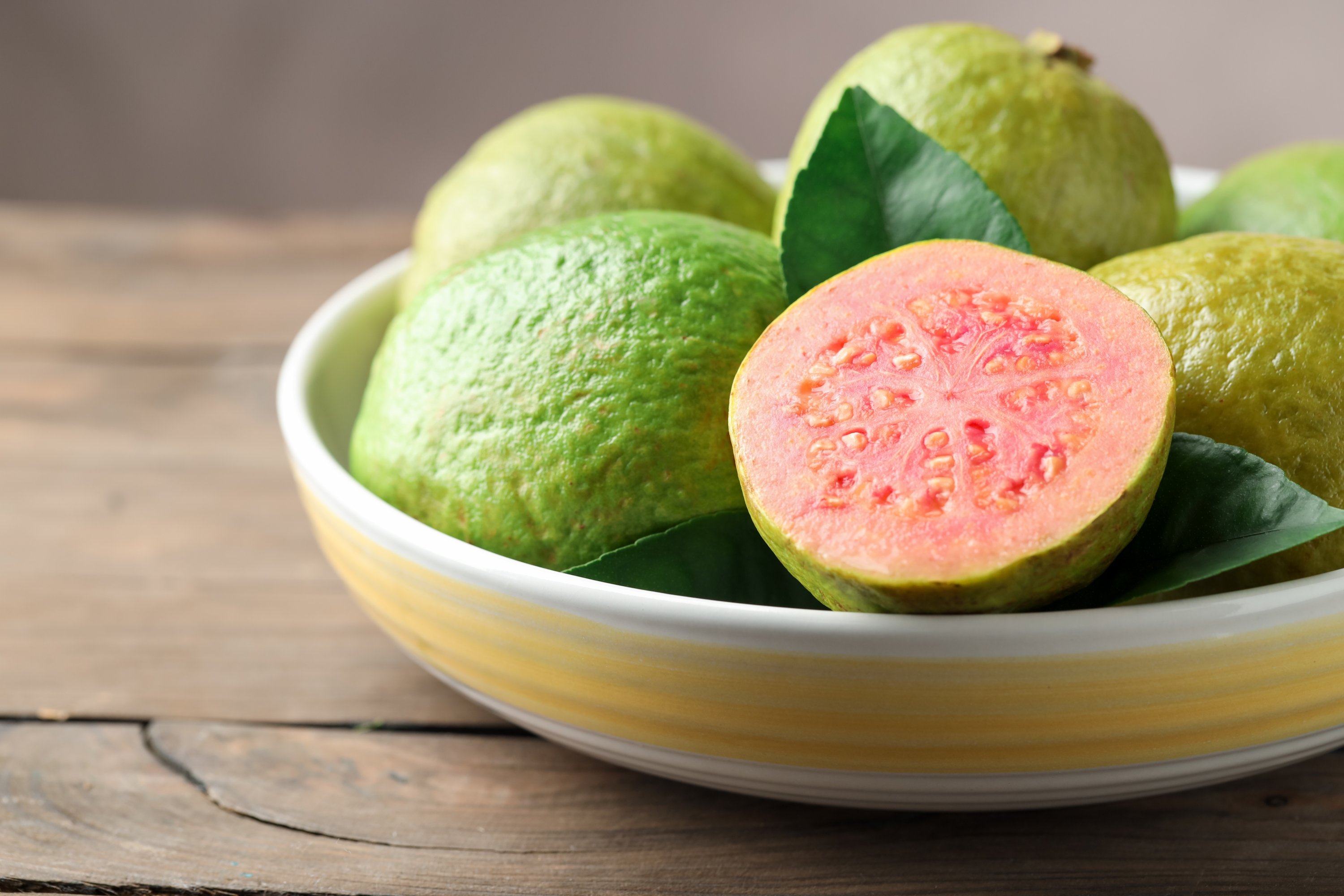
I tasted guava for the first time in my early years in America. Wandering through the Latino neighborhoods of Chicago, I came across it on the stalls of the hispanic markets locals had opened there. It was yellow skinned, eaten with the peel like an apple, about the size of a palm. On the first bite I could not tell what it was: peach, melon, banana? Then I realized it was all of them at once. Guava felt like a strange gift that carried the memory of many fruits inside a single one: the softness of peach, the freshness of watermelon, the sharpness of pineapple, the sweet tartness of strawberry, all together.
This abundance is no accident. Guava's story begins in the Amazon basin: scientists believe the fruit evolved in the savannas and semi-deciduous forests of South America, first carried by large mammals, then by humans, thousands of kilometers away. The word itself is a migration story too. "Wayaba," in the language of the Taino, the indigenous people of the Caribbean, became "guayaba" in Spanish, then leapt into French, Portuguese, English. A fruit, a word, a route, all traveling together.
In “The Fragrance of Guava,” his book length conversation with Plinio Apuleyo Mendoza (the English edition, published by Verso in 1983), Mendoza describes the house where Márquez grew up with his grandparents in Aracataca: a big, old house where the scent of jasmine hung heavy in the back garden on sweltering nights and where his grandfather sat at the head of the table every evening, calm and unhurried, amid the women's endless chatter, a plate of steaming stew in front of him. In that house, smell and hospitality were tangled together from the start; you could tell who had arrived, who was cooking, who was expected, just from what drifted through the rooms. I think this is the real subject hiding behind the title 'The Scent of Guava.' It is not really about the fruit. It is about how a house announces its own warmth before a single word is spoken.
Years later, as a grown writer working on "The Autumn of the Patriarch" in Barcelona, Márquez did something similar on purpose. The novel was set in a hot Caribbean city, but he found he could not make that heat land on the page in Barcelona's cold air. His solution was less about writing harder than about changing his surroundings: he packed up his family and spent nearly a year in the Caribbean, then, back in Barcelona finishing the book, he grew a few plants and, in his own words, "added a few smells." Only then could he carry the heat through to his reader. Maybe scent is never just a memory. Sometimes it is a summons, deliberately built.
Thinking about this, I realized I had been doing something similar without knowing it. I wanted to introduce the friends and guests I invited to our home in Hyde Park to guava, not by telling them about it, but through their own curiosity. A few hours before guests arrived, sometimes even a day before, I would set the guavas I had bought around the living room whole, unsliced, just as they were. The smell they left behind was so rich and sweet that within a short while the whole apartment smelled of guava; the moment people walked in, they found themselves chasing after a scent they could not place. When I told them it came from a fruit, their surprise only grew and they wanted to taste it right away. In a much smaller way, I think I was doing what that house in Aracataca had done long before me: letting a smell walk through the door ahead of the guest and making curiosity itself the beginning of hospitality.
One day, talking about guava, a friend of ours from Mersin, southern Türkiye, surprised me by saying he knew the fruit well, that it was actually grown in Mersin. It turns out it grows in Türkiye too, though the flesh inside is not quite like the guava I knew, leaning more toward red. He told me he had never seen the kind I was describing, the one that comes from Latin American countries, and that it caught his interest right away. I later learned that Mersin's guava is genuinely different from the guava I knew in America: the skin still turns from green to yellow, but the flesh inside is not yellow, it is a deep pink, almost slipping into red. The smell carries the same tropical, faintly musky note, but the taste is sharper, more tart, as if the Mediterranean sun had added its own edge to the fruit.
Guava's most unexpected story has nothing to do with warmth, and everything to do with the birth of a city. In 1884, a New York firm that imported guava jam sent Gavino Gutierrez, a Spanish-born civil engineer, to investigate rumors of wild guava trees near Tampa. Gutierrez never found the trees, but he fell for the region; he invited his friend, the cigar manufacturer Vicente Martínez Ybor, to come see it. In the end, Gutierrez himself drew the street grid of the new town. That is how Ybor City was born, home to thousands of immigrants from Cuba, Spain and Italy, and today one of Florida's few National Historic Landmark Districts. A search for a fruit, in an engineer's hands, became the plan of a city. Perhaps every city is, in some way, built while looking for something it never finds, but once it stands, it grows its own kind of hospitality, a place where immigrants open their doors to one another and sit down at the same table.
In the Philippines, guava is called "bayabas." A folk legend says the name comes from a cruel king called Barabas who let his people starve; a tree grew from his grave, bearing fruit that was sour at first and sweet later, feeding the hungry. Maybe it is no accident that guava, in nearly every culture, is told as a fruit that carries you from bitterness into sweetness.
Perhaps this is guava's real story: the same fruit, on two different coasts, carrying two different colors and two different memories. The yellow guava I know from America still tastes like discovery, like being a stranger somewhere new; the pink guava of Silifke tastes like home, like proximity. Elsewhere in the book, talking about what he learned from Graham Greene, Márquez makes a similar point, that the whole mystery of the tropics can be captured in something as small as the smell of a guava just beginning to rot. Now, whenever I smell a guava, I remember a Mexican market and a Mediterranean orchard at once, a city an engineer once built and a house in Aracataca that smelled of jasmine; and every time, I think that scent, in the end, is really an invitation.