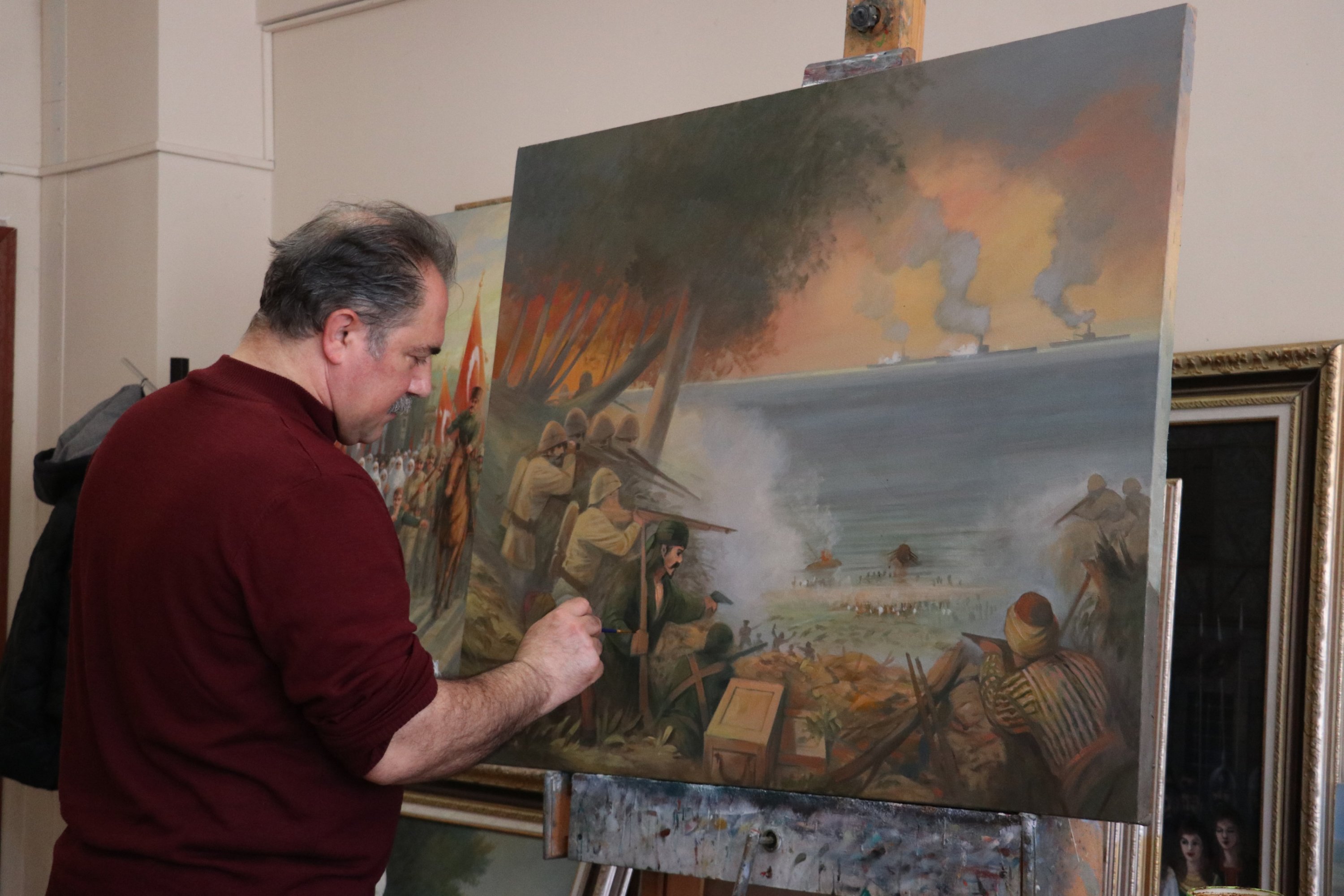
Şakir Şeyihoğlu, a lecturer at Trabzon University’s Fatih Faculty of Education, Department of Art Education, brings the history of the city onto canvas with paintings of the Ottoman and Republican periods using the Chinese ink technique.
Starting his work in 2009 to combine his interest in painting with the city’s historical past, Şeyihoğlu conducted research from various sources, especially museums.
Depicting figures who have an important place in Trabzon’s history, such as Fatih Sultan Mehmet, Kanuni Sultan Süleyman and Yavuz Sultan Selim, as well as Mustafa Kemal Atatürk, who visited the city, Şeyihoğlu has produced 200 works to date using Chinese ink and oil paint techniques.
Some of Şeyihoğlu’s works were presented as gifts to President Recep Tayyip Erdoğan during his visit to the city.
In his drawings, Şeyihoğlu prioritizes the conditions and historical details of the periods he depicts, and he presents his works to art lovers in various exhibitions organized both in Türkiye and abroad.
Speaking to Anadolu Agency (AA), Şeyihoğlu said his works were first exhibited during a promotional event held in Ankara and attracted considerable interest.
Stating that he turned to historical sources to provide more detailed depictions in his paintings, Şeyihoğlu said: “In 2018, I produced a substantial body of work with approximately 56 paintings. This series begins with the conquest of Trabzon and ends with the Republican era. I tried to depict almost all the events that we could see, access or be aware of.”
Şeyihoğlu explained that he first began working with drawings depicting Fatih Sultan Mehmet’s arrival in Trabzon with his army and continued: “After that, I painted works related to Yavuz Sultan Selim’s period as governor and certain events of the time. I also depicted Kanuni Sultan Süleyman, who was born in Trabzon. After Kanuni, I painted Trabzon Port, some locations in Trabzon and figures such as Iskender Pasha and Zağnos Pasha, who served as governors in Trabzon. Finally, we also worked on Atatürk and the Atatürk Mansion from the Republican era.”
Stating that he benefited from historical sources in his work, Şeyihoğlu said: “I also examined various visual documents from museums to reflect the atmosphere of the period and ensure that the subject was appropriate to its historical context. As a result, the paintings emerged. I bought many books. I studied everything from old engravings to sources such as the history of firearms. We also had the opportunity to obtain visual materials from museums in Europe, such as Vienna and Dresden.”
Şeyihoğlu noted that he transferred some of his drawings into a book in 2015, saying: “When we look at historical sources, I turned the attack on Trabzon in the years 1620, 1625 and 1631 into paintings. I created two works on this subject. While doing this, I also benefited from museums. I watched a film on the subject. After examining all of these, I made an interpretation. Of course, narrating the event in a single frame is quite difficult; time and process were important. With a cinematic perspective, I managed, although difficult, to place the arrival, attack and defense all in the same frame and create a strong composition.”
Şeyihoğlu added that some of his works have been included in textbooks of the Ministry of National Education, stating: “During visits to Trabzon when he was prime minister and later president, our President Recep Tayyip Erdoğan was presented with paintings featuring Fatih Sultan Mehmet, Yavuz Sultan Selim and Kanuni Sultan Süleyman.”