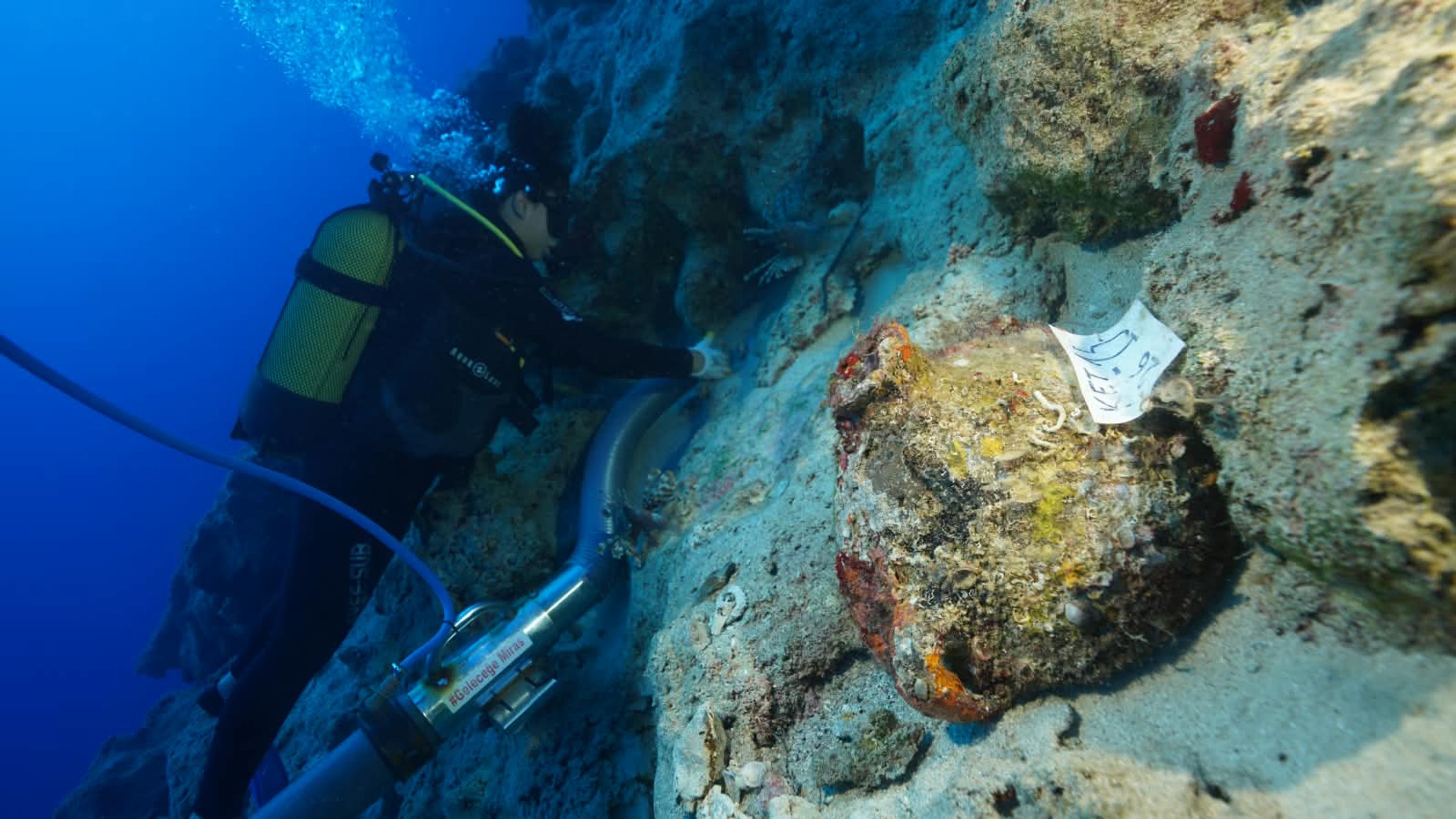
Amphorae recovered from what may be the world's oldest known shipwreck near Kekova Island off Antalya are shedding light on Anatolia's maritime history, Culture and Tourism Minister Mehmet Nuri Ersoy said.
“We are bringing traces of the world's oldest shipwreck to light in our Blue Homeland,” Ersoy said.
The amphorae, estimated to be between 4,400 and 4,700 years old, offer intriguing insights into the trade networks of the period as well as the daily lives of ancient seafarers.
In a social media post, Ersoy highlighted the significance of finds unearthed during underwater excavations off Kekova. He said the amphorae, believed to have been used to transport olive oil or wine, bear traces of trade and cultural exchange across the eastern Mediterranean.
“Clay analyses suggest the amphorae were likely produced in workshops in the Jordan Valley. Similar examples found in Egypt, Troy and Crete are particularly important for understanding the maritime trade networks that connected different regions,” he said.
Ersoy added that efforts to preserve underwater cultural heritage were continuing, saying the ministry would keep illuminating Anatolia's maritime history through new discoveries while safeguarding its underwater heritage for future generations. He also congratulated Hakan Öniz, who leads the excavations scientifically, and everyone involved in the work.
Amphora samples collected from shipwreck remains near Kekova Island during underwater archaeological surveys conducted by Akdeniz University in previous years suggest that the vessel may date back to the Early Bronze Age.
Excavations began at the site in 2026 with authorization from the Culture and Tourism Ministry, under the direction of the Antalya Museum and the scientific supervision of Öniz. The amphorae recovered from the seabed were found to be approximately 4,400 to 4,700 years old.
Clay analyses indicate that the vessels were likely made in workshops in the Jordan Valley. Similar amphorae have also been found near the pyramids of Giza, Saqqara and Abusir in Egypt, as well as in Troy and Crete, offering important clues about maritime trade connections of the era.
Researchers believe the vessel may have set sail from a port along the Levantine coast and been heading toward Troy or Crete.
One of the amphorae recovered during the excavations stands out for its nine distinct markings and two holes in its body. Researchers believe it may have been a churn amphora, a vessel used in making cheese or butter.
The find raises the possibility that sailors carried goats aboard their ships on long voyages, milked them and produced their own dairy products at sea.
The shipwreck therefore offers insights not only into the commercial cargo transported at the time but also into the diet and everyday living conditions of ancient seafarers.