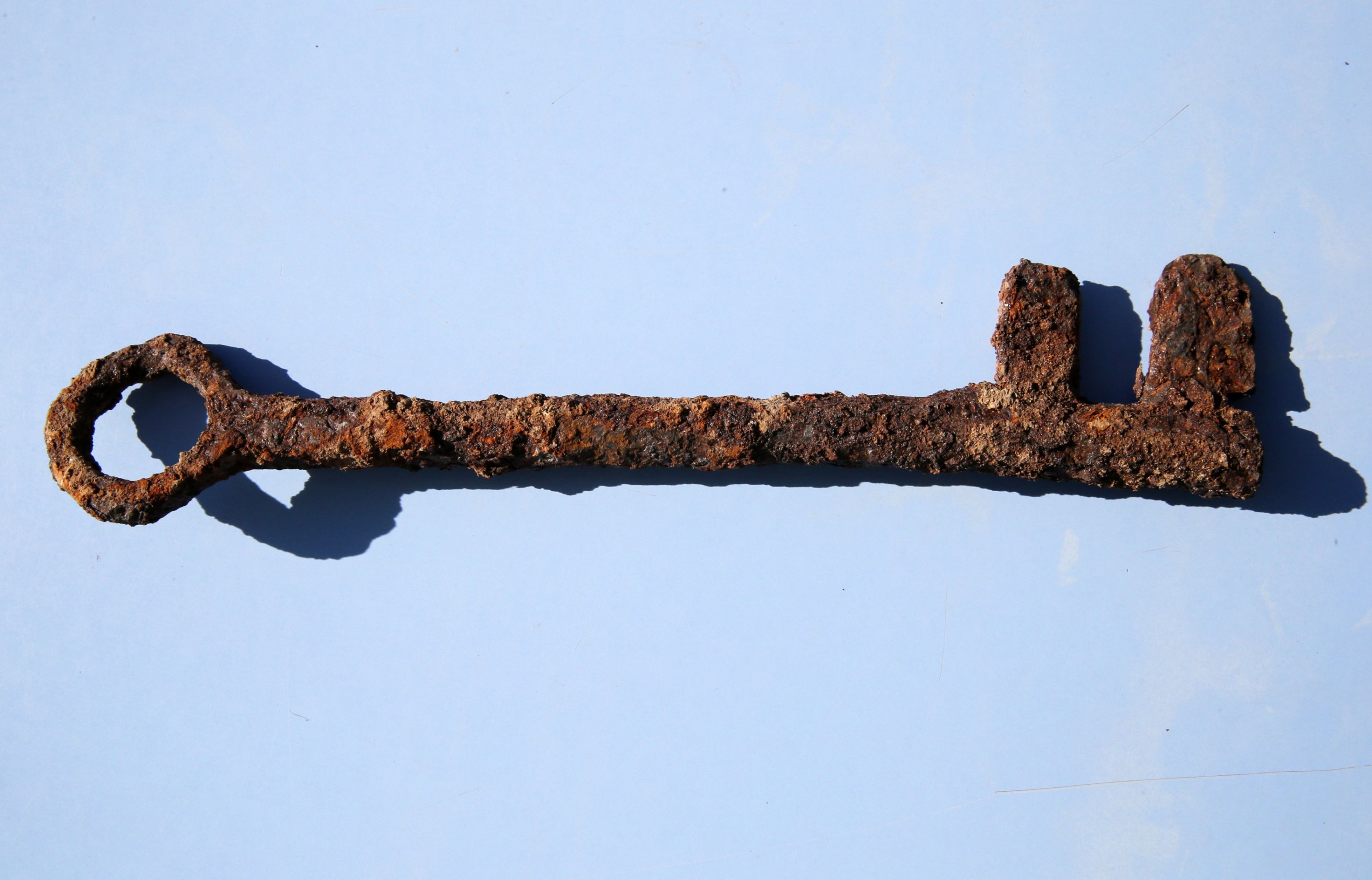
Archaeological excavations at Bitlis Castle in southeastern Türkiye, a historic site that has hosted numerous civilizations throughout history, have uncovered an iron key believed to belong to the castle’s main entrance gate. The key measures 29 centimeters in length and features a double-toothed design.
The excavations, conducted with permission from the Ministry of Culture and Tourism and led by Ahlat Museum, have revealed important findings that illuminate the rich history of the region.
Focusing primarily on the southern section of the castle, the archaeological work has been carried out under the scientific consultancy of Yunus Emre Karasu from the Department of Art History, Faculty of Literature at Bitlis Eren University.
Alongside the key, the expert team uncovered a variety of significant artifacts and structures within a 50-square-meter vaulted space, believed to be the palace’s reception area.
Due to long-term burial, the iron key and other movable cultural assets were oxidized but will undergo laboratory processing, documentation and photography before being handed over to Ahlat Museum for preservation.
Azad Örmek, the excavation and museum representative for Bitlis Castle, shared insights with Anadolu Agency (AA) about the ongoing work at the site. He emphasized the significance of this year’s discoveries, noting: “We uncovered water cisterns, water pipes, seven Muslim graves from a later era, civilian architectural remains, tandırs (traditional clay ovens), coins, pipes, oil lamps, decorative items and metal artifacts. Importantly, we found a vaulted palace reception area approximately 50 square meters in size with walls 80 centimeters thick, located near the southern main entrance of the castle, along with the key to that entrance.”
Örmek described the vaulted reception hall’s partially collapsed structure, including its brick floor and walls. He highlighted that the 29-centimeter-long key differs from other civilian keys, both in physical size and its double-toothed design, making it notably significant.
Regarding the key’s historical context, Örmek stated: “The excavation team dates the palace reception area and the key to the 15th or 16th century. Research, documentation, photography and publication processes are ongoing. After the completion of the excavation, the findings will be handed over to the Ahlat Museum. Simple maintenance, repairs and landscaping will be conducted at the castle following the archaeological work.”