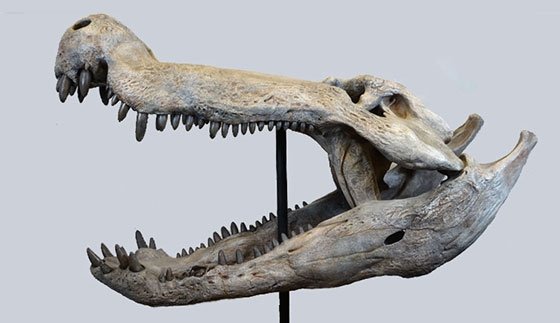
In the southern region of Patagonia, Argentina, paleontologists have uncovered the fossil remains of a massive predator believed to have fed on dinosaurs. This ancient reptile is a distant relative of today’s crocodiles and alligators.
The newly identified species has been named Kostensuchus atrox. It lived approximately 70 million years ago, during the late Cretaceous period. Researchers suggest that "K. atrox" was both a terrestrial and semi-aquatic hunter, capable of preying on herbivorous dinosaurs with relative ease.
The fossil was discovered in March 2020 during an excavation originally focused on dinosaur remains. Nearly the entire skeleton was recovered, except for parts of the tail and some limbs. Remarkably, the enamel on the teeth was well-preserved, making this the most complete peirosaurid crocodyliform fossil found in the region to date.
Fernando Novas, a paleontologist affiliated with the Felix de Azara Natural History Foundation at Maimonides University, reported that the creature measured about 3.5 meters (11.5 feet) in length and weighed around 250 kilograms (550 pounds). According to Novas, the fossilized skeleton is exceptionally well-preserved and nearly complete, providing valuable insights into this prehistoric predator.
While "K. atrox" bore a physical resemblance to modern crocodilians, researchers noted several distinct differences. Scientists interpret these similarities as an example of convergent evolution – where unrelated species independently evolve similar traits due to comparable environmental pressures. Despite their success during the Cretaceous, "K. atrox" and other large carnivorous relatives did not survive the mass extinction event at the end of the period. Experts speculate that the animal’s hypercarnivorous diet may have contributed to its inability to adapt and survive.
Future studies aim to analyze isotopic data from the teeth of K. atrox to better understand its habitat and feeding habits. Additionally, examining the bone structure could reveal information about its growth rate, age and possible diseases.
According to experts, this fossil discovered in Patagonia could unlock new secrets in the coming years about the evolution of ancient crocodile relatives and their role in the ecosystem.