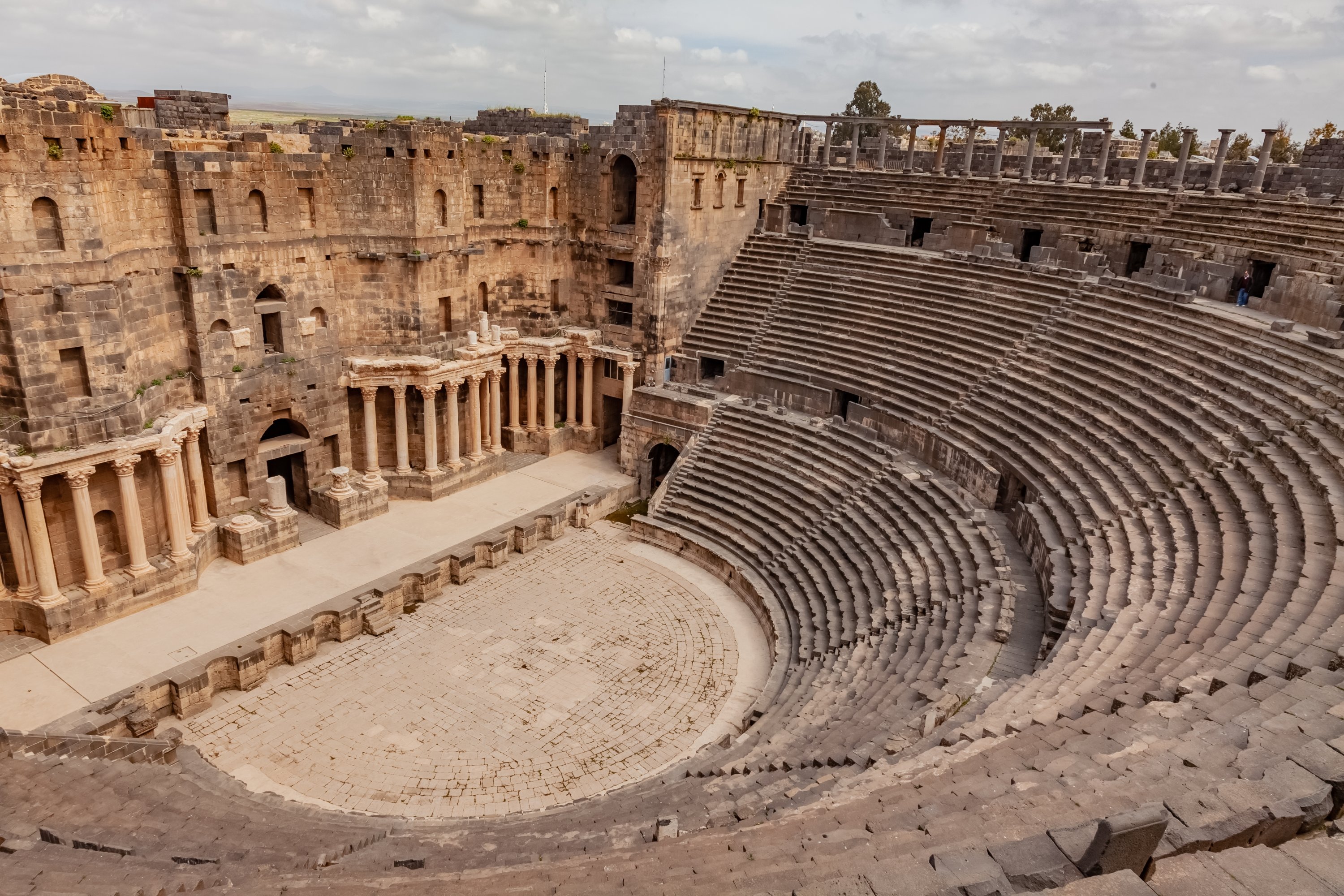
The ancient city of Bosra, a historic crossroads of civilizations and once a strategic military stronghold, continues to defy time with its striking architectural beauty.
Located near the Jordanian border in Syria’s Daraa province, Bosra is noted for its layered history spanning from the Roman Empire to the Ottoman era. The city has been on the UNESCO World Heritage List since 1980 and remains known for its well-preserved Roman theater and early Islamic-era structures.
Bosra’s name first appeared in the 15th century B.C. in the city lists of Egypt’s Pharaoh Thutmose III. By the 14th century B.C., it was recorded in the Amarna letters as “Buzruna.”
Before Roman rule, Bosra served as a major city of the Nabataean Kingdom. Under the Romans, it became the capital of the province of Arabia. During the Byzantine era, it developed into a prominent commercial hub and religious center.
The city was one of the first Byzantine territories captured by advancing Muslim forces in 634 and went on to become an important religious and cultural center during the Umayyad period.
Bosra holds a notable place in Islamic tradition. According to early biographical sources, the Prophet Muhammad traveled to Bosra twice before his prophethood.
During his first journey, at age 9 or 12, he accompanied his uncle Abu Talib. A Christian monk known as Bahira, living in a local monastery, was said to have recognized signs of prophethood in the young Muhammad.
His second visit occurred at age 25 while leading a trade caravan on behalf of Khadija. Another monk, Nastura, reportedly remarked upon seeing where Muhammad had rested, saying, “No one but a prophet has ever taken shelter beneath this tree.”
Bosra suffered damage during attacks carried out by the Syrian government in the country’s civil war between 2011 and 2024. Regime forces reportedly used the historic area as a base for operations targeting nearby settlements.
Several columns in the ancient city were destroyed and shrapnel scars remain visible on multiple historic structures, highlighting the toll of modern conflict on one of the region’s most treasured archaeological sites.