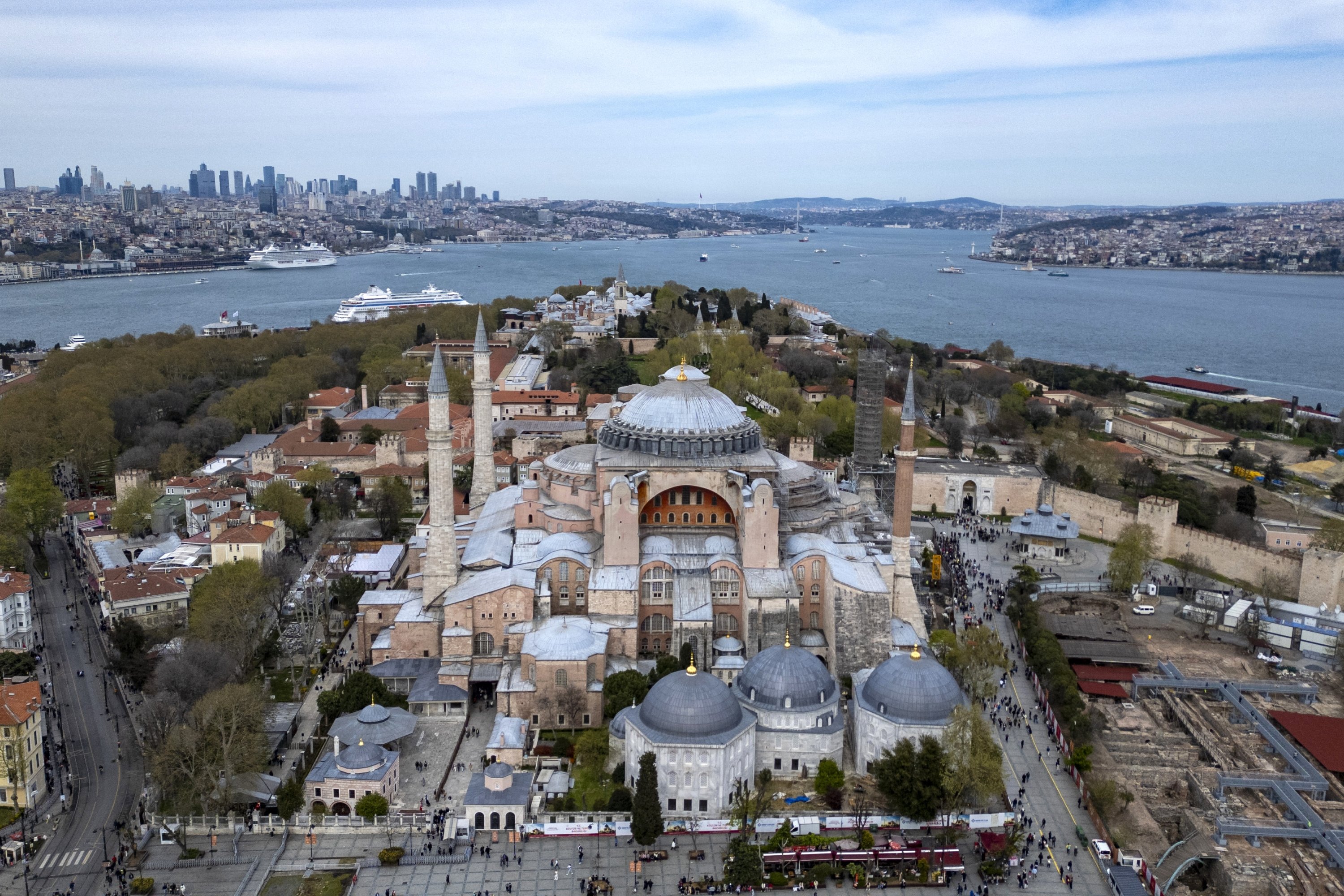
Istanbul and Ankara emerged as more strategically connected hubs than Rome in parts of the Roman Empire's extensive road system, a new international study has found, shedding light on how ancient transportation routes continue to shape modern infrastructure.
The study, titled Network Science Reveals the Structure and Lasting Impact of the Roman Road System, published in the journal Nature Communications, analyzed the empire's transportation infrastructure using mathematical models and network science.
Researchers identified several cities, including ancient Byzantium (present-day Istanbul), Ancyra (Ankara, Türkiye’s capital), Antiochia (Antakya, southern Türkiye), and Corinth (in Greece), that surpassed the capital Rome in their importance as connecting points within the empire's famed overland road system.
The findings also demonstrated how some routes established nearly 2,000 years ago continue to influence modern transportation networks across Europe, the Middle East, and North Africa.
Tom Brughmans, associate professor of classical archaeology at Denmark’s Aarhus University and one of the study's authors, told Anadolu Agency (AA) that roads played a crucial role in connecting communities across the vast Roman Empire.
He said the network facilitated not only the movement of people but also the spread of information, ideas, religious beliefs, and diseases.
Brughmans said the familiar saying "All roads lead to Rome" originated in the Middle Ages rather than the Roman era and was largely symbolic, not factual.
One of the study's most surprising findings, he said, was identifying cities that were more central than Rome within the road network.
"For example, modern-day Istanbul, or ancient Byzantium, was truly very central within the entire empire by connecting traffic between Europe and Asia," he said.
Although Rome remained an important center due to its Mediterranean location, Brughmans explained that Istanbul occupied a more central position in terms of overland transportation.
The research also highlighted the importance of ancient Ancyra, now Ankara, which served as the capital of the Roman province of Galatia.
Brughmans said Ankara's geographical location in the heart of Anatolia made it particularly suitable for organizing east-west transportation across the peninsula.
He explained that Ancyra stood along one of the province's most central roads, making it strategically positioned as a capital nearly two millennia before becoming the capital of modern Türkiye.
Matteo Mazzamurro, a lecturer in data science at Queen Mary University of London and another study author, said researchers assessed the importance of cities using three measures of network centrality.
They examined the number of road connections, accessibility to other locations, and the extent to which cities served as bridges between different routes.
"Byzantium, or later Constantinople, the area where modern Istanbul is located, is a city literally sitting at the intersection of two continents," he said, referring to Europe and Asia.
Mazzamurro emphasized that this geographical advantage made Istanbul a particularly significant connecting point within the network.
The researchers also found that some modern roads follow routes established during Roman times, particularly where ancient settlements have remained important population centers.
Brughmans said transportation networks changed considerably following the Industrial Revolution and the introduction of motorized vehicles, but notable continuity between ancient and modern routes remains.
Adam Pazout, a researcher at the Universitat Autonoma de Barcelona, said another important finding was the mathematical confirmation of the central positions occupied by Roman provincial capitals.
He noted that many roads, particularly near the empire's frontiers along the Rhine, Danube, and Euphrates rivers, were developed to meet military requirements.
In eastern Anatolia, Türkiye, some routes reaching elevations of approximately 2,000 meters (6,562 feet) in the Taurus Mountains were similarly linked to military needs, connecting frontier units despite limited settlements in surrounding areas.
Pazout said more research is needed to determine whether the centrality of provincial capitals resulted primarily from geography or deliberate Roman planning.
Hamdi Şahin, a professor of history at Istanbul University who contributed data from mountainous Cilicia in southern Türkiye, emphasized the importance of archaeological evidence in reconstructing ancient routes.
He said researchers rely on milestones, historical texts, and surviving paved roads to identify transportation networks.
According to Şahin, between 400 and 500 new inscriptions are still discovered annually in Türkiye, including milestones and other evidence related to ancient roads.
The international research team also developed a high-resolution digital dataset covering approximately 299,000 km (about 186,000 mi) of Roman roads.
The publicly accessible Itiner-e platform allows researchers to explore ancient routes and settlements, providing new opportunities for studies in archaeology, history, economic geography, and transportation.
The researchers hope the findings will serve as a foundation for further investigations into how ancient infrastructure shaped economic activity, urban development, and connections between regions.