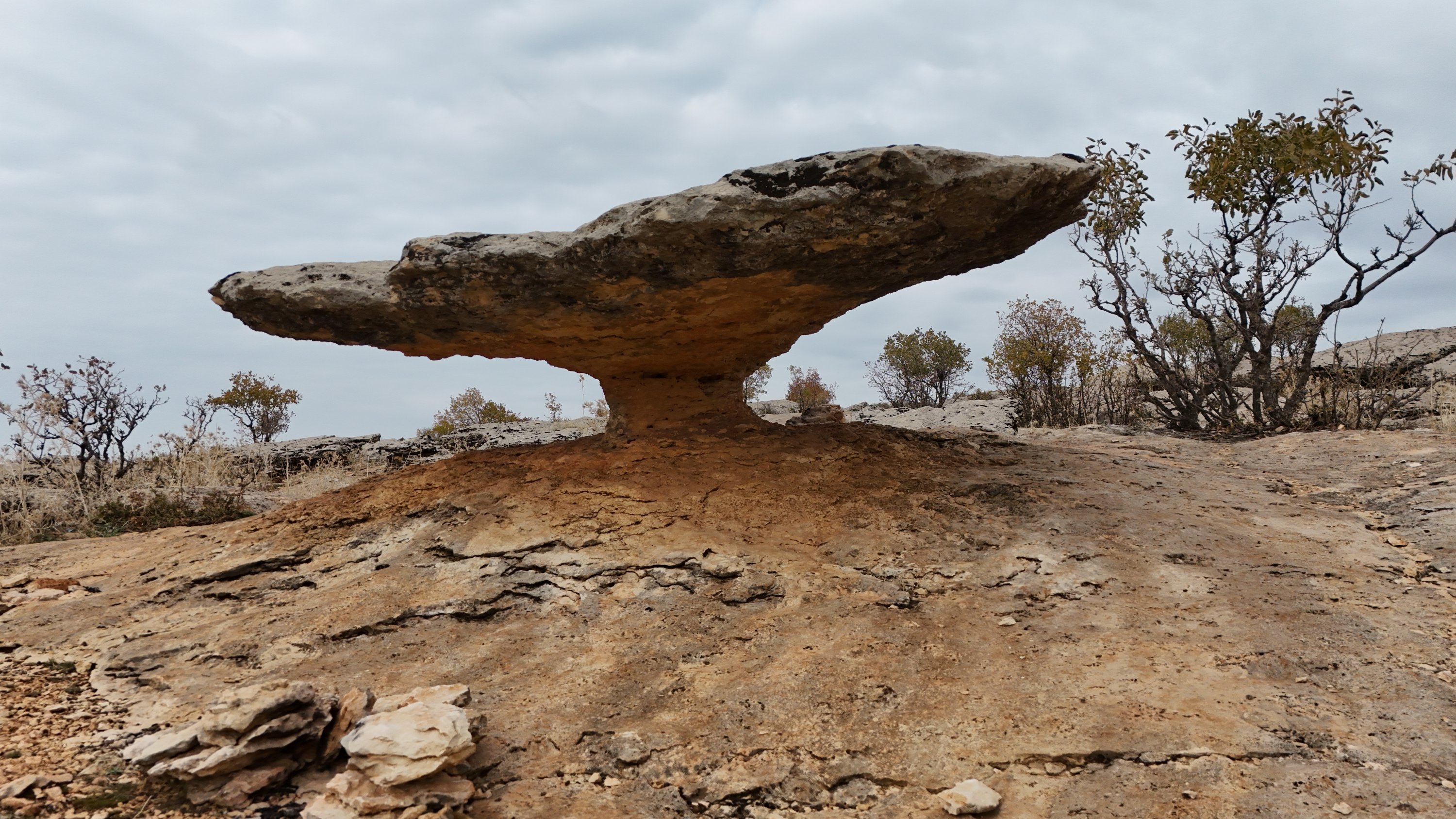
In the Kocaköy district of Diyarbakır, southeastern Türkiye, a broad rock formation perched atop a slender column draws attention as a striking natural wonder. Known locally as the “Mushroom Rock” or “Shield Rock,” this geological marvel, thought to be a remnant of the Ice Age, captivates both locals and visitors.
Located about 4 kilometers (2.4 miles) from the district center, the rock impresses with its seemingly impossible balance. Despite its narrow supporting column, the wide upper portion has remained intact for millennia of natural erosion.
Anthropologist Naci Akdemir explained that the area consists of sedimentary rock layers. He noted that the land was formed as the African-Arabian tectonic plate pushed the Eurasian plate northward. “This terrain is still both rising and slowly moving north,” Akdemir said. He added that this geological process began approximately 250-300 million years ago and continues today. “According to experts, the rate of movement is comparable to the growth of human nails – about 10-15 millimeters per year. The formation we see here is one of the finest examples of what geographers call a ‘devil’s table’ or ‘mushroom rock.’”
Akdemir believes that while such formations are generally shaped by water and wind erosion, this particular rock also bears the mark of glacial activity. “If you look carefully, there is no water stream or trace of significant water erosion on the site. That’s why I see this structure as a remnant from the Ice Age, formed through glacial abrasion,” he explained.
The formation is called “Shield Rock” because its shape resembles a battle shield. Akdemir emphasized its significance: “This rock is one of Kocaköy’s most important symbols. It took its current shape around 5-6 million years ago, at a time when the remnants of the ancient Tethys Sea still influenced the region’s geography. The Mediterranean is what remains of that ancient sea.”