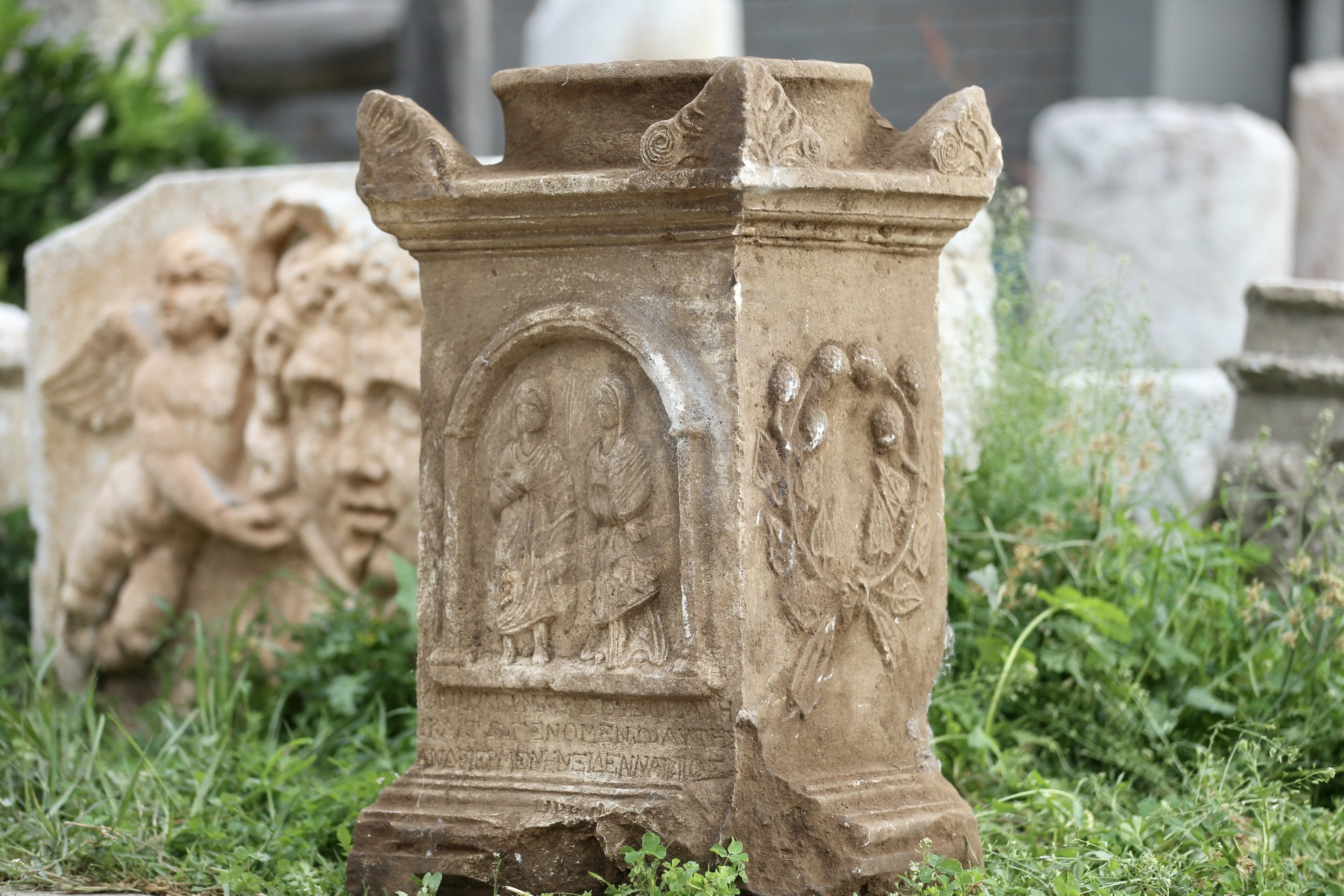
In the Seydikemer district of Muğla, located in southwestern Türkiye, a human-figured grave stele in the form of an altar – discovered by a shepherd grazing his goats – has been placed under protection and will soon be exhibited in a museum.
The shepherd noticed the stele while tending his goats in the forested area of Kayacık neighborhood and reported it to the Fethiye Museum Directorate.
Upon investigation by a team dispatched to the site, the artifact was determined to be historical. Due to its weight, it could not be immediately moved. To prevent damage, it was temporarily buried and surveillance cameras were installed in the area.
After preparatory work, the team returned to the site, reaching the stele after approximately a 45-minute walk from the main road. The artifact, estimated to weigh around 300 kilograms (661 pounds), was carefully wrapped and prepared for transport. In the rugged terrain, archaeologists and workers carried the stele for roughly seven hours before it was brought to the Fethiye Museum Directorate.
Once the necessary procedures are completed, the stele will be displayed to the public.
Ahmet Meke, an archaeologist involved in the transport, told Anadolu Agency (AA) that the artifact was discovered by a local herder and examined in detail by specialists following the report.
Meke noted that the stele dates back to the Roman Period, between the first and third centuries A.D. “This artifact is an example of an altar-type grave stele commonly seen in Anatolia. What makes it unique are its relief carvings, iconographic depictions and the inscription at the base, which provides it with epigraphic significance,” he explained.
“The front of the stele features figures of a man and a woman, likely representing a family portrait. From the clothing and depiction, we can observe aspects of family culture, daily life and socio-cultural status during the Roman Period,” Meke added.
The inscription on the stele contains information about the deceased. On the side, a wreath and additional depictions can be seen. “The wreath symbolizes victory and honor. The figure depicted is likely a significant person within the community. Examples like this highlight the importance of public awareness in protecting cultural heritage,” he emphasized.
Meke urged anyone who discovers or identifies cultural artifacts to report them to museum directorates or law enforcement to ensure their preservation.
“The stele was transported over rugged and rocky terrain in about seven hours. After cleaning and conservation work, it will be cataloged and exhibited. We have also proposed designating the area as a protected site and surveillance cameras have been installed for security,” Meke concluded.