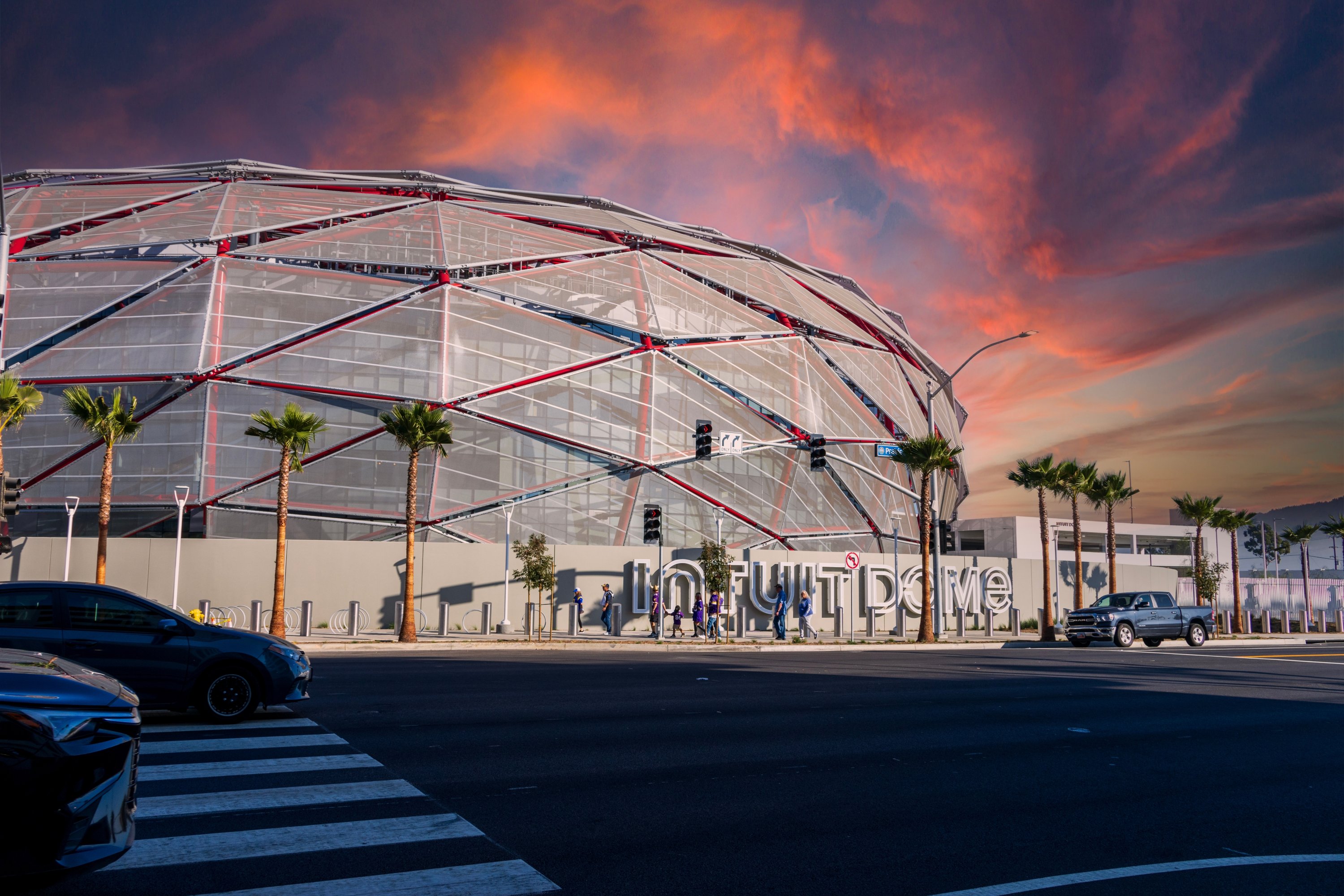
For a century, the architectural brief for a sports stadium was simple: provide a view of the grass or hardwood, keep the beer cold, and get the crowd out of the parking lot as fast as possible. But in the sprawl of Los Angeles – a city that eats, sleeps and breathes the intersection of technology and glamour – "simple" was never going to be enough. When Steve Ballmer set out to build a home for the Los Angeles Clippers, he didn't just build a basketball court. He built a $2 billion living sculpture.
The Intuit Dome, located in the heart of Inglewood, has effectively redefined the "night out." It is a place where the boundary between a high-stakes NBA game and a high-concept contemporary art gallery has been completely erased. For the modern traveler, the design enthusiast, or the digital art collector, the Intuit Dome is now as essential to an LA itinerary as a trip to the Getty or the LACMA.
To truly understand why the Intuit Dome is a sensory revolution, you have to look at the "dead time" – those moments usually spent in security lines, at ticket gates, or fumbling for a wallet. At the Dome, these moments have been engineered out of existence.
Your experience begins long before you reach the turnstiles. Through the Intuit Dome App, fans enroll in "GameFace ID." As you approach the massive, illuminated plaza – past the public basketball courts and Refik Anadol’s towering digital displays – there is no need to dig for a phone or a paper ticket.
The "Zoom Thru" lanes use facial recognition to identify you in motion. You simply walk at a natural pace, and the system clears you. It feels less like entering a high-security sports venue and more like walking into a private club that already knows your name. For those who prefer a more traditional touch, the "Identity Pass" allows for a simple tap-to-enter via Apple or Google Wallet, but the true magic lies in the seamless, hands-free flow of the crowd.
Once inside, the "Art Gallery" aesthetic extends to the concessions. Forget the neon-lit, plastic-wrapped stadium food of the past. The Intuit Dome features "checkout-free" markets. You tap your phone or simply walk in (if your payment is linked to your GameFace ID), grab a gourmet snack or a local craft beer, and walk right back out to your seat. Sensors and AI cameras track what you’ve taken, billing your account automatically.
This technological wizardry serves a human purpose: it ensures that the "sightseeing" isn't interrupted by a 20-minute wait for a drink. You spend your pre-game time wandering the concourses, taking in the curated art installations and the breathtaking views of the Inglewood skyline, rather than staring at the back of someone’s head in a queue.
As you move toward your seat, the transition from the airy, naturally ventilated concourses to the high-intensity "Bowl" is a master class in atmospheric pressure. The seating is steeply banked – the steepest in the NBA – designed specifically to keep every fan "on top" of the action.
As the lights dim for the player introductions, the Halo Board overhead ignites, and your seat’s built-in LED lights begin to pulse in synchronization with the music. You aren't just sitting in a chair; you are a single pixel in an 18,000-person light show. By the time the ball is tipped, the "sensory revolution" is complete. You have moved from the digital dreamscape of Refik Anadol on the plaza to the heart of the most technologically advanced sports environment on earth, all without ever having to stop moving.
Before you even step foot inside, the Intuit Dome announces itself as an architectural marvel. Designed by AECOM, the exterior features a stunning gridshell structure – a series of interlocking diamond-shaped metal panels that wrap around the building like futuristic armor.
The inspiration is poetic: the geometry is modeled after the flow of a basketball passing through a net. But the function is purely Californian. The shell is a "loose fit" over the actual building, creating naturally ventilated indoor-outdoor concourses. This allows the scent of the Pacific breeze and the warmth of the Inglewood sun to permeate the space, making the "sightseeing" aspect of the arena feel organic rather than clinical. It is the world's first 100% carbon-neutral arena, proving that the future of luxury and the future of the planet can exist in the same footprint.
While the architecture draws you in, the art keeps you there. The crown jewel of the Clippers' $20 million public art program is undoubtedly Refik Anadol’s "Living Arena." Anadol, a global pioneer in the aesthetics of data and machine learning, has transformed the very concept of a "stadium screen."
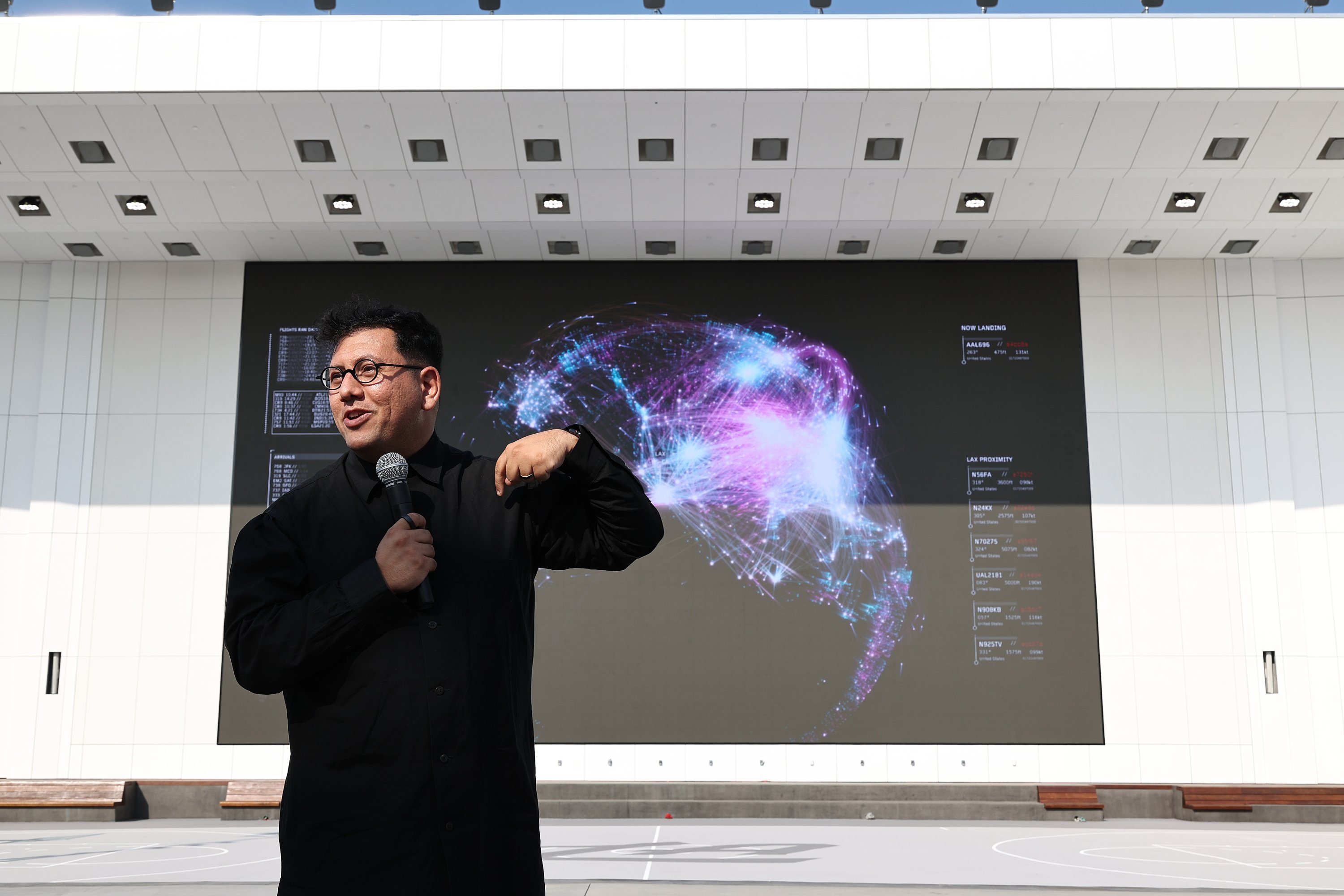
His installation is a monumental LED canvas that breathes with the city. Using AI to process fluid dynamics and environmental data, Anadol’s work visualizes the invisible. It takes the wind patterns of Los Angeles, the flight paths from nearby LAX, and the historical archives of the Clippers themselves, and weaves them into a hypnotic, shifting landscape of color and light.
To stand before Living Arena is to see the stadium’s "nervous system" exposed. It isn't just a static loop of images; it is a generative, real-time response to the world around it. For those who follow Anadol’s work in Istanbul, New York, or London, seeing this site-specific masterpiece in a sports context is a revelation. It tells the visitor that the Intuit Dome isn't just a place to watch a game – it’s a place to experience the cutting edge of human creativity.
The "Art Gallery" vibe doesn't stop at the lobby. Once you enter the seating bowl, you are greeted by the Halo Board – a 38,000-square-foot, double-sided 4K LED ring that hovers over the court. It is the largest ever built, but its purpose isn't just to show replays. It is a digital sky.
The interactivity of the dome is where the "sensory revolution" truly takes hold. Steve Ballmer’s background in technology is evident in every armrest. Each of the 18,000 seats is equipped with a game controller and four buttons. During timeouts, the entire arena turns into a massive, crowdsourced video game. Fans participate in real-time trivia, mentalist challenges and light shows that turn the crowd into a pixelated sea of color.
Even the acoustics were treated with the precision of a concert hall. Utilizing Glass Fiber Reinforced Gypsum (GFRG) ceilings and specialized noise-dampening walls, the sound of the ball hitting the hardwood is as crisp as a live recording. The dome was built to amplify the roar of "The Wall" – the 51 rows of dedicated fans – but it was also built to ensure that every note of a halftime performance or every word of a post-game interview is heard with museum-grade clarity.
What makes this experience truly unique for the high-end traveler is the "frictionless" nature of the visit. The Intuit Dome utilizes biometric "Zoom Through" technology. You don’t stand in line for popcorn; you don't wait to pay for a jersey. Facial recognition and palm-scanning allow you to walk into a shop, grab what you need, and walk out. This removes the "stress" of a traditional stadium visit, allowing more time to appreciate the dozens of other art installations, such as Glenn Kaino’s Sails or Jennifer Steinkamp’s Swoosh.
In a city that has seen it all, the Intuit Dome stands out because it refuses to be just one thing. It is a cathedral for basketball, yes. But it is also a testament to industrial design, a pioneer in sustainable engineering, and a world-class gallery for digital art.
Whether you are there to see a buzzer-beater or to lose yourself in the AI-driven dreams of Refik Anadol, the Intuit Dome offers a glimpse into the future of urban entertainment. It is a reminder that in the 21st century, the most exciting part of the game might just be the building it’s played in. If you find yourself in Los Angeles, don't just go for the game. Go for the experience. The "living arena" is waiting for you.