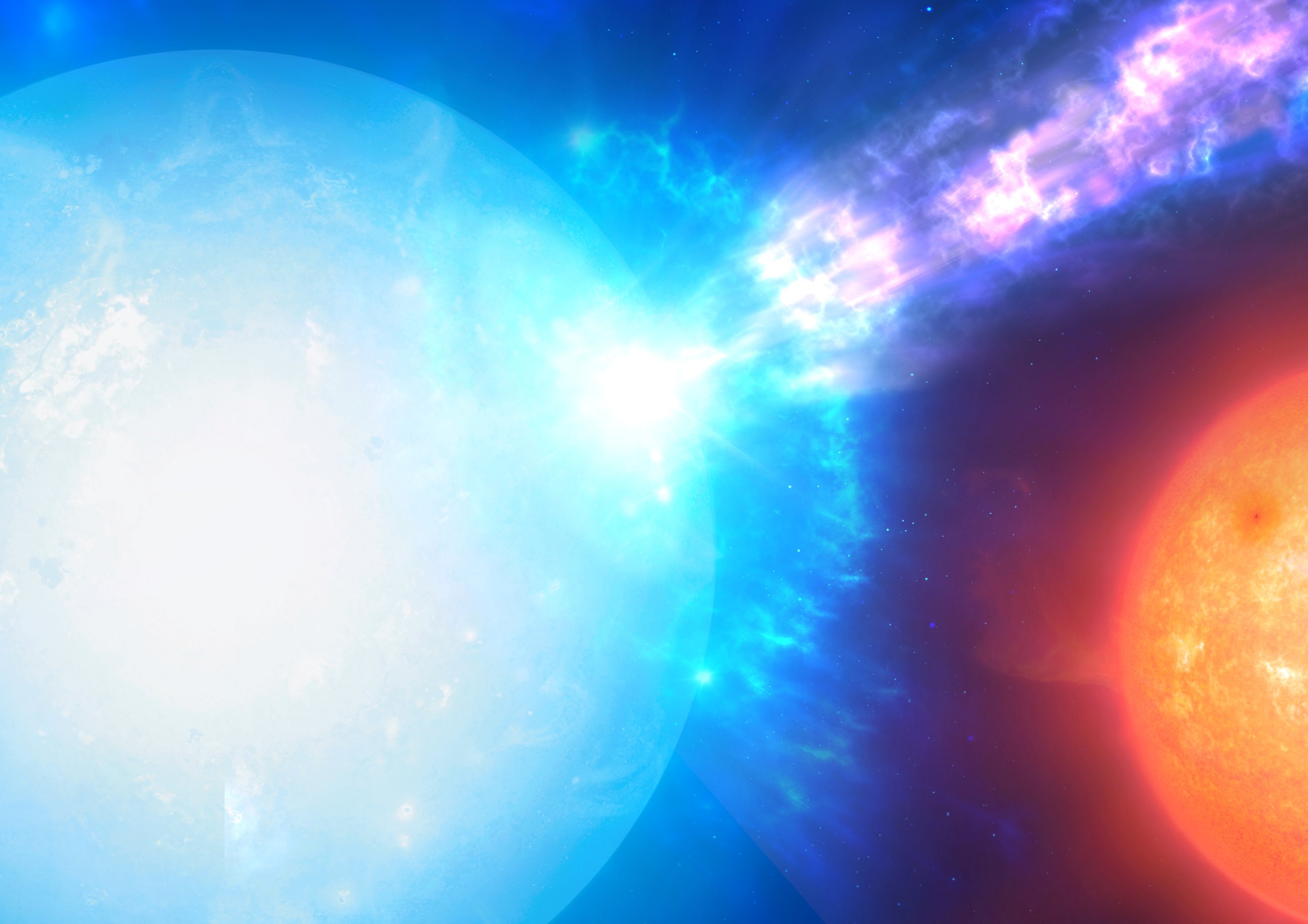
If there was a supernova, it only made sense that there would be a micronova as well, but that wasn't the case until recently, as astronomers have detected a previously unknown type of stellar explosion called a micronova just recently involving thermonuclear blasts at the polar regions of a type of burned-out star called a white dwarf after it has siphoned material from a companion star.
The researchers said on Wednesday a micronova is by far the least powerful type of star explosion now known – less energetic than a blast called a nova in which a white dwarf's entire surface blows up and tiny compared to a supernova that occurs during the death throes of some giant stars.
Micronovae are observed from Earth as bursts of light lasting about 10 hours. They were documented on three white dwarfs – one 1,680 light-years away from Earth, one 3,720 light-years away and one 4,900 light-years away. A light-year is the distance light travels in a year, 9.5 trillion kilometers (5.9 trillion miles).
"The discovery was an unexpected surprise. It goes to show just how dynamic the universe is. These events are fast and sporadic. Finding them requires looking at the right place at the right time," said astronomer Simone Scaringi of Durham University in England, lead author of the study published in the journal Nature.
White dwarfs, among the densest objects in the universe, resulting from the collapse of a dying star's core. They have the mass of our sun but are about the size of Earth in diameter. Most stars, including the sun, are destined to end their existence in this form.
Some white dwarfs are part of what is called a binary system in an orbit with another star.
Micronovae happen in very specific binary systems – with a white dwarf star possessing a strong magnetic field and a low-mass normal star. The white dwarf's gravitational pull can strip hydrogen gas from the companion star's surface. The hydrogen then flows toward the white dwarf's magnetic poles, similar to how Earth's magnetic field channels the solar wind to our planet's magnetic poles, causing the auroras.
At the base of accumulating columns of gas at the white dwarf's poles, pressure and temperature rise, causing thermonuclear fusion that converts hydrogen into helium.
"Under the conditions in which this is triggered, this fusion is explosive, and the micronova occurs: a thermonuclear 'bomb' goes off," said astronomer and study co-author Paul Groot, who divides his time between Radboud University in the Netherlands and the University of Cape Town and South African Astronomical Observatory.
The explosion is localized and does not destroy the white dwarf. In fact, the micronova cycle can repeat itself.
"Only a very small percentage of the white dwarf participates in this explosion, roughly about one-millionth of the surface area. Translated to the Earth this would be an area of about, say, the city of London," Groot added.
Each micronova event burns through the material the equivalent of one large asteroid, or just over one-millionth of Earth's mass, Scaringi said.
A micronova is similar to a nova, a thermonuclear explosion engulfing a white dwarf's entire surface. The white dwarf lacks a strong magnetic field with novae, meaning that hydrogen stolen from the companion star is distributed globally rather than concentrating at the poles. Novae can last for weeks or months, burning through about a million times more mass than micronovae, Scaringi said.
The researchers discovered the micronovae when analyzing data from NASA's TESS space telescope. They used the European Southern Observatory's Chile-based Very Large Telescope to confirm the explosions involved white dwarfs.
Some other types of stellar explosions include a kilonova, when two neutron stars or a neutron star and a black hole merge; a hypernova, a kind of supernova involving a massive star exploding at the end of its life cycle and collapsing to form a black hole; and a luminous red nova involving two stars merging.