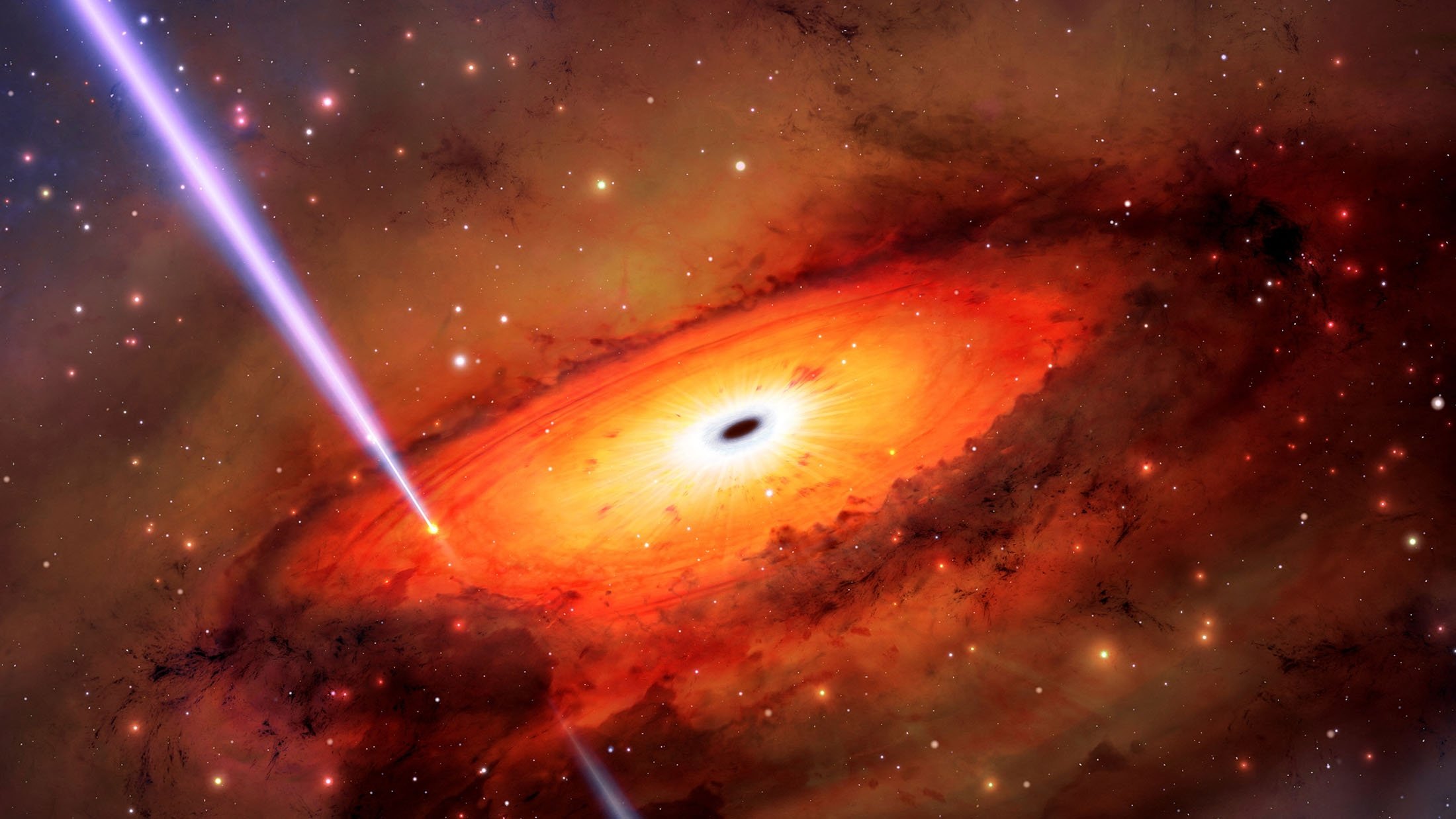
A colossal burst of energy originating from a distant galaxy has been detected by astronomers, in an extraordinary event that seems to have been caused by the destruction of a star, a phenomenon theorized for many years but never witnessed until now. One might call it stellar death by demolition derby.
Researchers said the gamma-ray burst they observed may have been caused by the collision of two compact stars in the densely packed and chaotic environment near a supermassive black hole at the center of this elliptically shaped galaxy. They suspect the two doomed stars were neutron stars, which pack roughly the mass of our sun into a sphere only the size of a city.
"In order to explain the gamma-ray burst, it has to have been a compact star, so not one like the sun," said astronomer Andrew Levan of Radboud University in the Netherlands, lead author of the research published this week in the journal Nature Astronomy.
"Gamma-ray bursts are the most powerful explosions in the universe. They release more energy per unit time than any other known cosmic phenomena. So they are really superlative in their properties. Their name comes from the first type of light that we see, gamma-rays, but they actually emit across the electromagnetic spectrum," said astrophysicist and study co-author Wen-fai Fong of Northwestern University in Illinois.
Immense gravitational forces exerted by the black hole at the galactic center may wreak havoc, perturbing the motion of nearby stars and other objects and increasing the chances of collisions - akin, the researchers said, to a demolition derby.
"Most stars in the universe die in a predictable way, which is just based on their mass," Levan said. "This research shows a new route to stellar destruction."
Very massive stars – more than 10 times the sun's mass – die in a supernova blast that leaves behind neutron stars or even denser black holes, whose gravitational pull is so strong no matter or light can escape. Relatively low-mass stars like our sun puff up and blow off their outer layers, transforming into a stellar remnant called a white dwarf.
The new findings show another path to stellar demise.
"The idea that stars also can die through collisions in extremely dense regions has been around since at least the 1980s. So we've been waiting for 40 years for the signatures to be found observationally," Levan said.
The researchers used data from orbiting and ground-based telescopes to study the gamma-ray burst in a galaxy about 3 billion light-years away from Earth, roughly in the direction of the constellation Aquarius. A light year is the distance light travels in a year, 5.9 trillion miles (9.5 trillion kilometers).
This ancient galaxy was populated primarily by stars several billion years old.
"The galaxy is what we call 'quiescent' – a galaxy that is not actively forming stars at a high rate and is past its heyday," Fong said. "These quiescent galaxies are very massive and have built up large supermassive black holes in their centers, making them a perfect breeding ground for stellar collisions."
The distance between our sun and the nearest star, Proxima Centauri, is about four light years. This same expanse of space would be filled with perhaps ten million stars in a galactic core, with the supermassive black hole's destabilizing influence stirring things up.
"You certainly wouldn't want a front-row seat to one of these events," Levan said.
"But, if you were close enough, you would see the two neutron stars get ever closer until their gravity deforms them and they begin to shred," Levan added. "Then the cores of the stars would merge to make a black hole, surrounded by a disc of the remaining material. A fraction of a second later, this material would flow into the black hole, and a jet of material moving at 99.99% of the speed of light would launch," representing the gamma-ray burst.