Daily Sabah logo

Politics
Diplomacy Legislation War On Terror EU Affairs Elections News Analysis
TÜRKİYE
Istanbul Education Investigations Minorities Expat Corner Diaspora
World
Mid-East Europe Americas Asia Pacific Africa Syrian Crisis Islamophobia
Business
Automotive Economy Energy Finance Tourism Tech Defense Transportation News Analysis
Lifestyle
Health Environment Travel Food Fashion Science Religion History Feature Expat Corner
Arts
Cinema Music Events Portrait Reviews Performing Arts
Sports
Football Basketball Motorsports Tennis
Opinion
Columns Op-Ed Reader's Corner Editorial
PHOTO GALLERY
JOBS ABOUT US RSS PRIVACY CONTACT US
© Turkuvaz Haberleşme ve Yayıncılık 2025

Daily Sabah - Latest & Breaking News from Turkey | Istanbul

  • Politics
    • Diplomacy
    • Legislation
    • War On Terror
    • EU Affairs
    • Elections
    • News Analysis
  • TÜRKİYE
    • Istanbul
    • Education
    • Investigations
    • Minorities
    • Expat Corner
    • Diaspora
  • World
    • Mid-East
    • Europe
    • Americas
    • Asia Pacific
    • Africa
    • Syrian Crisis
    • Islamophobia
  • Business
    • Automotive
    • Economy
    • Energy
    • Finance
    • Tourism
    • Tech
    • Defense
    • Transportation
    • News Analysis
  • Lifestyle
    • Health
    • Environment
    • Travel
    • Food
    • Fashion
    • Science
    • Religion
    • History
    • Feature
    • Expat Corner
  • Arts
    • Cinema
    • Music
    • Events
    • Portrait
    • Reviews
    • Performing Arts
  • Sports
    • Football
    • Basketball
    • Motorsports
    • Tennis
  • Gallery
  • Opinion
    • Columns
    • Op-Ed
    • Reader's Corner
    • Editorial
  • TV
  • Life
  • Health
  • Environment
  • Travel
  • Food
  • Fashion
  • Science
  • Religion
  • History
  • Feature
  • Expat Corner

Lab-grown embryo models offers insights amid ethical debates

by Agence France-Presse - AFP

BANGKOK Sep 07, 2023 - 2:09 pm GMT+3
Edited By Buse Keskin
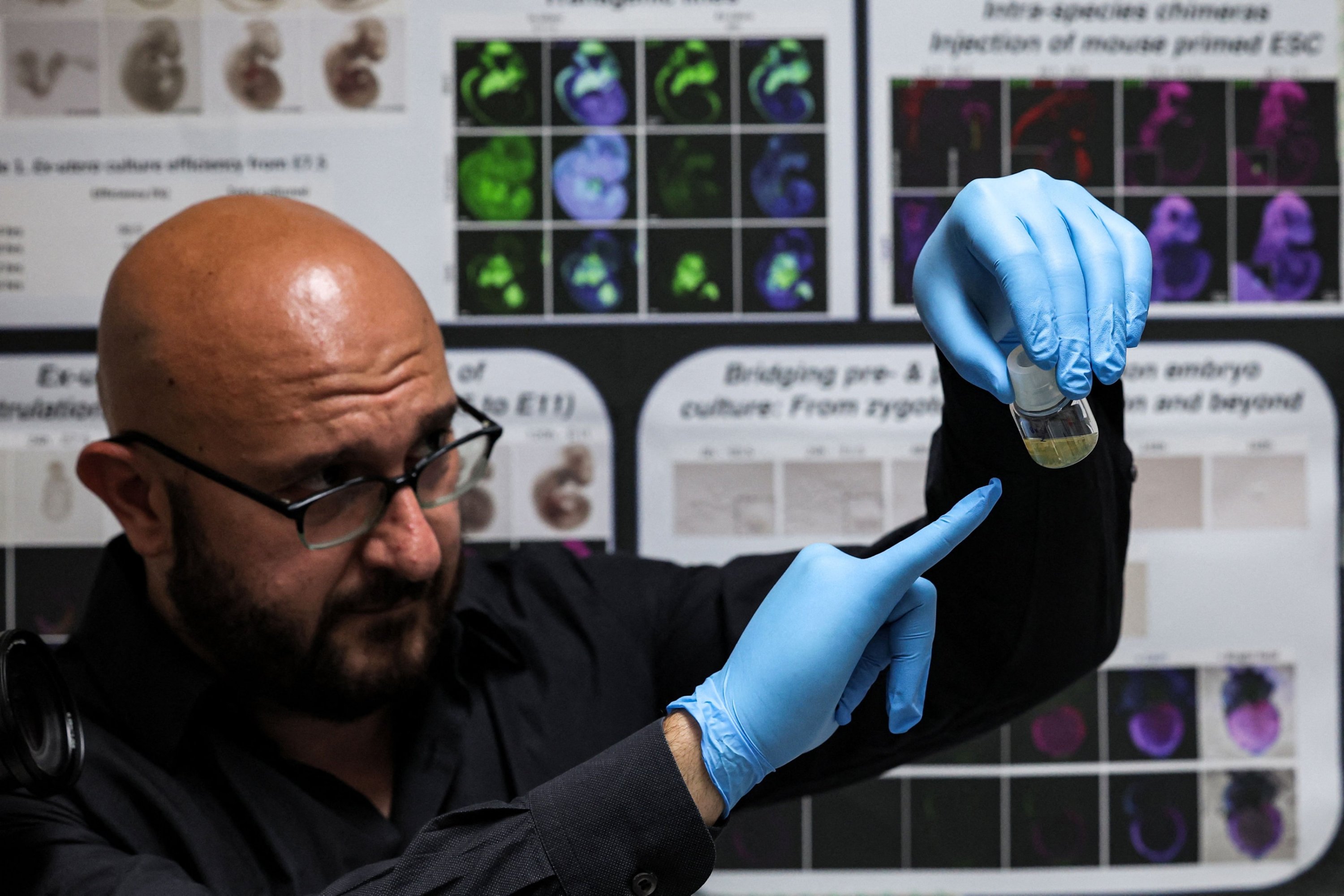
Dr. Jacob Hanna, a specialist in molecular genetics at Israel's Weizmann Institute of Science, holds a vial containing five-day-old synthetic mouse embryos grown in an electronically controlled ex-utero roller culture platform, Rehovot, Israel, Aug. 04, 2022. (AFP Photo)
by Agence France-Presse - AFP Sep 07, 2023 2:09 pm
Edited By Buse Keskin

Scientists have achieved the creation of structures resembling human embryos without the conventional use of sperm, eggs, or fertilization. This breakthrough holds promise for advancing research on miscarriage and birth defects, but it also raises new ethical questions.

Earlier this year, several laboratories around the world released pre-print studies that had not been peer-reviewed, describing their development of early human embryo-like structures.

But now one group's research has been published in the peer-reviewed journal Nature, describing how they coaxed human embryonic stem cells to self-organize into a model resembling an early embryo.

The research was welcomed by some scientists as an "impressive" advance that could help unlock secrets about the precarious early stages of pregnancies when failure is most common.

The work will, however, renew debate on the need for clearer ethical rules on the development of laboratory-grown human embryo models.

The researchers, led by Palestinian scientist Jacob Hanna at the Weizmann Institute in Israel, harnessed the power of embryonic stem cells, which can become any cell.

They produced embryo models up to 14 days old, which is the legal limit for human embryo laboratory research in many countries and the point at which organs like the brain begin to develop.

The researchers say their work differs from those of other teams because it uses chemically rather than genetically modified embryonic stem cells and produces models more like real human embryos, complete with yolk sac and amniotic cavity.

These similarities could make the models more useful for research into conditions like miscarriage, birth defects, and infertility, said James Briscoe of Britain's Francis Crick Institute.

The model "seems to produce all of the different types of cells that form tissues at this early stage of development," said Briscoe, principal group leader and associate research director at the biomedical research charity.

The research "is a step towards opening a window on the period of human development where many pregnancies fail and which has been really difficult to study up until now."

Both the researchers and scientists not involved in the work emphasized that the models should not be considered human embryos.

The structure "highly resembles, but (is) not identical, to the in utero situation," the research notes.

The success rate in generating the models was also low, with the stem cells organizing correctly just a small percentage of the time.

Still, "in contrast to similar studies published earlier this year, these embryo-like structures contained most of the cell types found in developing embryos," said Darius Widera, an expert in stem cell biology at the UK's University of Reading.

The research and other recent work show "that models of human embryos are getting more sophisticated and closer to events that occur during normal development."

That highlights "that a robust regulatory framework is more needed than ever before," he added.

In Britain, Cambridge University has begun developing the country's first governance framework for stem cell-based human embryo models.

British law prohibits the culturing of human embryos in laboratories beyond the 14-day mark, but because the structures derived from stem cells are formed artificially, they are not explicitly covered by existing regulations.

Still, most researchers have adopted voluntary limits on their work at this stage.

The Weizmann Institute research did not develop its models beyond 14 days and does not involve transferring the models into a human or animal womb.


  • shortlink copied
  • KEYWORDS
    embryo pregnancy
    The Daily Sabah Newsletter
    Keep up to date with what’s happening in Turkey, it’s region and the world.
    You can unsubscribe at any time. By signing up you are agreeing to our Terms of Use and Privacy Policy. This site is protected by reCAPTCHA and the Google Privacy Policy and Terms of Service apply.
    No Image
    Tesla opens 'Gigafactory' near Berlin, its 1st in Europe
    PHOTOGALLERY
    • POLITICS
    • Diplomacy
    • Legislation
    • War On Terror
    • EU Affairs
    • News Analysis
    • TÜRKİYE
    • Istanbul
    • Education
    • Investigations
    • Minorities
    • Diaspora
    • World
    • Mid-East
    • Europe
    • Americas
    • Asia Pacific
    • Africa
    • Syrian Crisis
    • İslamophobia
    • Business
    • Automotive
    • Economy
    • Energy
    • Finance
    • Tourism
    • Tech
    • Defense
    • Transportation
    • News Analysis
    • Lifestyle
    • Health
    • Environment
    • Travel
    • Food
    • Fashion
    • Science
    • Religion
    • History
    • Feature
    • Expat Corner
    • Arts
    • Cinema
    • Music
    • Events
    • Portrait
    • Performing Arts
    • Reviews
    • Sports
    • Football
    • Basketball
    • Motorsports
    • Tennis
    • Opinion
    • Columns
    • Op-Ed
    • Reader's Corner
    • Editorial
    • Photo gallery
    • DS TV
    • Jobs
    • privacy
    • about us
    • contact us
    • RSS
    © Turkuvaz Haberleşme ve Yayıncılık 2021