From Khiva in the Khorezm region, a journey across the Amu Darya (known in antiquity as the Oxus River) leads to Transoxiana. Islamic historians described this land north and east of the river as “beyond the Oxus.” It is here that Uzbekistan’s two great cities, Bukhara and Samarkand, rose to prominence. At the heart of this region lies Bukhara, long celebrated as the “Dome of Islam,” a city revered for centuries as a center of faith, scholarship and Sufi tradition.
Bukhara is a city that embodies the spirit of Central Asia. For more than a millennium, it has been a cradle of scholars, mystics, poets and scientists, spreading its intellectual and spiritual legacy across the Islamic world. Its madrassas and mosques stand as living testaments to a cultural continuity that bridges centuries, while its bazaars and caravanserais evoke the vibrant days when Bukhara was a bustling crossroad on the Silk Road.
Bukhara is inseparable from the Naqshbandi tradition. Beyond the resting place of the order’s founder, Bahauddin Naqshband, the city also holds the tombs of Abdulkhalik Gujduvani, Arif Rivgeri, Mahmud Incirfaghni, Ali Ramiteni, Muhammed Baba Samasi and Seyyid Emir Kilal. Together, these revered masters, the “Seven Pirs,” have turned Bukhara into a spiritual landmark of the Islamic world. Visiting their shrines is more than a historical encounter; it is a journey into the soul, where every street of the city offers both echoes of the past and moments of inner reflection.
The spiritual climate of Bukhara is evident in its architectural splendor as well as in the natural pace of daily life. At dawn, the bazaars awaken with the voices of vendors setting up stalls of fresh fruits, fragrant spices and embroidered textiles glistening in the early light. The air is rich with the scent of cumin and coriander, mingling with the aroma of bread pulled fresh from clay ovens.
No visit to the city is complete without tasting its cuisine, a reflection of Bukhara’s layered history. The rich and hearty pilaf, cooked with lamb, carrots and aromatic spices, remains the pride of local kitchens. Samsa, baked in tandir ovens, emerges golden and steaming, filled with pumpkin or minced meat. Guests are welcomed with green tea (often accompanied by sweet black grapes), a gesture of hospitality as symbolic as it is refreshing.
The city’s craft traditions are just as enduring. In narrow streets and caravanserais, Damascus knives and elegant stork-shaped scissors still showcase the artistry of generations, standing as emblems of Bukhara’s commercial vitality. Hospitality, too, carries customs as old as the city itself. Guests bring their own spoons to the table, and the first cup of tea is always served to the host. What once began as precautions against poisoning has, over centuries, become part of Bukhara’s unique culture of warmth and welcome.
Even today, life here is rooted in community. Families gather in courtyards shaded by mulberry trees, neighbors exchange dishes over low garden walls, and the tea houses remain the city’s beating heart – places where stories, wisdom and laughter are shared as generously as the tea itself.
Bukhara is a city where history speaks through stone and brick. The city's skyline is shaped by soaring minarets, domed madrassas, elegant mosques and caravanserais that have welcomed traders for centuries. Each structure bears witness to a different era of the city. One of Bukhara's oldest structures is the Ark Fortress. Built in the sixth century, this fortress is said to have been founded by the legendary hero Siyavush. Used for centuries as a palace for emirs, a place of worship, and a treasury, the structure was severely damaged during the Mongol invasion and restored in the 16th century, surviving to this day. Today, it continues to welcome visitors as one of Bukhara's iconic landmarks.
One of the city's most striking structures is the Bolo Hauz Mosque. Used as the city's Friday Mosque during the Bukhara Khanate, this structure stands out with its exquisite woodwork. Twenty wooden columns added in the 1900s give the mosque a unique grandeur. When the water rises in the pool in front, the columns' reflections are visible, earning the mosque its name, "The Mosque of Forty Columns."
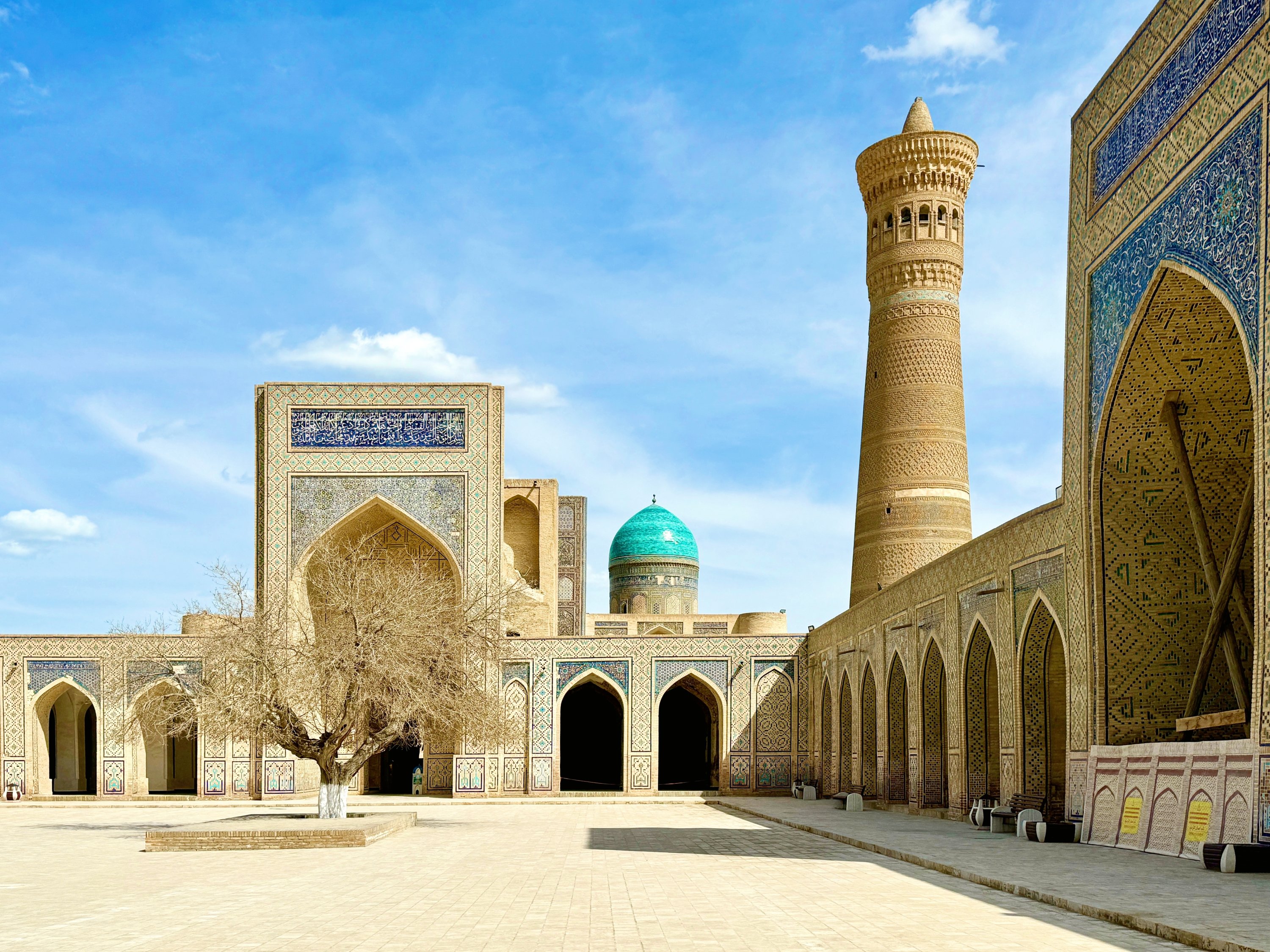
The Po-i-Kalyan Minaret, considered the symbol of Bukhara, is one of the city's most magnificent structures. Built in 1127 by the Karakhanid ruler Arslan Khan, the minaret, with its height exceeding 46.5 meters (153 feet), is one of the most remarkable works not only in Central Asia but also in the Islamic world. Its bricks, adorned with geometric patterns and Kufic inscriptions, transform the structure into an architectural masterpiece. Throughout history, it has served as a beacon to guide caravans, a pulpit from which the call to prayer echoes, and, at times, a lookout point. The fact that it is popularly known as the "death tower" stems from the rumors that criminals were punished by being thrown from here in the past.
The other structures in the complex are just as important as the minaret. The Kalyan Mosque, with its 288 domes, rising next to it, is one of the largest places of worship in Central Asia. Capable of hosting thousands of people at once, it is a powerful symbol of Bukhara's religious identity.
The Mir Arab Madrassa, which completes the complex, is one of the few structures that still maintains the city's scholarly tradition through its educational activities. Built in the 16th century by Ubaydullah Khan in the name of Abdullah Yemeni, who came to Bukhara from Yemen, the Mir Arab Madrassa is one of the few madrassas still active today. This structure, consisting of 114 cells and referring to 114 Surahs of the Quran, has educated thousands of students over the centuries. Inside, the tombs of Ubaydullah Khan and Abdullah Yemeni are located side by side. Ubaydullah Khan's value for knowledge and scholars, combined with his efforts to preserve Bukhara's Hanafi identity, has preserved the city's religious heritage to this day.
The heart of the city's social life is Lyabi-Hauz Square. Built in the 17th century, this square, with its surrounding madrassas and plane trees, is at the heart of Bukhara's daily life. A resting point for caravans, merchants and travelers, today it is one of the city's most vibrant venues, with its teahouses and small restaurants. The sun and peacock motifs of the Nadir Divan Bey Madrassa are especially worth seeing.
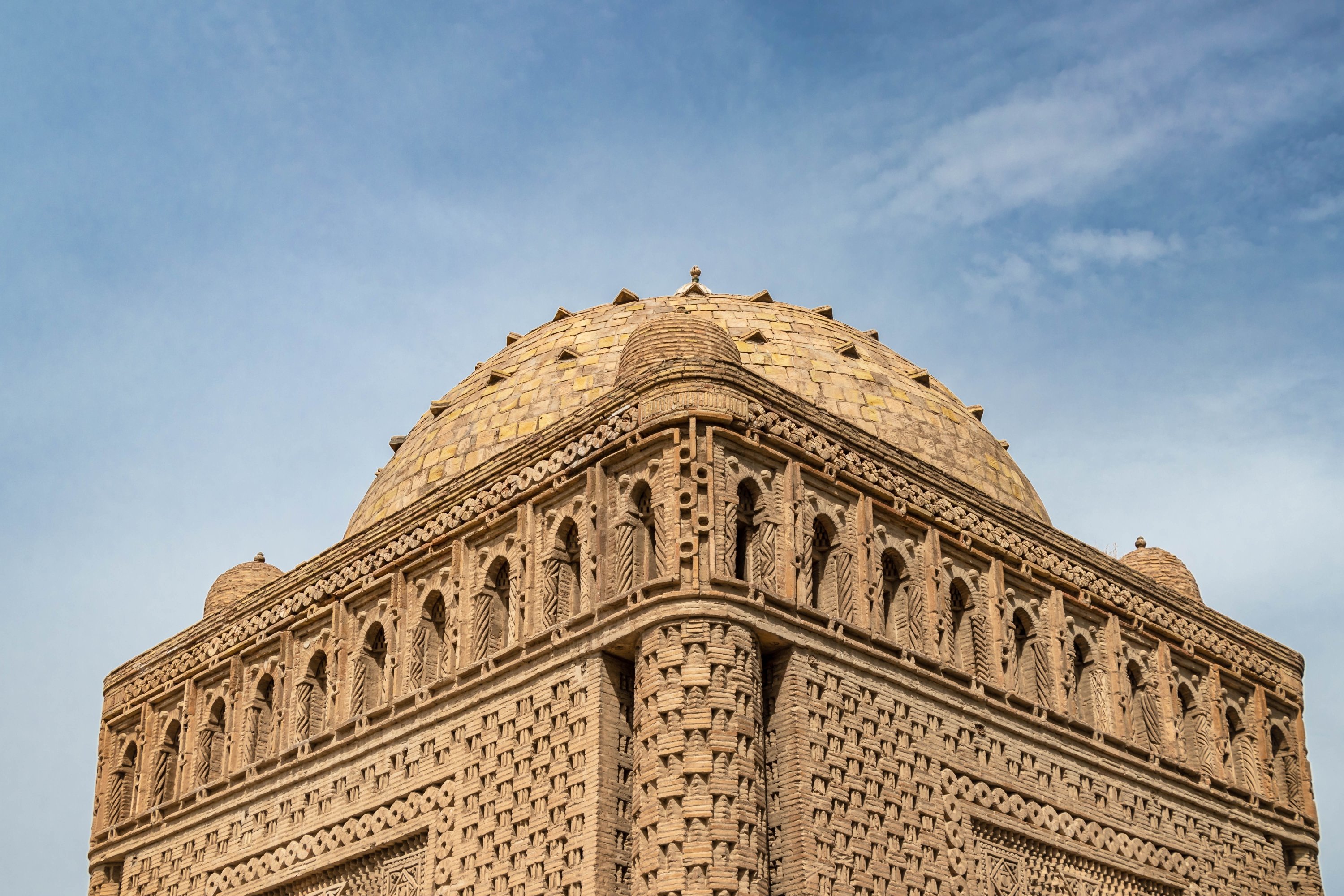
One of the most striking structures in Bukhara is the Tomb of Ismail Samani. Dating back to the ninth century, this tomb, with its geometric arrangement of cut bricks, is considered one of the most elegant examples of Islamic architecture. The site’s significance extends beyond its structure, reflecting the legacy of the historical figure it represents. Praised for his virtues in Nizam al-Mulk's Siyasetname, Ismail Samani is remembered for his efforts to unite Muslims and his service to his people. His tomb is a tangible symbol of this legacy.
Bukhara is thus remembered for both its splendor and its tragedies. Legend has it that after Timur burned the city's great library, the sky was illuminated for days by the flames of books. This library, which housed the most valuable works of the Islamic world, was destroyed, and a significant portion of knowledge was lost to the darkness of history. The lament still echoed by locals today epitomizes this loss: "If those works had survived to this day, Muslims would be a space-faring civilization today."
For centuries, Bukhara has been a crossroads of diverse cultures and beliefs. From Turks and Persians to Jews and Arabs and Russians, many communities have left their mark on this ancient city. This diversity has made Bukhara a center of culture and education. Inscribed on the UNESCO World Cultural Heritage List, the city, thanks to its location on the historic Silk Road and the valuable commercial goods it produced, has been a frequent destination for traders for centuries. This has enabled Bukhara to flourish both materially and spiritually, giving it its present-day identity.
Today, Bukhara remains a symbol of tolerance and cultural continuity, a meeting place where people from diverse religious traditions have lived together for centuries.