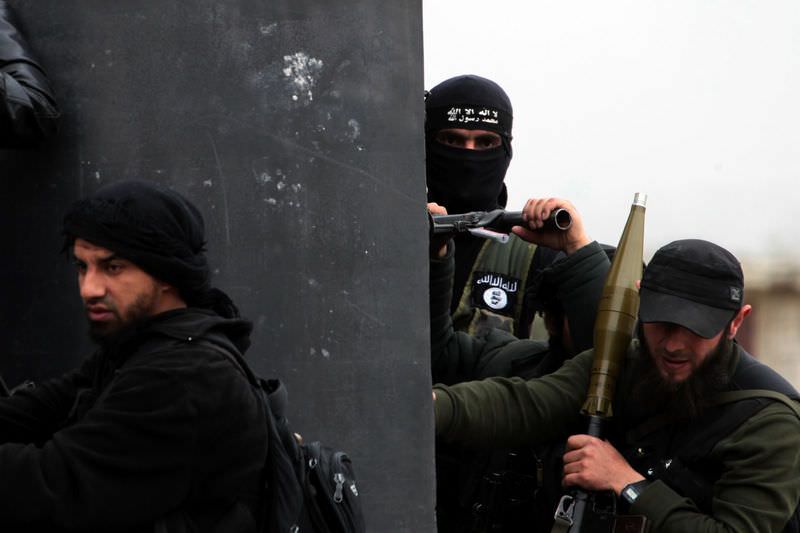
After the U.S. invasion of Iraq in 2003, Abu Musab al-Zarqawi established Jamaat al-Tawhid wal-Jihad one year later to confront U.S. troops.
After many transformations, that extremist group eventually became what is now known as Daesh.
With the escalated situation in Iraq and Syria, the group has since managed to establish a strategic terrorist base in the Middle East by seizing large swathes of territory in both countries.
Daesh's ideology and terrorist methods, meanwhile, have made the group a primary factor in the burgeoning Islamophobia now seen in the West.
In 2006, al-Zarqawi announced the establishment of the "Mujahideen Shura Council", which aimed to unify all of Iraq's armed Sunni factions under a single umbrella.
However, U.S. forces killed al-Zarqawi in the same year, and he was succeeded by Abu Omar al-Baghdadi.
The new leader changed the Council's name to "the Islamic State of Iraq", but the group was subsequently worn down in fighting U.S. and Iraqi military forces.
Abu Bakr al-Baghdadi replaced Abu Omar al-Baghdadi after the U.S. managed to kill the latter in 2010.
After a popular uprising in Syria turned into civil war in 2011, Abu Mohamed al-Julani, a Syrian national who had been one of Abu Bakr al-Baghdadi's top commanders, split with a number of other Syrians from the Islamic State of Iraq to form the "Nusra Front" in Syria.
The Nusra Front eventually joined other Syrian opposition groups in the ongoing conflict against the regime of Bashar al-Assad.
In 2013, al-Baghdadi announced the formation of "the Islamic State in Iraq and al-Sham", later known as "Daesh".
Al-Baghdadi called on al-Julani to swear allegiance to Daesh, but the latter refused to do so, even though some of al-Julani's men later joined al-Baghdadi, allowing Daesh to make inroads into Syria.
Daesh engaged in armed conflict in Syria, but instead of fighting the Syrian regime, it preferred to seize opposition-held areas in the northern parts of the country, thereby weakening Syria's moderate opposition and strengthening Assad.
Daesh has also engaged in fierce clashes with the Nusra Front, especially after the assassination of Abu Khaled al-Suri in February 2014. Al-Suri had been tasked by al-Zawahiri, leader of Al-Qaeda in Iraq, to settle the ongoing dispute between the two groups.
Al-Julani at one point broadcast a voice recording in which he vowed to fight Daesh. Later, the Nusra Front began attacking Daesh positions -- and those of other pro-regime armed groups -- in eastern Syria's Deir Ez-zor province.
Daesh also assassinated high-ranking commanders in moderate Syrian opposition groups, such as the Free Syrian Army and the Ahrar al-Sham movement.
Moreover, Daesh executed a number of Christian clerics, creating a negative impression about the Syrian opposition in western countries, since Daesh used to define itself as an anti-Assad opposition group.
One of Daesh's turning points was the Abu Gharib prison break in July 2013, when around 1,000 prisoners escaped. The prisoners included a number of extremists who later became senior Daesh commanders.
Meanwhile, Iraq's then prime minister, Nouri al-Maliki, took advantage of the regional competition between the U.S. and Iran to carry out numerous violations against Sunni Arabs in Iraq. This led to what was later called "the Sunni Arab revolution" against al-Maliki in 2014.
Daesh also took advantage of a Sunni tribal uprising against the al-Maliki government -- and the Iranian-U.S. rivalry -- to recruit former officers loyal to ousted former President Saddam Hussein.
In June 2014, Daesh overran the city of Mosul, the regional capital of Iraq's Nineveh province, without encountering significant resistance from the Iraqi army.
Afterwards, the group advanced on Baghdad, taking the cities of Fallujah, Diyala and Tikrit.
On June 29, 2014, Daesh's self-proclaimed ''Caliphate'' was declared in Iraq, headed up by its so-called ''Caliph'', Abu Bakr al-Baghdadi.
Daesh, which contains both pro-Saddam elements and foreign fighters, lists its enemies as non-Muslims and Muslims who don't share its worldview, describing the latter as "apostates".
The group deals brutally with its enemies, while destroying the region's pre-Islamic historical heritage.
Daesh later captured Raqqa city, which became its headquarters in Syria, while targeting elements of the Syrian opposition, especially near the Turkish border.
Meanwhile, the group secretly dealt with the Syrian regime and seized a number of the country's oil wells.
Daesh has indiscriminately killed children, women and journalists, destroyed artifacts and historical sites, and has caused Syrian Turkmen, Kurds and Yazidis to flee the country to next-door Turkey.
Notably, the rise of Daesh dovetails with the desire of certain world powers to divide the region, leading some observers to believe that the group is working in conjunction with foreign intelligence agencies.
These suspicions were heightened when Daesh targeted Iraq's Yazidi-majority Sinjar district and the predominantly-Kurdish city Kobani while avoiding any conflict with the Syrian regime in Syria's Deir ez-Zor province.
Within the same context, since late September, Russian warplanes have mainly targeted moderate Syrian opposition groups that are opposed to Daesh.
The ascendancy of Daesh, meanwhile, has contributed to rising Islamphobia in the West by giving foreign observers the impression that its violent methods are being done in the name of Islam.