
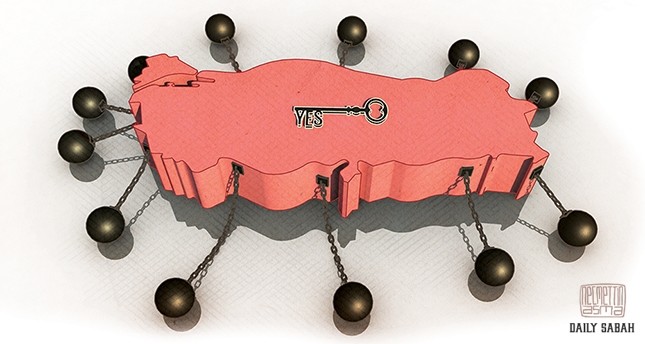
Turkey's recent referendum vote marked one of the most critical junctures in the history of Turkey. The proposed administrative reform might contain 18 articles but it is a deep-rooted one. With around a 51.5 percent "yes" vote, the people of Turkey paved the way for a chance to replace the current parliamentary system with a presidency. The debate revolving around changing the system of government is not new. Although perceived to be raised only by President Recep Tayyip Erdoğan, thanks to a far-fetched global campaign of anti-Erdoğanism, it actually goes back to the 1960s. First raised in 1969 by former Prime Minister Necmettin Erbakan, as well as by Alparslan Türkeş in his famous book "Nine Light," and former Prime Minister Süleyman Demirel and former President Turgut Özal, respectively, a presidential system of government has been put forward to mitigate systemic challenges and smooth governance.
Due to the constitutional change put in place in 1982 by the military after the coup two years earlier, the political system granted executive power both to the president and prime minister. Since then, both political bodies enjoyed a sort of power in the political system, but with severe repercussions. Most of the political crises throughout modern Turkey's brief history have been a product of a two-headed political system. Given the inherent systemic inconsistencies and power conflicts, not even people from the same ideological basis holding the post of these two executive branches were able to reconcile their differences. In 1991, during the Gulf war, the conflict between then president Özal and Prime Minister Akbulut over Mosul and Kirkuk, even though appointed by Özal himself from the same party he once led, is just one of the many examples in Turkey's political history.
Not long ago in 2001, the disagreement between then the Prime Minister Bülent Ecevit and President Ahmet Sezer in the National Security Council (MGK) triggered a deep financial crisis, also known as "Black Wednesday" (Kara Çarşamba), with severe repercussions for the economy, costing around $50 billion. Also, the crisis between former President Demirel and Prime Minister Tansu Çiller in 1994, despite both having the same party line, is well known. It led Demirel to openly criticize Çiller, saying he would "throw her out of a window if she were not a women." Of course, such a statement came at a price. The Turkish lira lost 100 percent of its value against the dollar. What is critical to bear in mind is that the deadlocks were not mainly due to the nature of the personalities but because of the deficient and fragile structure of the system itself.
Although Turkey has enjoyed political stability over the last 14 years thanks to the Justice and Development Party's (AK Party) consolidation over the country's constituency, the previous system has been the core component of unstable and uncertain political times. Since the establishment of the Republic, Turkey has witnessed more than 65 governments, mostly coalition governments, in 95 years. This amounts to one and half years of governance on average. In such a short term of governance, it is undeniably difficult to preserve stability and deliver political, economic and social services to people. There might be some objections pointing to successful examples of coalition governments around the world, such as Germany. Unfortunately, we have to admit that not a single coalition has worked and lasted in Turkey. The first coalition government, for example, formed in 1961, only lasted seven months, while the latest one formed in 1999 only survived for around two years. A Turkish experience, in this sense, does not shine as a good example. It is also worth noting that most of the coups happened due to the political crises created by coalition governments.
People mostly point out that the AK Party only achieved given its dominance over the last decade. However, this argument, mostly articulated by the main opposition party and some pundits in the West, fails to capture the very fact that it is the AK Party's political success that has prevented crisis and instability. One has to admit that, and think about how Turkey would have looked without it, given the history of political crisis. Turkey's inherent systemic shortcomings and political risks over the last few years have been mitigated so far as a result of the AK Party's electoral success.
Looking from this angle, the referendum, for the first time, was able to deliver much-sought and needed political stability for Turkey, not through the consolidation of a political party but instead through the system itself. As far as constitutions are concerned, it should create a political system with the aim of providing harmony and a foreseeable future, not the opposite. It is what Turkey has desperately lacked. Every election was a source of uncertainty not only for politicians but businessmen and ordinary people alike. President Erdoğan clearly reiterated why constitutional change was of the utmost importance for the future. "This constitutional change is no ordinary change. It is different and very meaningful. A historic decision where people voted for their future," he said in a press conference at Huber Villa in Istanbul.


